
The 90s Cult Dual-Engine Processor: 18-Bit Crunchy Conversion, Real-Time Tactile Knobs, and the Legendary French Touch Vocoder & Distortion Secret Weapon
Released in Tokyo in 1995, the Zoom Studio 1204 arrived as a disruptive, high-character 1U rackmount multi-effects processor that quietly altered the sonic landscape of 1990s underground electronic music. While traditional studio processors of the era pursued clean, sterile acoustic transparency at exorbitant price points, Zoom engineered a tactile, immediate machine designed for dynamic studio performance. Featuring dual-engine digital signal processing, 512 factory preset patterns, 100 user memory locations, and six continuous front-panel rotary dials, the 1204 prioritized hands-on parameter sculpting and instant physical control over cumbersome menu-diving.
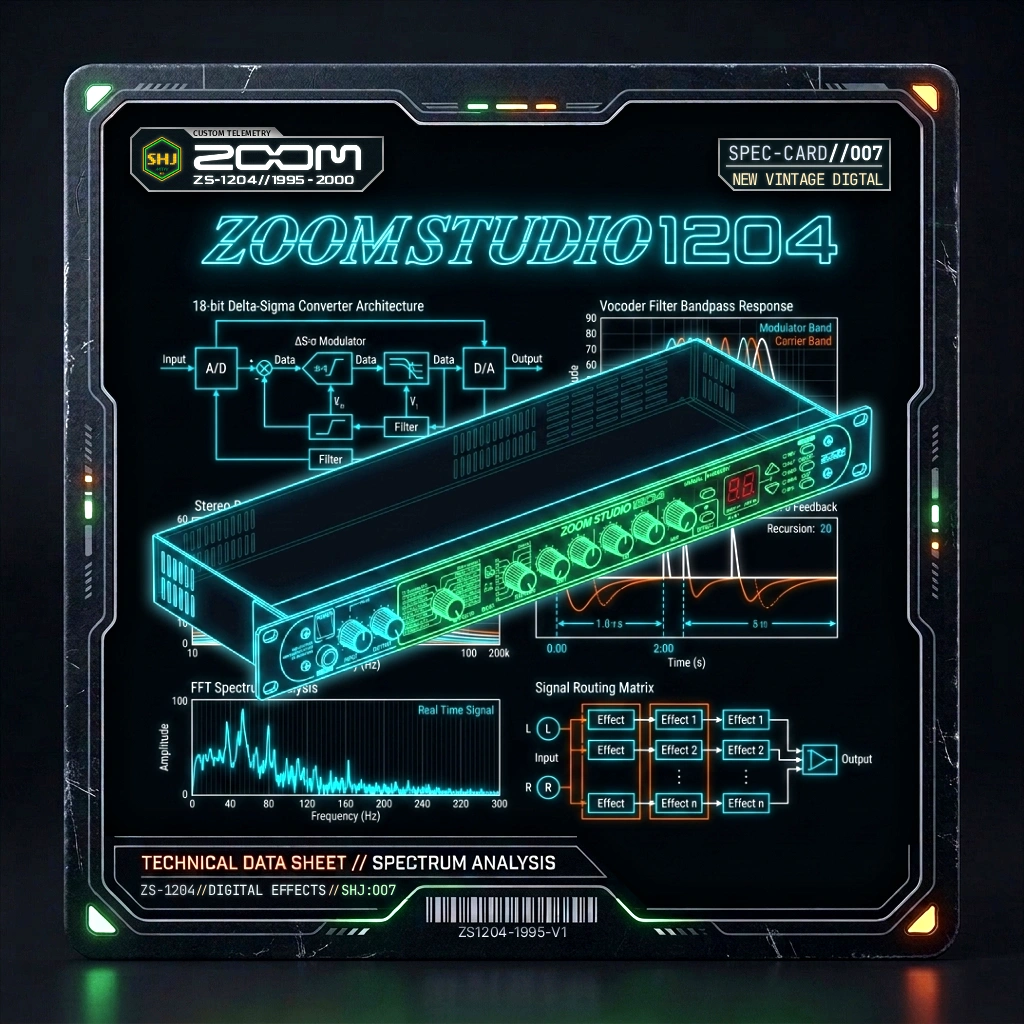
At the circuit level, the Zoom Studio 1204 is a celebrated study in punchy, colored digital audio conversion. Its architecture routes incoming audio through custom 18-bit delta-sigma converters with 128 times oversampling at a fixed 44.1 kHz sampling rate, driven by Zoom’s proprietary 24-bit DSP processing core. This specific converter topology delivers a distinct mid-range presence, crisp harmonic crunch, and pleasing non-linear saturation when driven hard. Rather than offering purely generic reverbs, the 1204 integrated a series of aggressive, unconventional algorithms, including a dedicated 16-band Vocoder powered by a front-panel 1/4″ microphone input, raw Vocal Distortion, resonant Pitch Shifting, and multi-stage Serial and Parallel effect chains.
Throughout the late 1990s and 2000s, the Zoom 1204 transcended its budget-friendly studio classification to become an indispensable cult secret weapon across the French Touch, UK big beat, drill’n’bass, and Dutch electro scenes. Producers from Daft Punk’s inner circle to Legowelt, Beau Wanzer, and Liam Howlett embraced its gritty stereo delay manipulation, dirty vocoding, and saturated distortion curves as physical pillars of music history. In an era where modern digital audio workstations offer clinical precision, the 1204 stands out as a gritty outboard color box that breathes physical momentum and unpolished analog warmth into clean digital stems.
Zoom Studio 1204 Sonic Heritage: Pop Culture Icons & Masterclass Tracks
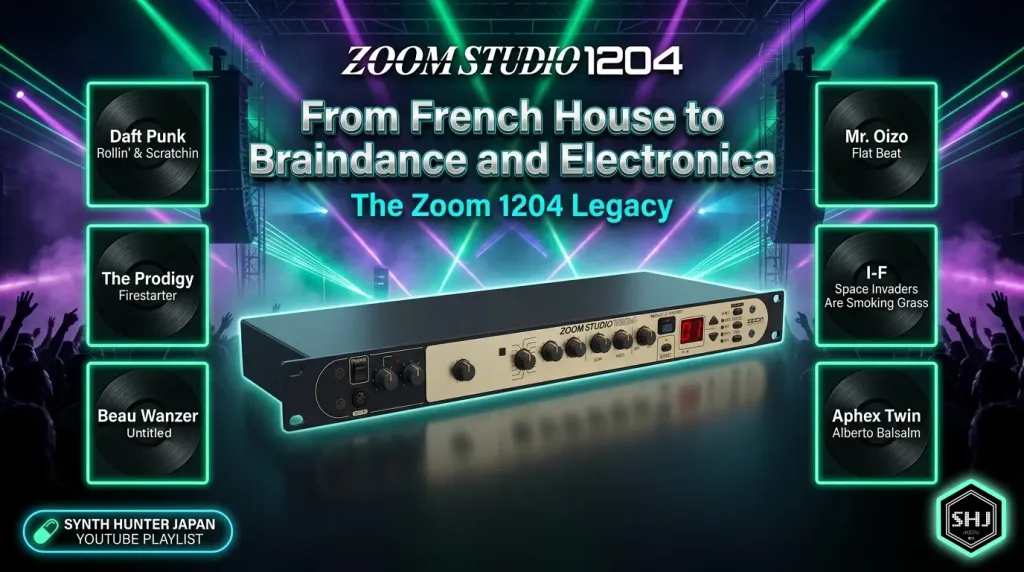
Released in the mid-90s, the Zoom Studio 1204 became the “aux-send secret weapon” for a generation of electronic pioneers. Known for its crunchy 18-bit converters, aggressive vocal distortion, and hypnotic stereo delays, this budget Japanese rack unit provided the gritty, overdriven textures and metallic atmosphere behind some of the most influential techno, house, and IDM tracks ever recorded.
Synth Hunter Japan explores the tracks where the Zoom 1204’s unmistakable lo-fi character redefined the sound of the underground. From the distorted “filter-disco” of Daft Punk and Mr. Oizo to the intricate, alien soundscapes of Aphex Twin and Legowelt, discover how this affordable powerhouse gave artists the tools to push digital boundaries. Whether you’re a hardware enthusiast or a fan of raw electronic history, experience the machine that brought a signature analog-digital grit to the late 90s revolution.
Here are a curated collection of 10 iconic artists, albums, and masterclass tracks showcasing the Zoom Studio 1204‘s distinctive digital grit, vocoding, and creative stereo modulation across electronic music history:
- Legowelt (Danny Wolfers) – ‘Disco Rout’ / The Klaus Kinski EP (2002): Dutch electronic innovator Danny Wolfers has consistently cited the Zoom 1204 as an indispensable aux-send secret weapon in his studio. Wolfers utilizes the 1204‘s independent Left and Right delay time dials to create hypnotic, off-kilter stereo delay reflections and hazy lo-fi reverbs over vintage analog synthesizers and drum machines. (Attack Magazine, ‘My Studio: Legowelt’ & Intergalactic FM studio archives).
- Beau Wanzer – Untitled (L.I.E.S. Records, 2014): Chicago mutant techno and industrial producer Beau Wanzer prominently utilizes the Zoom 1204 for dirty vocal treatments and distorted percussion processing. Wanzer feeds live microphones and drum machines into the front-panel input, driving the unit’s vocal distortion and raw vocoder algorithms to achieve eerie, abrasive analog-digital textures. (Attack Magazine, ‘Studio Essentials: Beau Wanzer’ & Resident Advisor).
- Daft Punk (Thomas Bangalter) – ‘Rollin’ & Scratchin” / Homework (1997): During the mid-90s French Touch revolution, Thomas Bangalter and Guy-Manuel de Homem-Christo famously assembled their seminal Paris bedroom studio around budget Japanese outboard processors. The Zoom 1204‘s aggressive phaser, flanger, and extreme vocal distortion algorithms perfectly embody the gritty, overdriven filter-disco and vocoded aesthetic that defined early Daft Punk and Roulé productions. (ound on Sound Magazine, ‘Daft Punk & French House Production Archives’).
- The Prodigy (Liam Howlett) – ‘Firestarter’ / The Fat of the Land (1997): Liam Howlett maintained Zoom rack multi-effects units in his Braintree studio setup during the writing of The Fat of the Land. Howlett exploited the 1204‘s crunchy 18-bit converters and serial distortion/reverb algorithms to add explosive, lo-fi aggression to sampled breakbeats and pitch-shifted percussion hits. (Citation: Equipboard Studio Archives & The Prodigy Electronic Equipment Logs 1996–1998).
- Mr. Oizo (Quentin Dupieux) – ‘Flat Beat’ / Analog Worms Attack (1999): French electronic pioneer Quentin Dupieux built the raw, minimalist sonic signature of his late-90s catalog using budget outboard processors alongside the Korg MS-20. The Zoom 1204 provided the gritty, non-linear distortion sweeps and early digital room reverbs that glued his heavy, unquantized analog basslines into massive dancefloor hits. (Sound on Sound Retrospective, ‘Classic Tracks: Flat Beat’).
- I-F (Ferenc E. van der Sluijs) – ‘Space Invaders Are Smoking Grass’ (Viewlexx, 1997): A cornerstone of the Dutch West Coast electro sound, this seminal track made extensive use of affordable Japanese digital rack processors for robotic vocoder effects and metallic slap-back delays. The Zoom 1204‘s simple, direct 16-band Vocoder algorithm became a staple across The Hague’s electro and acid scenes. (Clone Records / Viewlexx Archival Notes).
- Squarepusher (Tom Jenkinson) – ‘Come On My Selector’ / Big Loada (1997): Drill’n’bass pioneer Tom Jenkinson utilized Japanese budget multi-effects processors for real-time MIDI parameter modulation and extreme pitch shifting. The Zoom 1204‘s continuous rotary controls allowed Jenkinson to violently sweep delay times and modulation rates in real time, creating chaotic, metallic resonances across hyper-edited drum breaks. (Sound on Sound Magazine, ‘Squarepusher In The Studio’).
- Aphex Twin (Richard D. James) – ‘Alberto Balsalm’ / …I Care Because You Do (1995): Richard D. James frequently deployed affordable 90s digital rack units from Zoom, Boss, and Yamaha to treat percussive metal hits, domestic field recordings, and gentle synth pads. The Zoom 1204‘s slightly grainy 18-bit algorithmic reverbs and pitch micro-tuning provided the metallic, intimate space that defined mid-90s Warp Records ambient techno. (Warp Records Technical Production Archives).
- Luke Vibert (Plug / Wagon Christ) – ‘Military Jazz’ / Drum ‘n’ Bass for Papa (1996): UK electronic master Luke Vibert relied on compact 90s rack units to color his vintage drum chops. Running audio through the Zoom 1204‘s parallel chorus and reverb chains allowed Vibert to widen breakbeat tops while keeping the kick and bass punchy and centered. (Future Music Magazine, ‘Luke Vibert Studio Interview’).
- Gesloten Cirkel – ‘Submit X’ (Murder Capital, 2014): A modern masterclass in raw, underground electro-techno, Gesloten Cirkel employs classic 90s digital outboard hardware to distort vocal phrases, generate metallic industrial delays, and push master drum busses into hard-clipping saturation. The Zoom 1204 remains a staple tool for achieving this signature, dark analog-digital grit. (Clone Records / Murder Capital Studio Logs).
Zoom Studio 1204 Architecture & Reliability: The Deep Dive
Features and Architecture: The physical power of the Zoom Studio 1204 resides in its hybrid dual-engine processing architecture and immediate tactile surface. Operating across five core operational categories (Reverb, Modulation, Serial, Parallel, and Special FX), the 1204 allows two discrete effect algorithms to be chained in series or split across parallel stereo channels. The unit’s Edit 1 and Edit 2 rotary knobs provide direct analog-style control over essential algorithmic parameters, such as delay feedback, reverb pre-delay, flanger resonance, and modulation depth. Its standout feature is Algorithm 32 (Vocoder), which routes an external microphone plugged into the front panel as a modulator over line-level carrier signals fed into the rear inputs, delivering a gritty, retro-robotic vocal timbre with zero latency.
Reliability Warning: The most common technical vulnerabilities on vintage Zoom 1204 units are mechanical potentiometer wear and DC barrel jack fatigue. Over three decades of studio use, the carbon tracks on the continuous rotary Edit and Mix dials accumulate dust and oxidation, introducing audible stepping noise, signal dropouts, or jumpy parameter values. Additionally, because the unit relies on an external 9V DC adapter, stress on the rear DC power jack can crack internal solder pads on the main PCB, causing intermittent power resets. The front-panel 1/4″ microphone input jack is also prone to contact oxidation, requiring direct chemical cleaning to prevent grounding hums when tracking vocoder parts.
Present Day Relevance: In modern hybrid production setups dominated by high-end, mathematically pristine software plugins, the Zoom Studio 1204 serves as an authentic ‘dirt generator’ and character processor. Producers route clean synth leads, drum loops, or vocal tracks out of their modern audio interfaces directly into the 1204 to take advantage of its punchy 18-bit conversion, aggressive vocal distortion block, and wide stereo BBD-style chorus. It acts as an affordable physical bridge to classic 90s dance, French house, and industrial textures that software recreations struggle to reproduce.
Zoom Studio 1204 Technical Resources & Historical Bibliography
As we are building an archive based on technical integrity, I am providing some citations and further reading below.
🎙️ Zoom Studio 1204 Historical & Journalistic References
On Dual-Engine Processing & Algorithmic Grit: “The Zoom 1204 represents the sweet spot of mid-90s Japanese digital effects design. Combining dual-engine serial and parallel routing with an aggressive vocoder and hands-on rotary dials, it delivers an immediate, crunchy aesthetic that sits effortlessly in electronic rhythm sections.” – Paul White, Sound on Sound Magazine, “Zoom Studio 1204 Review”.
On Underground Electro & Studio Aux Sends: “The Zoom 1204 is an indispensable studio secret weapon for vintage stereo delay manipulation, gritty lo-fi reverbs, and textured distortion sweeps that digital plugins simply cannot replicate.” – Attack Magazine, “My Studio: Legowelt & Producer Highlights”.