
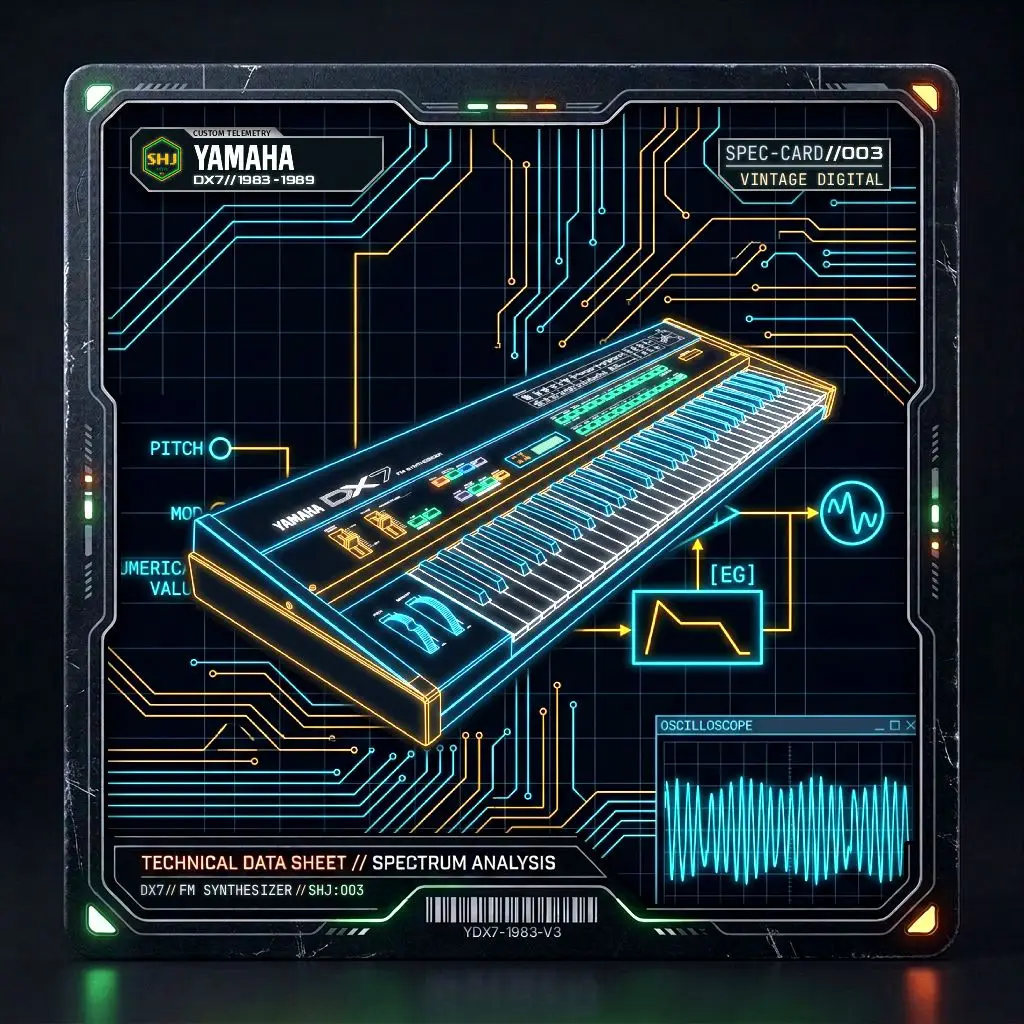
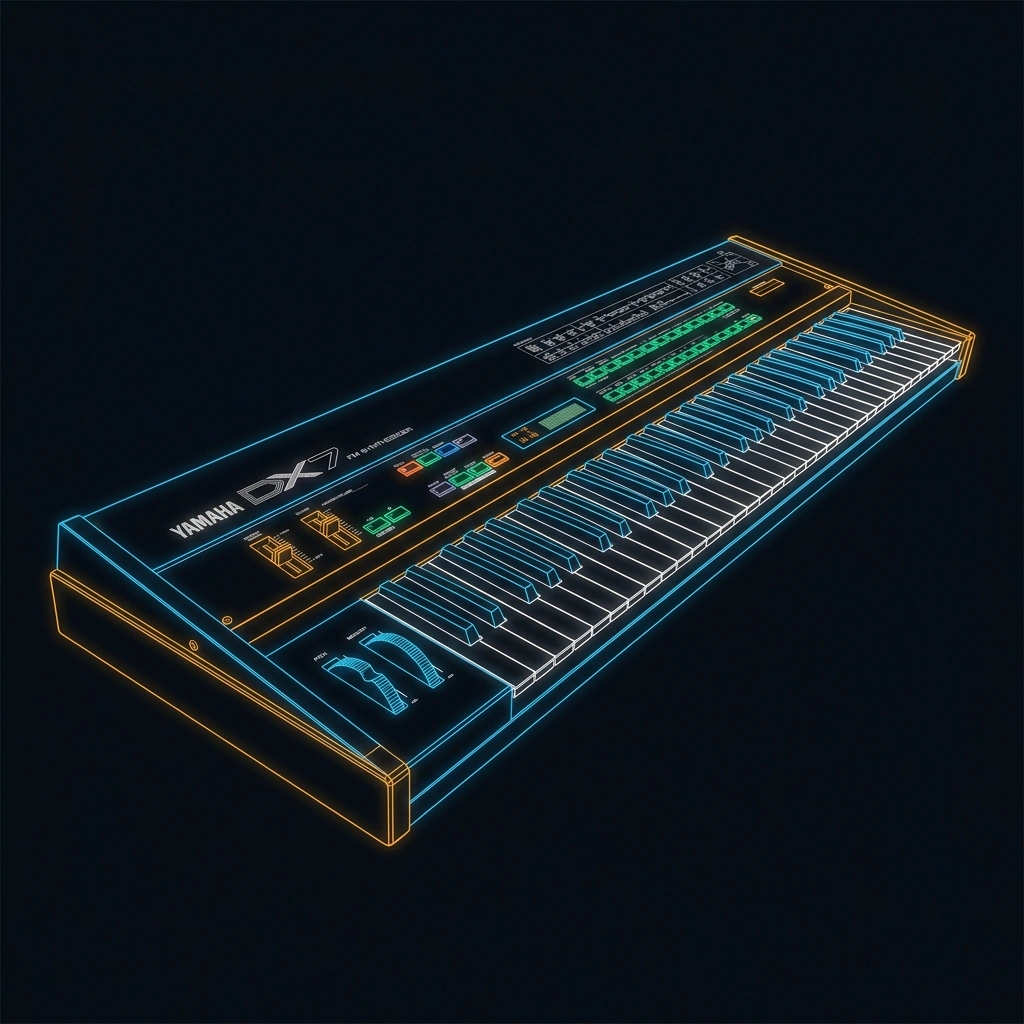
Yamaha DX7 The Glass, the Grit, and the Pure Phase-Modulation Force that Re-Engineered the 1980s Soundscape
Released in 1983, the original Yamaha DX7 (Mark I) did not merely succeed the analog era; it fundamentally disrupted it. While western synthesizers relied on subtractive synthesis utilizing VCOs and low-pass filters to carve away harmonics, Yamaha introduced a highly sophisticated digital architecture based on Phase Modulation (marketed as Frequency Modulation). By utilizing mathematical phase relationships between high-frequency sine-wave oscillators, the DX7 unlocked a whole new landscape of metallic, glassy, percussive, and acoustic-emulative sounds that analog synthesis could never produce, establishing the sonic vocabulary for an entire decade of popular music.
Beneath its brown leatherette-painted steel casing and pristine membrane panel, the DX7‘s digital engine is driven by a custom Hitachi HD63B03XP main processor, running in tandem with two proprietary Yamaha LSI chips: the YM21280 (OPS – Operator Generator) and the YM21290 (EGS – Envelope Generator). The raw digital output of this phase-modulation engine is routed directly into a classic Burr-Brown PCM53JP-V 16-bit digital-to-analog converter (DAC). Because the internal floating-point math of the operators scaling is compressed and truncated before hitting this early DAC, the DX7 exhibits a distinctive, organic digital grit, low-level distortion, and dynamic high-frequency sidebands. This unique combination makes the Mark I sound noticeably wider, dirtier, and more acoustically “alive” than later, more polished 16-bit FM machines.
Yamaha DX7 Sonic Heritage: Pop Culture Icons & Masterclass Tracks

Step back into the golden era of Japanese FM synthesis with this collection of iconic hit songs defined by the legendary Yamaha DX7. From shimmering electric pianos and crystalline bells to the punchy basslines and brass sounds that dominated the 80s charts, the DX7 changed music production forever.
In this playlist, Synth Hunter Japan explores the tracks that made this synthesizer a household name and defined a generation of pop, R&B, and electronic music. Whether you’re a gear enthusiast or a fan of classic hits, discover how one instrument revolutionized the sound of music.
- Brian Eno – Apollo: Atmospheres and Soundtracks (1983): Brian Eno famously bypassed the factory presets, programming custom, organic ambient textures. His track “An Ending (Ascent)” relies heavily on the DX7‘s complex operator envelope curves, generating slow-rising, brassy, flute-like textures that feel profoundly physical and alive.
- Harold Faltermeyer – “Axel F” (Beverly Hills Cop Soundtrack, 1984): The signature metallic bassline and bright chime-percussion leads were crafted using custom FM patches on the DX7. Faltermeyer ran these voices directly into an analog console, utilizing hardware-driven preamp saturation to thicken the digital transients.
- A-ha – “Take On Me” (1985): The iconic digital bassline that propels this synth-pop classic is a combination of a Roland Juno-60 and a Yamaha DX7 (preset “E. BASS 1”). The DX7 provided the surgical, metallic transient attack, while the Juno provided the sub-bass warmth.
- Depeche Mode – Black Celebration (1986): Alan Wilder leaned heavily on the DX7 for dark, industrial percussive hits, metallic pipe clangs, and bell tones. The band used the DX7‘s early MIDI capabilities to trigger sample-playback modules, combining FM grit with acoustic samples.
- Trent Reznor (Nine Inch Nails) – Pretty Hate Machine (1989): Famous for utilizing the DX7 both in-studio and live. Tracks like “Terrible Lie” and “Sin” rely on the DX7 for harsh, metallic bass sweeps and industrial noise sequences, frequently driving the outputs directly into guitar distortion pedals.
Yamaha DX7 Architecture & Reliability: The Deep Dive
Owning a Yamaha DX7 is a serious commitment to synthesizer history. Here are some core architectural details and physical considerations to keep in mind when investing in this analog legend:
- Features and Architecture: The raw synthesis capability of the DX7 rests on its 6-operator engine. These sine-wave generators can be organized in 32 different combinations (algorithms), where “modulator” operators shift the frequency of “carrier” operators at blinding digital speeds. Each operator has its own dedicated 4-rate, 4-level envelope generator, enabling complex, time-variant harmonic shifts. This allows a note’s timbre to change dynamically from a sharp metallic pluck to a soft wooden tone as it decays, mimicking the natural physics of struck acoustic instruments.
- Reliability Warning: The original 1983 DX7 exhibits several age-related vulnerabilities that demand professional service. The internal memory backup lithium battery is soldered directly to the mainboard; once depleted, the unit loses all presets and displays corrupted character strings, requiring desoldering and replacement. Mechanically, the membrane panel switches can stiffen and fail, and the keybed spring-contact strips can collect microscopic dust, causing key deadness or random velocity spikes. Most critically, the power supply board contains vintage RIFA paper-film filter capacitors that are highly prone to cracking and catastrophic smoking failures upon power-up.
- Present Day Relevance: In the modern DAW environment, a software FM synth can sound pristine, yet utterly flat. The original DX7‘s physical presence on a track stems from its hardware limitations. The nonlinearities of the Burr-Brown PCM53JP-V DAC, combined with the subtle digital quantization noise of the YM21280 processor, inject a specific mid-range harmonic thickness and transient “punch” that digital plug-ins lack. Furthermore, the physical response of the premium Yamaha keybed, coupled with the expressive control of the BC1 breath controller interface, provides an acoustic-style physical feedback loop.
Yamaha DX7 Technical Resources & Historical Bibliography
As we are building an archive based on technical integrity, I am providing some citations and further reading below.
🎙️ Yamaha DX7 Historical & Journalistic References
- On the Architecture of FM: “The DX7 changed the way we approached synthesis, replacing knobs with menus and analog filters with pure digital phase calculation…” – Classic Synths: Yamaha DX7 via Sound On Sound
- On Brian Eno’s Programming: “Eno was one of the few who treated the DX7 as a modular synth, diving into the algorithms to create textures that define ambient music…” — Brian Eno and the DX7 via Gearnews