
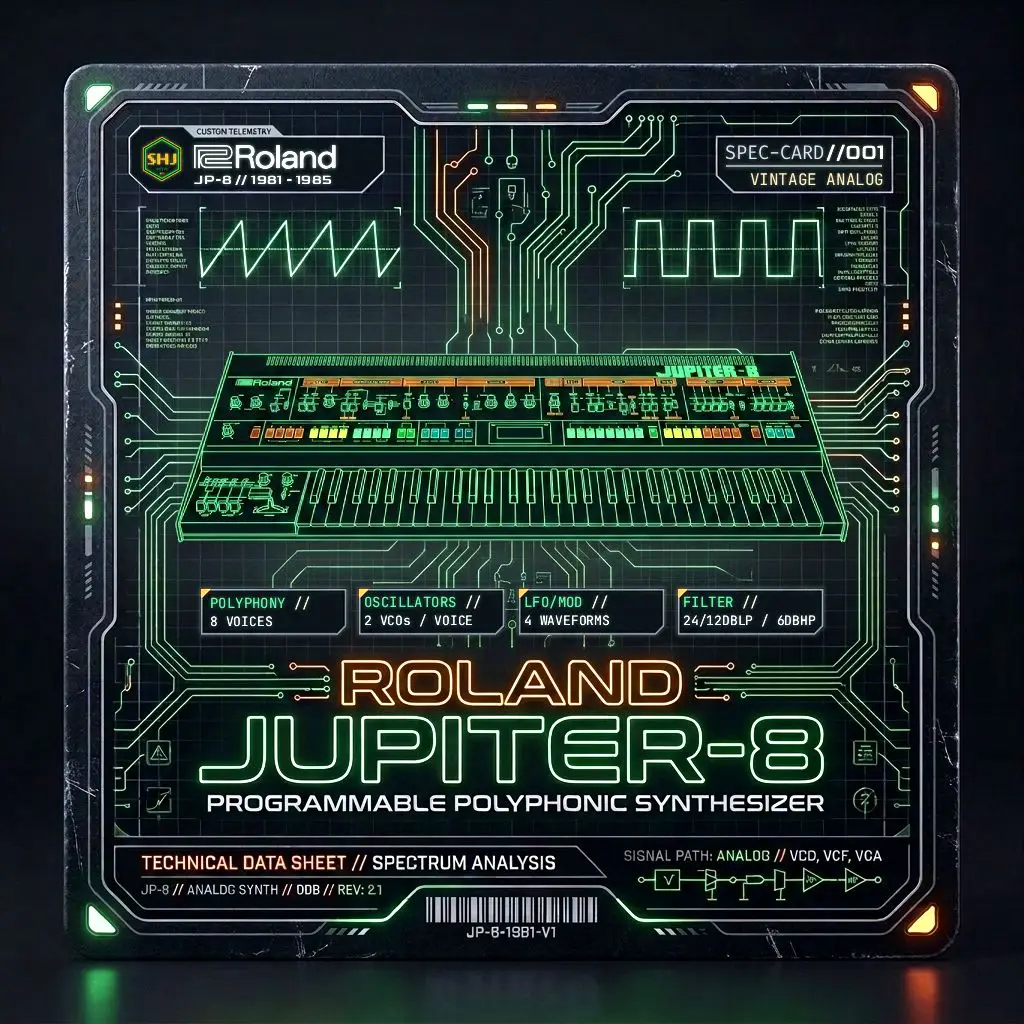
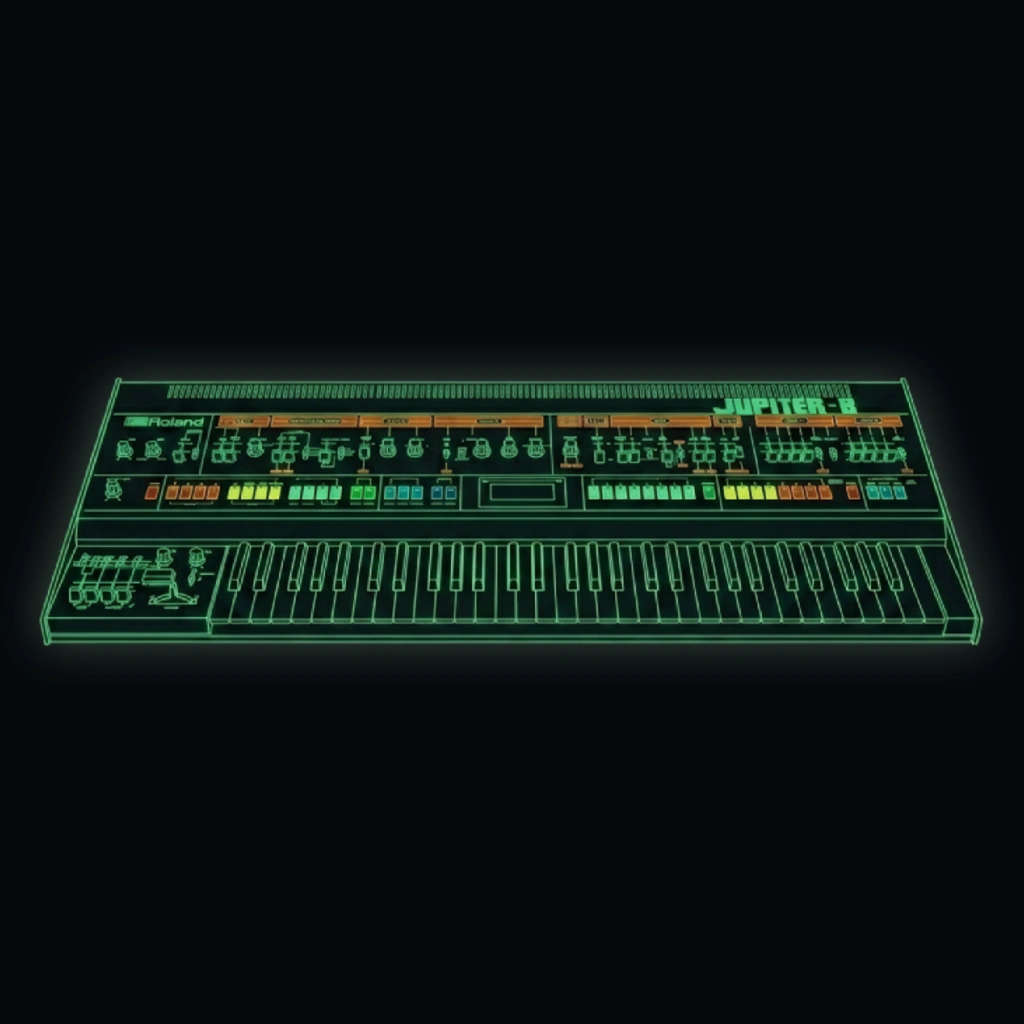
Roland Jupiter-8: The Crown Jewel of Analog Mastery
The Roland Jupiter-8 stands as the absolute pinnacle of 1980s Japanese analog synthesizer engineering!
Arriving in 1981, it was Roland’s first true flagship synthesizer, delivering a lush 8-voice polyphony powered by two oscillators per voice (totalling 16 VCOs at full polyphony), split-keyboard performance modes, and those iconic “rainbow” buttons. It defined the sonic landscape of the decade’s synth-pop pioneers and laid the foundation for Hollywood’s most memorable film scores.
Today, it remains one of the most sought-after flagships for collectors around the world who demand that distinct, lush and thick analog warmth that modern digital synths and plugins still struggle to replicate.
When you hear that signature warmth, you’re hearing the result of a no-compromise architecture: a versatile cross-modulation system, Dual and Split modes for layering or dividing two independent 4-voice patches, and that legendary switchable 2-pole/4-pole VCF that offers surgical sound-shaping. This is the hardware that perfected the performance blueprint for every poly-synth that followed, and in 2026, it remains the “Golden Ratio” of analog design.
Roland Jupiter-8 Sonic Heritage: Pop Culture Icons & Masterclass Tracks

Step into the lush, analog warmth of the early 80s with this collection of iconic hit songs defined by the legendary Roland Jupiter-8. From its thick, polyphonic pads and sweeping filters to the vibrant leads and arpeggios that graced countless platinum records, the Jupiter-8 set the gold standard for professional synthesizers.
In this playlist, Synth Hunter Japan explores the tracks that showcased the power of this Japanese masterpiece and defined the sound of pop, rock, and electronic music. Whether you’re a gear enthusiast or a lover of classic hits, discover how this iconic instrument shaped the sonic landscape of a generation.
- Duran Duran – “Hungry Like the Wolf” & “Save a Prayer” (1982): Keyboardist Nick Rhodes put the Jupiter-8 at the absolute center of the band’s identity. The glittering, iconic arpeggio line in “Save a Prayer” is a direct demonstration of the JP-8‘s onboard random arpeggiator mode paired with the analog delay of its internal clock.
- Michael Jackson – “Thriller” & “Billie Jean” (1982): Greg Phillinganes extensively utilized the JP-8’s dual-layered voice boards to craft the massive, punchy horn stabs on “Thriller.” The heavy, soaring brass and string elements underpinning the legendary tracks on this album are pure, discrete Jupiter-8.
- Queen – “Radio GaGa” (1984): The driving, mechanical bass pulse and sweeping, majestic pads that carry this anthem were programmed on a Jupiter-8 by Roger Taylor and Fred Mandel, utilizing the JP-8’s lightning-fast envelope transients to anchor the groove.
- Harold Faltermeyer – “Axel F” (1984): The definitive synth-pop instrumental. While the lead was the Moog, Faltermeyer used the Jupiter-8‘s unique cross-modulation (X-Mod) capability to construct the highly metallic, percussive backing synth brass stabs that give the theme its bouncy drive.
- Tears for Fears – “Shout” (1984): The massive, wide-stereo sweeping chorus pads and deep baseline textures on this track showcases the “Split” layout in a professional mixing environment, demonstrating the incredible thickness of the physical voice cards.
Roland Jupiter-8 Architecture & Reliability: The Deep Dive
Owning a Roland Jupiter-8 is a serious commitment to synthesizer history. Here are some core architectural details and physical considerations to keep in mind when investing in this analog legend:
- Features and Architecture: The JP-8 is built like an industrial tank but sounds like a dream. The cross-modulation (X-Mod) and sync capabilities allow for metallic, aggressive, and glassy textures that standard VCO synths simply can’t touch. The Split and Dual modes are where the performance architecture really shines—layering two patches creates a density that fills a modern wide-stereo mix perfectly.
- Reliability Warning: We have to be completely real—these 4 discrete dual-voice boards are aging. Internal wire-to-board connectors can oxidize, and the linear power supplies run incredibly hot. Early units (pre-serial #171700) lack the stable factory DCB interface and are more prone to tuning “adventures.” Our pre-purchase audit specifically targets these structural failure points to ensure your unit isn’t a ticking time bomb.
- Present Day Relevance: Even with amazing modern plugins and AI-modelled software recreations, the “Ears-First” physical experience of a real Jupiter-8 is undeniable. The subtle, organic drift of 16 discrete physical VCOs provides a “living” texture that deterministic digital clocks struggle to replicate. It is the ultimate forward-thinking move for a 2026 studio to anchor its sound in a peak-era analog masterpiece.
Roland Jupiter-8 Technical Resources & Historical Bibliography
As we are building an archive based on technical integrity, I am providing some citations and further reading below.
🎙️ Roland Jupiter-8 Historical & Journalistic References
- On UI Design & Interface Mastery: “If the Prophet-5 was the design that established the programmable synthesizer, the Jupiter-8 was the one that perfected its interface.” – Gordon Reid, Sound on Sound Magazine, “Roland Jupiter-8 Retrozone” (Legacy Archive).
- On Architectural Influence & Voice Allocation: “The Jupiter-8 set a new standard for reliability, sonic flexibility, and stage presence. Its voice-assign modes, split/layer capabilities, and built-in arpeggiator established the baseline features that keyboardists expected from any flagship polyphonic synthesizer going forward.” – Mark Vail, The Synthesizer: A Comprehensive Guide to Understanding, Programming, Playing, and Recording the Ultimate Electronic Music Instrument (Oxford University Press).