
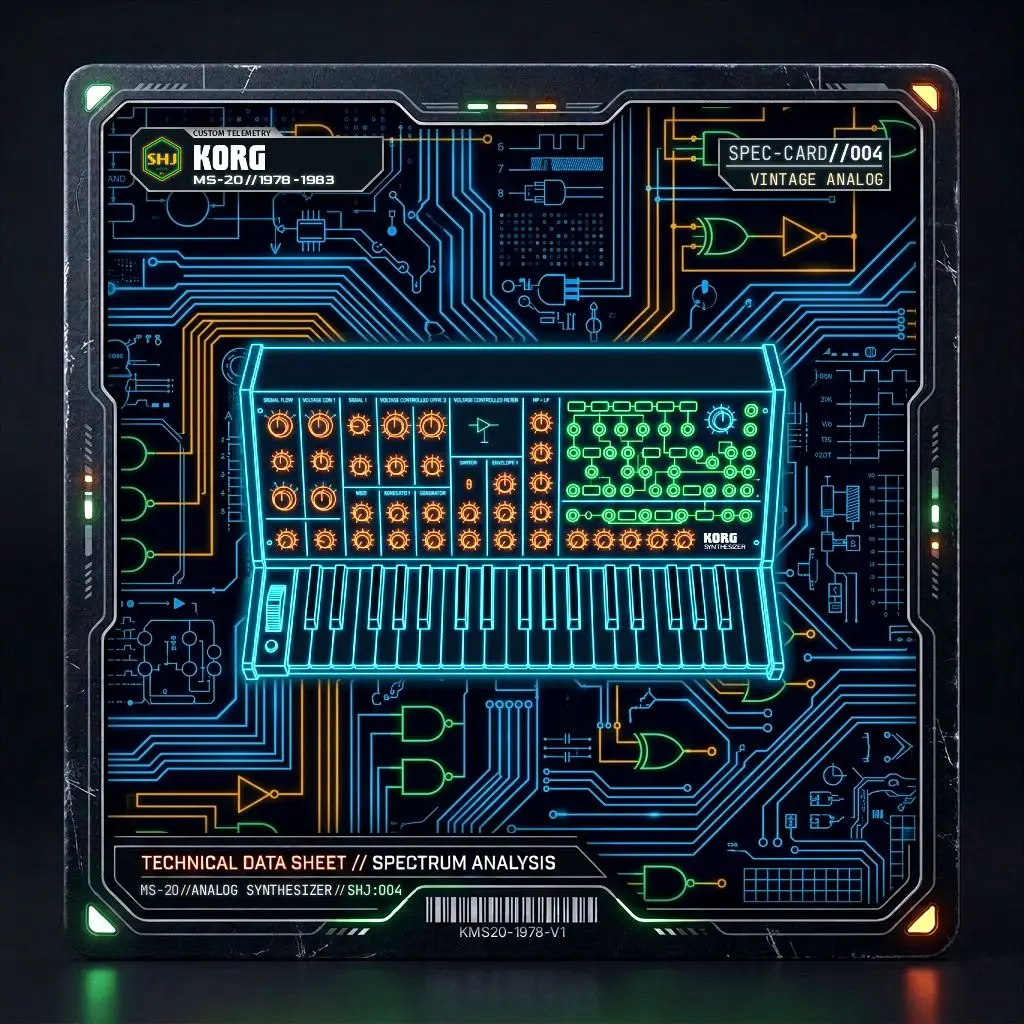
Korg MS-20 Seminal Screaming Monosynth: The Dual-Filter Patchable Icon
Introduced in 1978 alongside its smaller sibling the MS-10, the Korg MS-20 is a towering achievement in semi-modular analog synthesis. Designed as an affordable but incredibly flexible desktop instrument, it quickly defied its budget origins to become one of the most aggressive, volatile, and expressive monophonic synthesizers ever built. Its dual-VCO architecture, paired with a physical, tactile front-panel patch bay, bypassed the standard closed architectures of the era. Rather than offering polite, predictable subtractive sounds, the MS-20 was engineered to scream, establishing itself as a foundational voice for industrial, punk, early electro, and the harder edges of techno.
The defining characteristic of the MS-20 is its unparalleled filter topology, specifically the early Sallen-Key design based on the custom, discrete KORG35 hybrid integrated circuit. This design cascades an independent, resonant high-pass filter directly into an independent, resonant low-pass filter. At high resonance settings, the filters begin to self-oscillate, transforming the machine into an unstable, non-linear distortion device. Combined with the onboard External Signal Processor (ESP) circuit, which analyzes the pitch and amplitude of external acoustic signals to generate CV and Gate commands, the MS-20 acts as a highly interactive, tactile processor. It is an “Ears-First” playground where circuit instability, phase distortion, and raw, overdriven harmonics thrive far outside the bounds of sterile digital emulations.
Korg MS-20 Sonic Heritage: Pop Culture Icons & Masterclass Tracks

Unleashed in 1978, the Korg MS-20 semi-modular synthesizer became an undeniable force in electronic music history. Famous for its aggressive dual voltage-controlled filters, raw analog patch bay versatility, and menacing low-end grit, this iconic semi-modular powerhouse helped shape the sonic identity of hard-hitting techno, trance, and industrial anthems across the globe.
Synth Hunter Japan explores tracks where the raw power of the MS-20 left an indelible mark on dancefloors. From the infectious basslines to heavy hitters, dive into the unfiltered analog character and legendary patch-cable madness that defined a generation of electronic music producers.
- Mr. Oizo – “Flat Beat” (1999): The entire squelchy, distorted, monophonic main bass riff was generated on a Korg MS-20. Quentin Dupieux (Mr. Oizo) famously produced Flat Beat using almost no gear beyond a Korg MS-20 and an Akai S1000 sampler. The main squelchy, raw, monophonic bass line was generated directly on the MS-20.
- A Flock of Seagulls – I Ran (So Far Away) (1982): Mike Score and Paul Reynolds extensively used the Korg MS-20 for the song’s iconic futuristic noise sweeps, wind-like effects, and soaring synth textures.
- Röyksopp – Vision One (2009): Svein Berge and Torbjørn Brundtland are well-documented MS-20 users. The track’s modular-style bass sequence relies heavily on the MS-20’s signature dual high-pass and low-pass filter routing, giving it its distinct resonant resonance and movement.
- The Chemical Brothers – The Big Jump (2005): Tom Rowlands and Ed Simons have used the MS-20 as a core studio weapon throughout their career. Their signature technique involves feeding external synths or guitar lines directly into the MS-20’s External Signal Processor (ESP) and filter section to achieve heavy, overdriven saturation
- Goldfrapp – “Lovely Head” (2000): Will Gregory routed Alison Goldfrapp’s vocal performance into the MS-20’s ESP module, using the pitch-to-CV converter and peak filters to track her voice and create the haunting, whistling synth lead heard on the track.
Korg MS-20 Architecture & Reliability: The Deep Dive
Owning a Korg MS-20 is a serious commitment to synthesizer history. Here are some core architectural details and physical considerations to keep in mind when investing in this analog legend:
- Features and Architecture: The MS-20‘s raw power lies in its aggressive dual-filter signal path. Sallen-Key filters are notorious for their highly nonlinear resonance loops. When self-oscillating, they generate pure, volatile sine waves that can be pushed into extreme saturation by overdriving the mixer stage. Unlike most modern synthesizers that utilize standard Oct/V pitch tracking and V-Trig gating, Korg designed the MS-20 around an Hz/V scaling system. This design choice, combined with S-Trig gating, results in a unique pitch-tracking behavior that feels physically responsive, introducing subtle tuning anomalies and timing jitters that inject acoustic movement directly into modern DAW compositions.
- Reliability Warning: The MS-20 features a massive array of vertical, panel-mounted 3.5mm jacks. Over decades of patching, these jacks oxidize, crack their solder connections on the internal PCBs, and suffer from microtrace lifting, leading to intermittent signal paths, pitch drift, or complete envelope failure. Furthermore, the early proprietary KORG35 hybrid IC filter submodules are highly susceptible to thermal degradation and internal moisture buildup. If a unit uses the later OTA-based LM13600 filter revision, it is more stable but lacks the extreme, dirty, and chaotic character of the KORG35. Finally, the physical keyboard bushings dry out, leading to clacking, misaligned keys, and poor contact tracking.
- Present Day Relevance: In a modern production environment dominated by clean, phase-perfect software plugins, the MS-20 is a sonic bulldozer. The physical workflow of patching real cables on the front panel forces a tactile, exploratory interaction. Routing the output of VCO2 into the frequency modulation input of VCO1 yields unstable, metallic FM tones, while feeding a modern DAW drum track back into the ESP input allows you to completely mangle and saturate your digital signals through pure analog circuitry.
Korg MS-20 Technical Resources & Historical Bibliography
As we are building an archive based on technical integrity, I am providing some citations and further reading below.
🎙️ Korg MS-20 Historical & Journalistic References
- On the Sallen-Key Filter Architecture: “The original filter used a proprietary hybrid IC called the KORG 35. It is a discrete design that self-oscillates wildly and produces a highly colored, aggressive distortion…” – Korg MS-20 Vintage Review via Sound on Sound
- On the Modular Signal Path: “It’s the ultimate patchable monosynth because of the External Signal Processor. You can play your guitar through it, track the pitch, and let the MS-20 scream along with you.” – The Legacy of the MS Series via Vintage Synth Explorer