
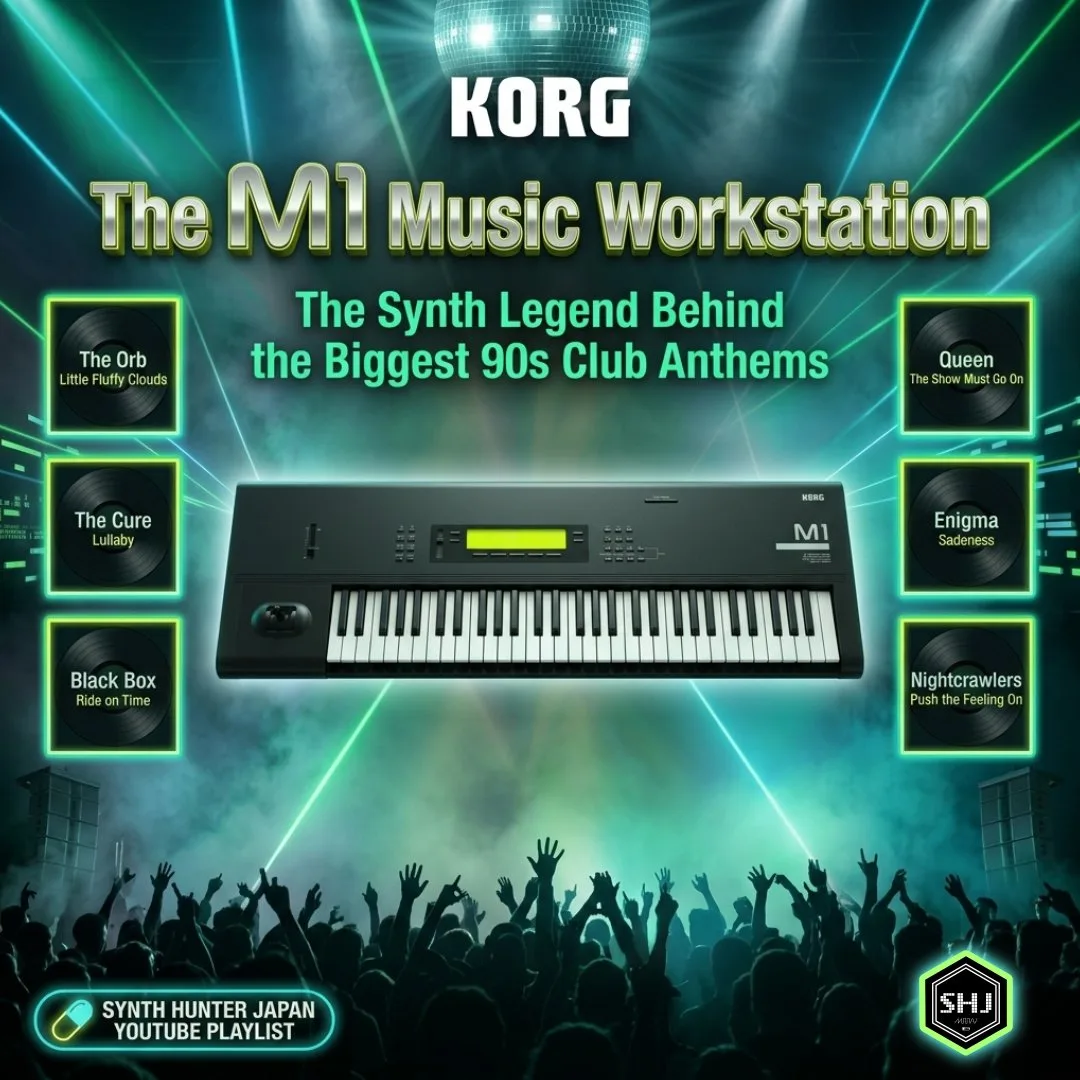
The Workstation Revolution: 16-Bit AI Synthesis, Burr-Brown DAC Punch, and the Defining Sounds of Late-80s Dance and Pop History
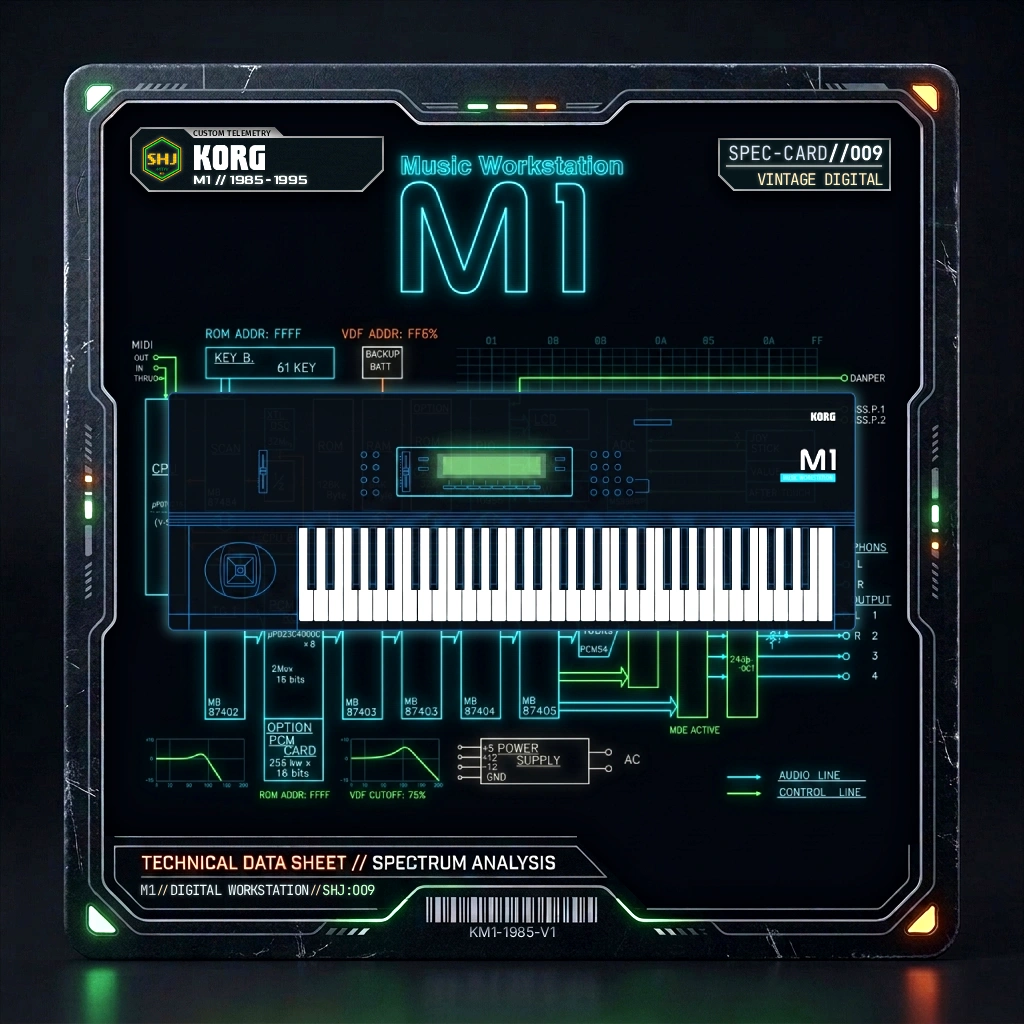
Released in Tokyo in May 1988, the Korg M1 is not simply a classic synthesizer: it is one of the most commercially successful synthesizer in electronic music history, defining the shift toward the modern ‘music workstation’ format. By uniting a 16-bit digital synthesizer engine, a dual digital multi-effects processor, and an 8-track onboard MIDI sequencer under an elegant, matte-black chassis, the M1 revolutionized studio production. Selling over 250,000 units worldwide, it empowered musicians and producers to compose, arrange, and mix complete commercial tracks on a single machine, laying the sonic foundations for the late-80s and 1990s dance, house, and pop movements.
At the heart of the M1‘s legendary acoustic footprint lies Korg‘s proprietary Advanced Integrated (AI) Synthesis system. Rather than generating simple mathematical waveforms, the M1 utilizes 4 Megabytes of high-density, 16-bit PCM multi-samples stored across internal ROM chips. Managed by an Intel-derived NEC V50 microprocessor running at 10 MHz, these samples are processed through digital low-pass filters (VDF) and amplifiers (VDA). The defining element of its punchy, forward sound is the digital-to-analog conversion stage, powered by the musical 16-bit Burr-Brown PCM54HP DAC. This circuit configuration delivers a muscular, mid-range-focused presence with a crisp transient attack that effortlessly punches through dense mixes without heavy outboard EQ.
Throughout the 1990s, the M1 became an absolute acoustic fixture across global music culture. Its factory presets, most notably ‘Piano 16”, ‘Organ 2’, and ‘Universe’, became legendary sonic hallmarks across Chicago house, UK garage, Italo-dance, ambient, and pop productions. From Robin S and Madonna to The Orb, Enigma, and Queen, the M1 was embraced not merely as a studio workstation, but as a physical pillar of music history. In an era where modern digital audio workstations offer clinical precision, the M1 stands out for its warm summing, analog-like punch, and nostalgic mojo.
Korg M1 Sonic Heritage: Pop Culture Icons & Masterclass Tracks
A curated collection of 10 iconic artists, albums, and masterclass tracks showcasing the Korg M1‘s signature AI synthesis, Burr-Brown DAC punch, and legendary presets across music history:
- Robin S. (Prod. StoneBridge): ‘Show Me Love’ (1993 / Champion / Big Beat)
The undisputed crown jewel of dance music basslines. Swedish producer StoneBridge modified the decay of M1‘s Preset 17 ‘Organ 2’ and pushed it through a mixing console pre-amp to craft the punchy, physical percussive bassline that defined 90s house and UK garage. (Sound on Sound Magazine, ‘Classic Tracks: Robin S – Show Me Love’). - Madonna (Prod. Shep Pettibone): ‘Vogue’ / I’m Breathless (1990 / Sire)
Producer Shep Pettibone heavily compressed and equalized the iconic M1 ‘Piano 16” patch, driving the energetic, bright piano chord stabs that define the verses and choruses of this global pop masterpiece. (Sound on Sound Magazine, ‘Classic Tracks: Madonna – Vogue’). - The Orb: ‘Little Fluffy Clouds’ / The Orb’s Adventures Beyond the Ultraworld (1990 / WAU! Mr. Modo / Big Life)
Alex Paterson and Youth utilized Preset 00 ‘Universe’, layering its breathy choir transients, flute harmonics, and spacey bells into the defining atmospheric soundscape of ambient house. (Future Music Magazine, ‘The Making of Little Fluffy Clouds’ & Sound on Sound). - Black Box: ‘Ride on Time’ / Dreamland (1989 / Deconstruction / RCA)
The defining early Italo-house anthem, propelled by relentless, bright octave riffs of the M1 ‘Piano 16” patch layered underneath Loleatta Holloway’s powerhouse vocal samples. (Red Bull Music Academy Archives & Sound on Sound Retro). - Queen: ‘The Show Must Go On’ & ‘Don’t Try So Hard’ / Innuendo (1991 / Parlophone)
Underpinned by the atmospheric M1 ‘Universe’ pad and ‘Ooh/Aah’ vocal choir presets, adding a vast, dramatic cinematic space beneath Brian May’s guitars and Freddie Mercury’s soaring final vocal performances. (Sound on Sound Magazine, ‘Queen: Recording Innuendo at Mountain Studios’). - Enigma (Michael Cretu): ‘Sadeness (Part I)’ / MCMXC a.D. (1990 / Virgin)
Producer Michael Cretu combined the M1‘s breathy ‘Pan Flute’ (Shakuhachi / Pan Mallet) and ambient choir pads with Gregorian chants and a TR-808 drum groove to create a worldwide crossover phenomenon. (Keyboard Magazine, ‘Michael Cretu: Inside Enigma’s Studio’). - CeCe Peniston (Prod. Felipe Delgado): ‘Finally’ (1991 / A&M Records)
Built upon driving M1 ‘Piano 16” house chord progressions accented by crisp M1 organ chords, creating one of the defining vocal dance anthems of the early 1990s. (Billboard Dance Floor Archives & Sound on Sound). - Nightcrawlers (Prod. MK – Marc Kinchen): ‘Push the Feeling On’ (The Dub of Doom) (1992 / 1995 / FFRR)
Marc Kinchen deconstructed the original vocal and anchored the entire track around the physical transient knock of the M1 ‘Organ 2’ patch, cementing it as the foundational rhythm sound of 90s deep house. (Resident Advisor, ‘MK: In the Studio’ & Attack Magazine). - The Cure: ‘Lullaby’ / Disintegration (1989 / Fiction Records)
Robert Smith and producer David M. Allen utilized the Korg M1 for its lush string swells, pizzicato accents, and subtle reed textures to construct the dark, Gothic atmosphere of Disintegration. (Sound on Sound Magazine, ‘Classic Tracks: The Cure – Lullaby’). - A Guy Called Gerald: ‘Voodoo Ray’ (1988 / Rham! Records)
Gerald Simpson combined early Korg M1 vocal multisamples and metallic percussive textures with the Roland TB-303 and TR-808, forging Manchester’s seminal acid house blueprint. (Red Bull Music Academy Lecture: A Guy Called Gerald & The Guardian).
Korg M1 Architecture & Reliability: The Deep Dive
Features and Architecture: The physical sound of the M1 is driven by its unique sample playback engine. Rather than using sterile, mathematically perfect waves, Korg loaded the 4MB ROM with highly characterful acoustic and synthesized transients, most notably the legendary ‘Piano 16”, ‘Organ 2’, and ‘Universe’ presets. The Burr-Brown PCM54HP DAC converts these digital samples with a unique, warm mid-range color and high-frequency punch. This analog summing stage, combined with two independent digital multi-effects processors (running in series or parallel), allows the M1 to output incredibly dense, radio-ready sounds directly from its physical outputs.
Reliability Warning: The Korg M1 is approaching four decades of age, and its mechanical and electronic components require proactive maintenance. The original yellow-green backlit LCD screen relies on an electroluminescent (EL) foil powered by a high-voltage internal inverter. Over time, these foils dim to near-black, and the aging inverter transformer emits an irritating, high-frequency coil whine that bleeds into the studio space. Additionally, the original CR2032 lithium backup battery is soldered directly to the mainboard; when this battery dies, all internal program and combination memory is lost, rendering the keyboard silent until a MIDI Sysex dump is performed. Finally, the carbon contacts beneath the Yamaha FS keybed accumulate dust and oxidation, causing dead keys or erratic velocity response.
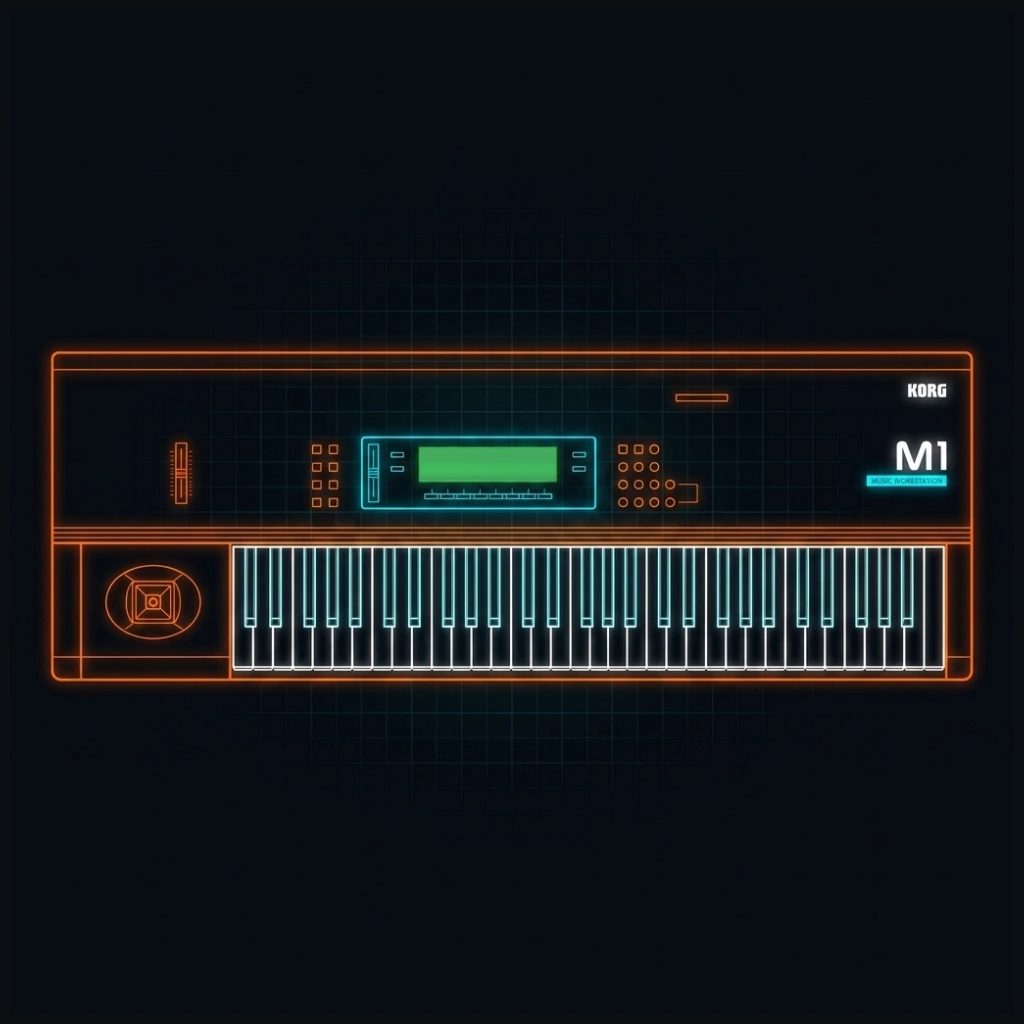
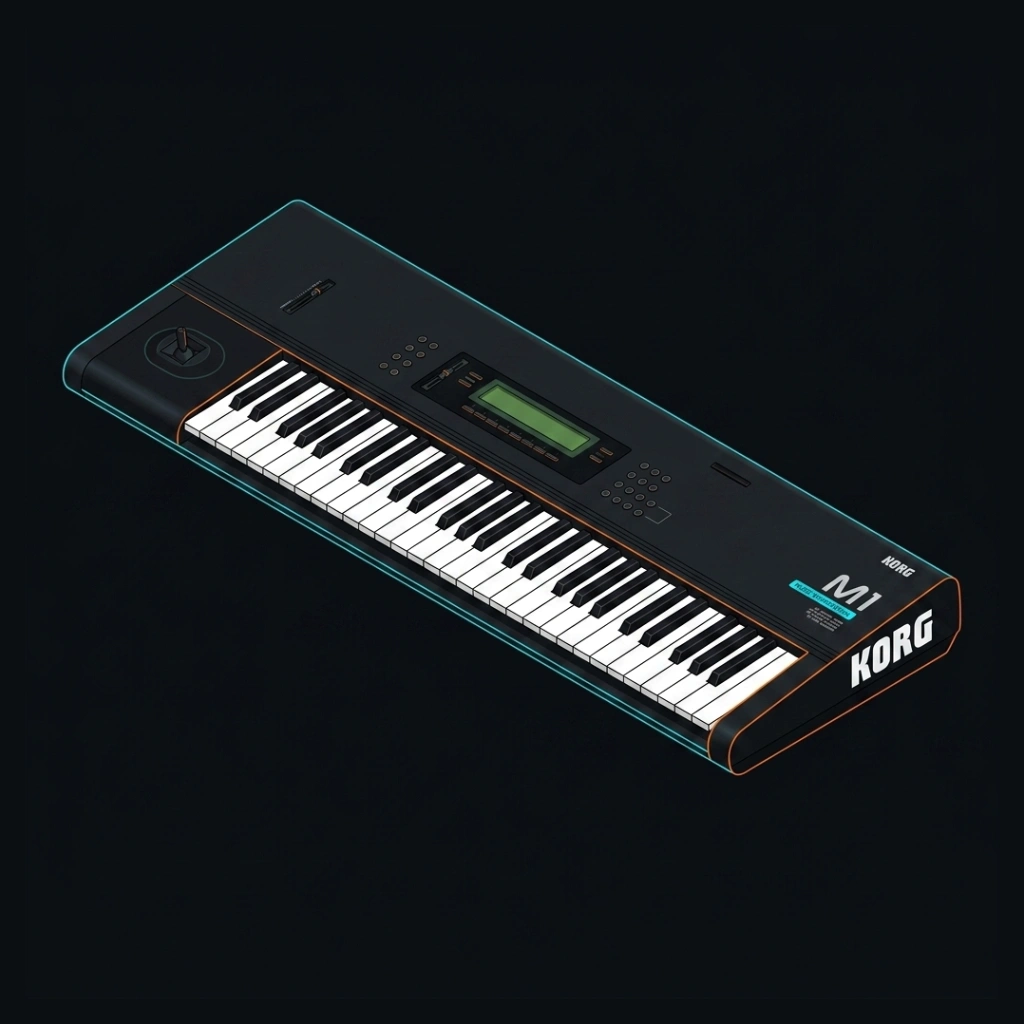
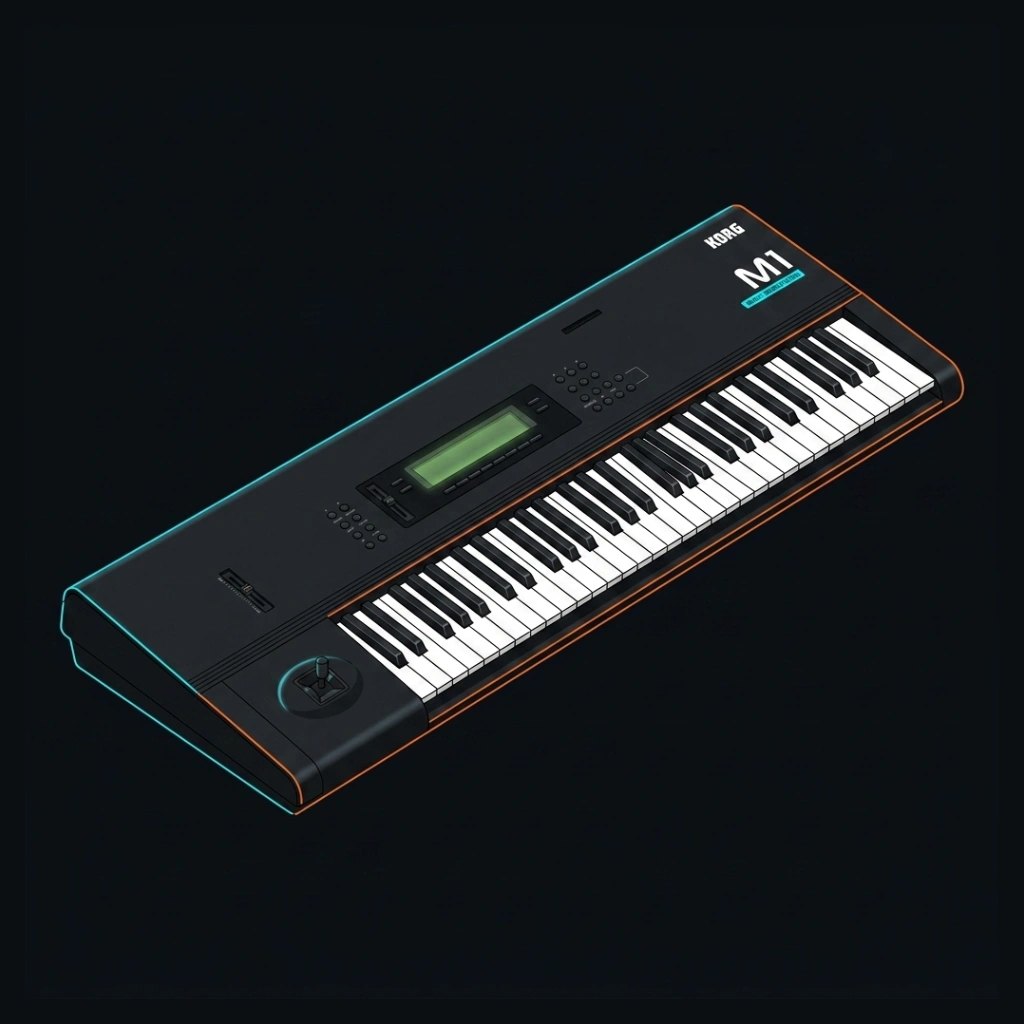
Present Day Relevance: In modern production setups dominated by sterile, multi-gigabyte virtual instrument libraries, the M1 provides an immediate injection of vintage late-80s and 90s character. Its sounds possess an unmistakable, nostalgic presence and punch that sit effortlessly in contemporary house, synthwave, and pop mixes. The tactile experience of playing the responsive Yamaha FS keybed (widely regarded as one of the finest semi-weighted keybeds ever manufactured) and manipulating the physical joystick for real-time pitch and modulation delivers a degree of expressive control that software plugins cannot duplicate.
Korg M1 Technical Resources & Historical Bibliography
As we are building an archive based on technical integrity, I am providing some citations and further reading below.
🎙️ Historical & Journalistic References
On AI Synthesis & Studio Dominance: “The Korg M1 was the instrument that defined the transition into the modern digital workstation era. By combining multi-sampled 16-bit acoustic transients with musical Burr-Brown conversion, it delivered an immediate, punchy mid-range that dominated 90s dance and pop radio.” (Sound on Sound Magazine, ‘The Legendary Korg M1 Workstation’).
On the House Music Legacy of ‘Organ 2’: “No single synthesizer preset has defined a musical movement as completely as the M1‘s Organ 2 defined 90s house and garage, showcasing the enduring power of 16-bit PCM transient design.” (Vintage Synth Explorer, ‘Korg M1 Architectural Profile’).