
ARCHIVE_ONLINE
COMMUNITY_INITIALIZING
KAWAI 1996 - 1999 DIGITAL SYNTHESIZERS

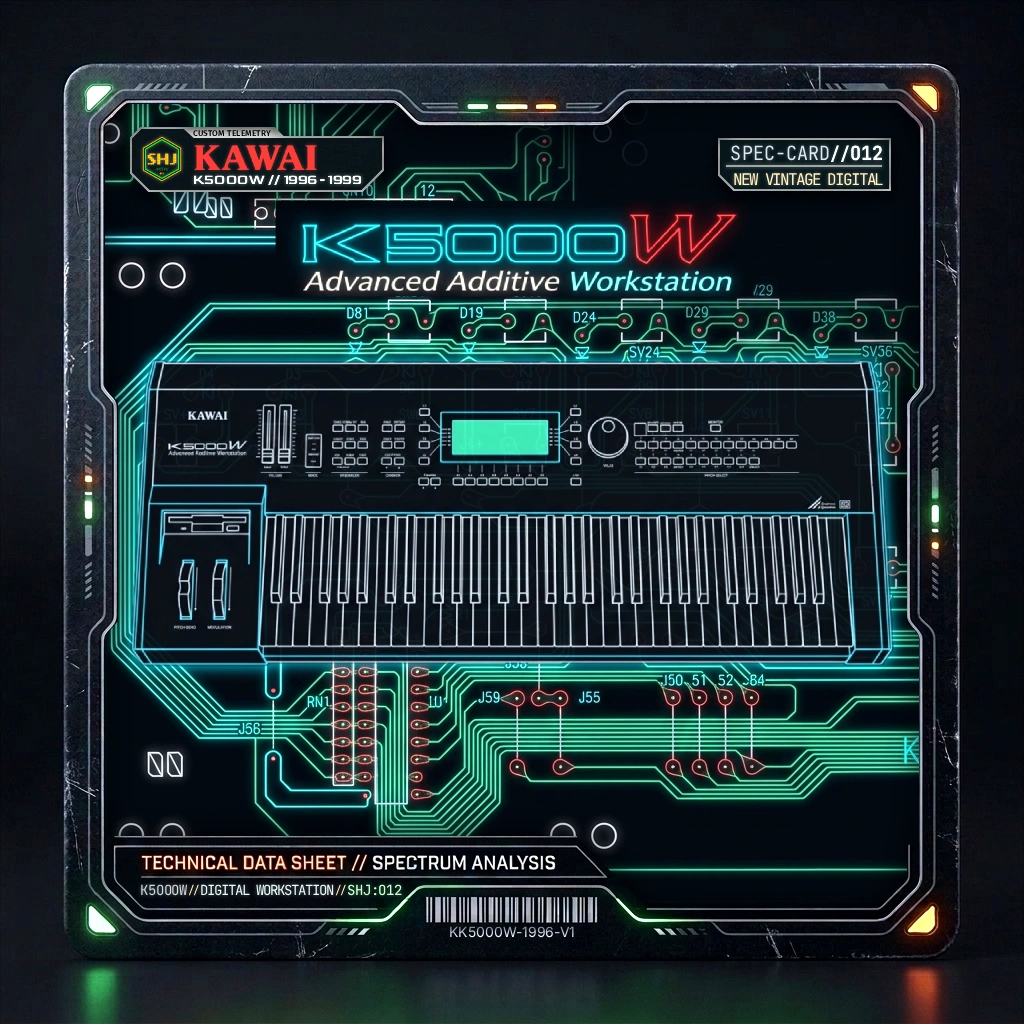
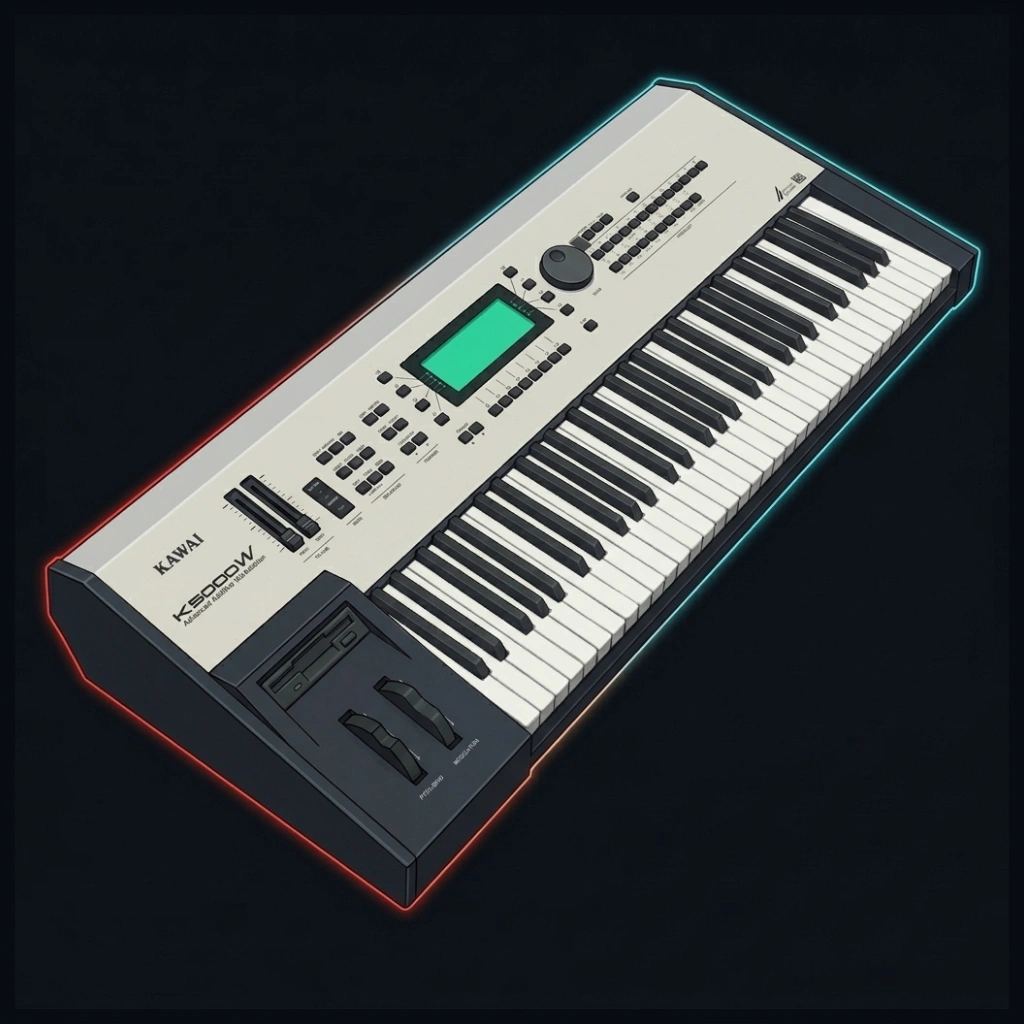
Kawai K5000W

// NEW VINTAGE DIGITAL SYNTHESIZER //
// BE THE FIRST TO LOG IN RACK // BE THE FIRST TO PUT ON RADAR
MANUFACTURER: Kawai (Japan)
PRODUCT: Kawai K5000W
RELEASE YEAR: 1996 - 1999
SYNTHESIS ENGINE: Advanced Additive Synthesizer and 16-bit PCM Sample Playback
POLYPHONY / VOICES: 32 Voices (AAS+PCM) / 64 Voices (PCM)
LAUNCH PRICING: 180,000 JPY (K5000S) / 198,000 JPY (K5000W) / 125,000 JPY (K5000R)
CURRENT PRICING: $900 USD to $1,600 USD

HARDWARE OVERVIEW & HISTORY

The Advanced Additive Monolith Workstation: 128-Band Formant Filtering & Biomechanical Synthesizer Masterpiece

Unveiled by Kawai in Hamamatsu in 1996, the Kawai K5000 stands as the absolute zenith of hardware additive synthesis: a bold, unapologetic digital titan engineered at a moment when the global synthesizer industry was completely fixated on generic, disposable sample-playback workstations. Rather than taking the easy road of static PCM romplers, Kawai’s acoustic research laboratories committed massive DSP processing power to real-time spectral generation, creating a machine that generates sound from its purest mathematical components: harmonic sine waves calculated and animated in real-time.

Beneath its sleek, dark graphite steel chassis, the K5000 is powered by an advanced 16-bit NEC V53 central microprocessor working in tandem with custom Kawai ADD-LSI real-time additive math ASICs and dual audiophile-grade Burr-Brown PCM1702 20-bit digital-to-analog converters. Each of the instrument’s multi-source voices can stack up to 128 individual harmonic sine waves via high-speed Inverse Discrete Fourier Transform algorithms, routed through an astonishing 128-band dynamic formant filter. This dedicated formant architecture allows producers to morph spectral resonant peaks across time, generating vocal chorales, metallic bells, and biomechanical textures that possess uncanny acoustic realism and infinite harmonic depth.

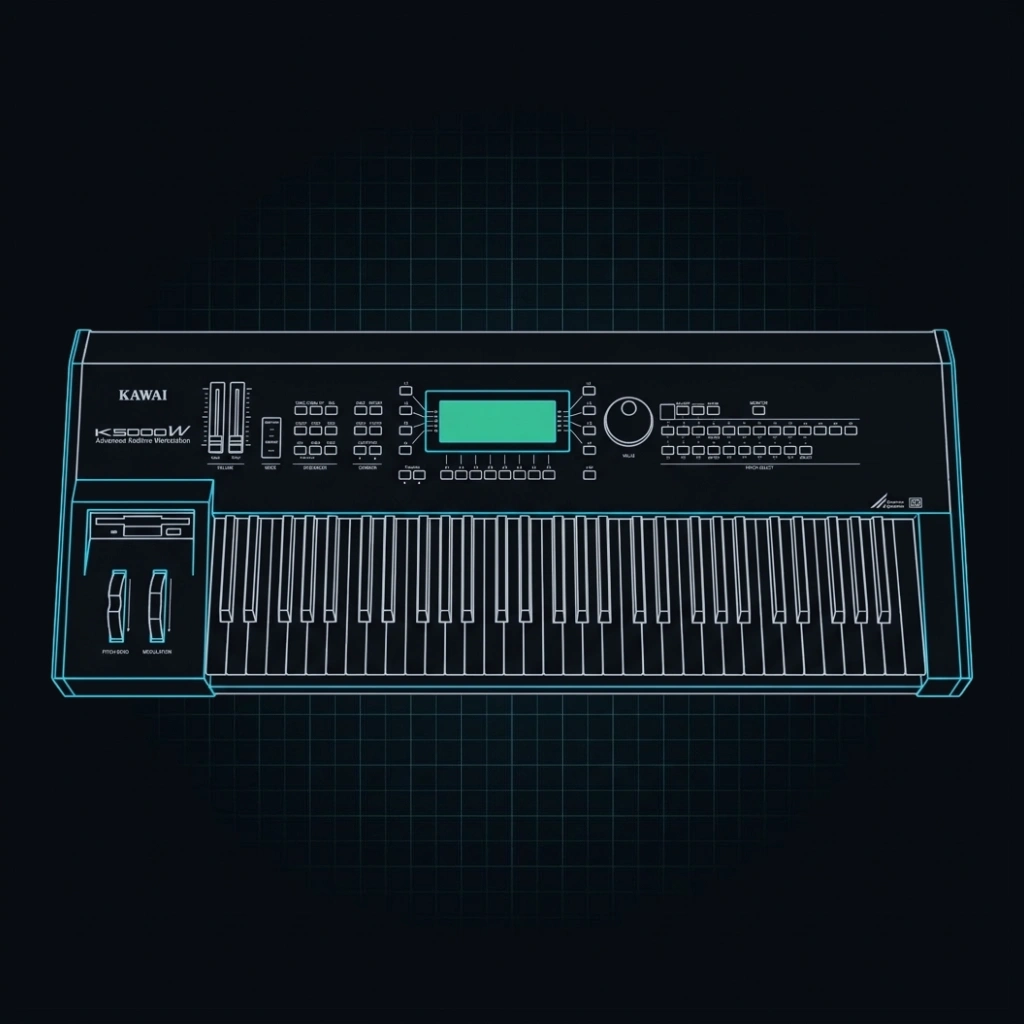
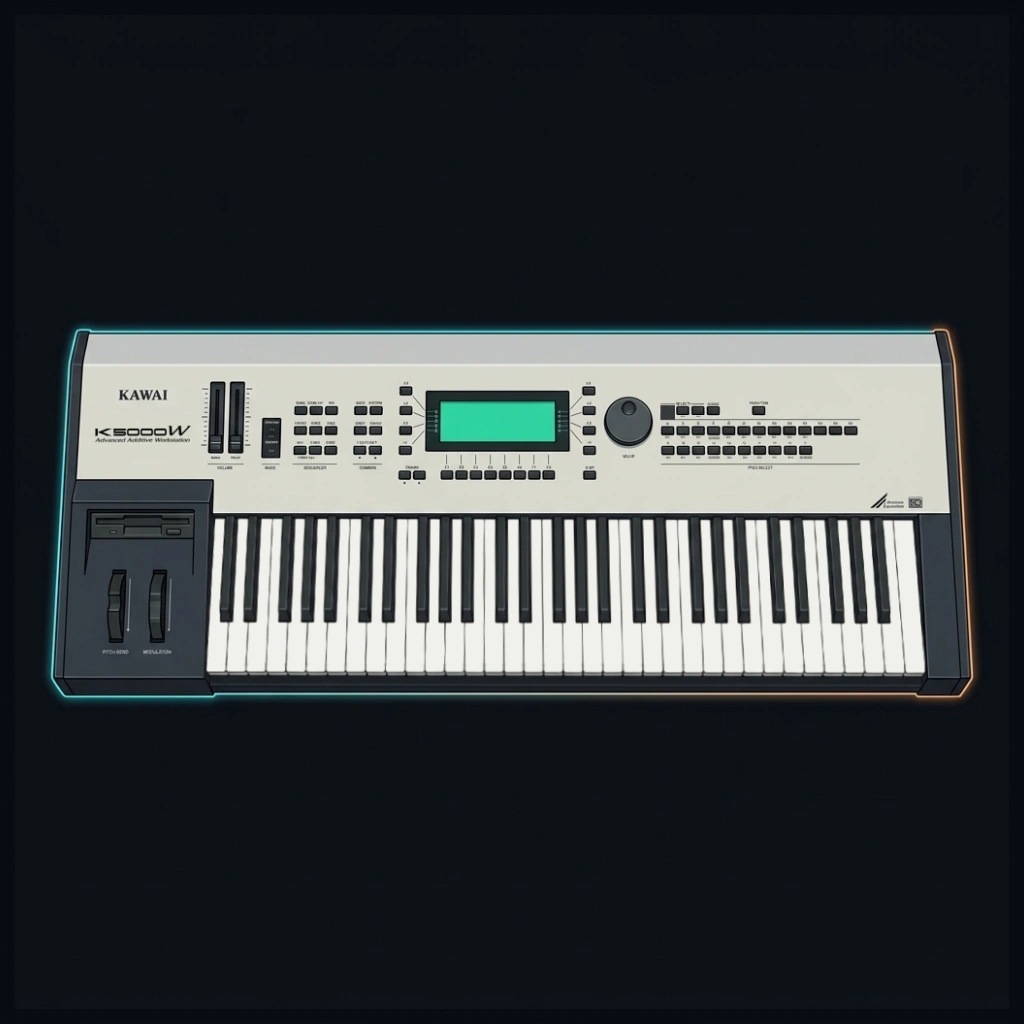
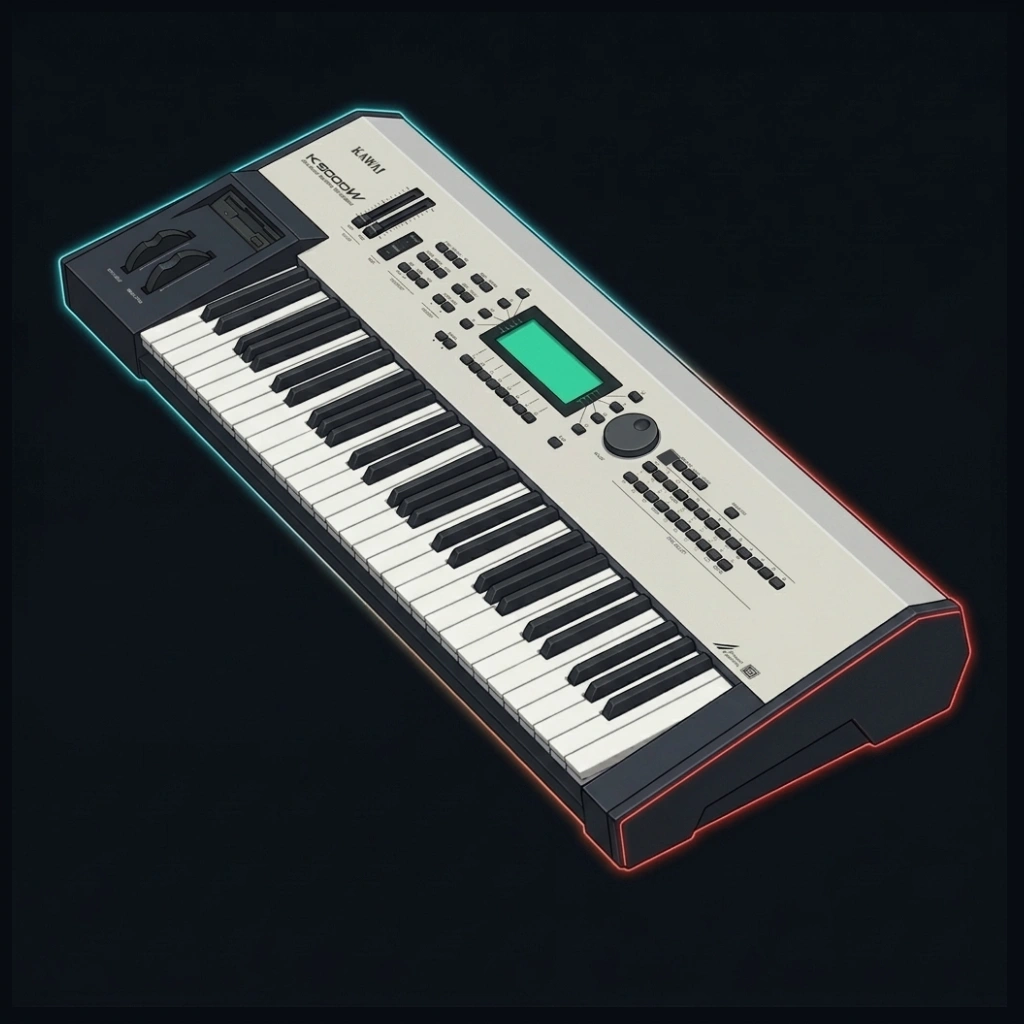
To address different production workflows, Kawai released the K5000 family in three distinct hardware variants, each tailored to specific studio and stage demands. The flagship K5000S (‘Synthesizer’) was engineered specifically for live sound sculptors, equipping a 61-note semi-weighted keybed with channel aftertouch and a dedicated front-panel matrix of 16 continuous real-time control knobs (arranged in four banks of four) for instantaneous, tactile manipulation of additive harmonics, formant filters, and envelopes. By contrast, the K5000W (‘Workstation’) targeted complete music production: while omitting the 16-knob matrix in favor of sequencer transport buttons, it integrated an onboard 40-track MIDI sequencer and an expanded General MIDI (GM) compatible PCM soundbank alongside the core additive engine. Finally, the K5000R (‘Rackmount’) consolidated the complete Advanced Additive Synthesis engine and 128-band formant filter of the K5000S into a rugged 2U 19-inch rack unit, featuring the full 240 x 64 dot backlit LCD and four assignable macro knobs for dense studio rack environments without sacrificing deep sonic editing.

Despite its technical brilliance, the K5000 arrived just as the market was shifting toward software instruments, leading to a limited production lifecycle across the K5000S, K5000W, and K5000R. Today, visionary electronic artists recognize the K5000 as a physical pillar of music history. From Klaus Schulze and Kraftwerk to Vince Clarke and Steve Roach, the instrument’s razor-sharp 20-bit DAC stage and alien, evolving soundscapes deliver an organic presence that modern software plugins simply cannot replicate.

SONIC HERITAGE: POP CULTURE ICONS & MASTERCLASS TRACKS

Synth Hunter Japan Youtube Playlist: The Secret Synth Behind Chemical Brothers, Kraftwerk, Klaus Schulze & 90s Icons: Kawai K5000

A curated collection of 10 iconic artists, albums, and masterclass tracks showcasing the Kawai K5000‘s legendary sonic signature, hardware architecture, and cultural impact across music history:

  • Klaus Schulze: ‘Are You Sequenced?’ (1996 / WEA / Big Bellies)
    Klaus Schulze deployed the Kawai K5000S extensively throughout this landmark release, using its 128-band formant filter to sculpt evolving, alien vocal-like pads and atmospheric textures over Berlin-school sequencer sequences. (Citation: Sound on Sound Magazine, ‘Klaus Schulze: In The Studio’ & Album Liner Notes).
  • Kraftwerk (Ralf HΓΌtter & Florian Schneider): ‘Tour de France Soundtracks’ / Live Setups (1998 / 2003 / Kling Klang / EMI)
    Florian Schneider and Ralf HΓΌtter incorporated the Kawai K5000 into their Kling Klang studio and live touring rigs for pristine, synthetic vocal formants and robotic choir textures. (Citation: Keyboard Magazine, ‘Kraftwerk: Return of the Synthesizer Masters’ & Kling Klang Studio Archives).
  • Vince Clarke (Erasure): ‘Cowboy’ / Studio Sound Design (1997 / Mute Records)
    Vince Clarke integrated the Kawai K5000W into his legendary 37B studio, exploring its additive harmonic synthesis and dynamic formant morphing to contrast against his analog monophonic synthesizers. (Citation: Sound on Sound Magazine, ‘Vince Clarke: Analogue & Additive Horizons’).
  • Meat Beat Manifesto (Jack Dangers): ‘Subliminal Sandwich’ (1996 / Nothing / Interscope)
    Jack Dangers abused the K5000’s real-time macro knobs and 128-band formant filter to generate mutated, biomechanical sweeps and eerie dissonant harmonic pads across experimental breakbeats. (Citation: Keyboard Magazine, ‘Jack Dangers: Deconstructing Industrial Beats’).
  • Biosphere (Geir Jenssen): ‘Cirque’ (2000 / Touch)
    Geir Jenssen layered the Kawai K5000’s additive bell tones and evolving subterranean formant washes over Arctic field recordings to craft hypnotic, glacial ambient environments. (Citation: Resident Advisor, ‘Biosphere: Sound Architectures’ & Touch Archive).
  • Download (cEvin Key & Phil Western): ‘The Eyes of Stanley Pain’ (1996 / Subconscious Communications / Nettwerk)
    Key and Western pushed the K5000’s additive sine arrays and high-speed modulation LFOs to create disturbing, organic digital drones and microtonal textures for post-Skinny Puppy industrial soundscapes. (Citation: Alternative Press, ‘Download: Experimental Synthesis’ & Subconscious Studio Production Logs).
  • Steve Roach: ‘The Magnificent Void’ (1996 / F连续 / Projekt)
    Ambient master Steve Roach utilized the K5000’s multi-stage dynamic envelopes and formant filtering to design vast, shimmering cosmic drone expanses with perpetual harmonic movement. (Citation: Electronic Musician Magazine, ‘Steve Roach: Sonic Cartography’).
  • Banco de Gaia (Toby Marks): ‘The Magical Sounds of Banco de Gaia’ (1999 / Disco Bongo)
    Toby Marks used the K5000’s semi-weighted keybed and real-time additive controllers to generate fluid, microtonal Middle Eastern and Asian lead timbres layered over global dub grooves. (Citation: Future Music Magazine, ‘Banco de Gaia: Studio Gear & Global Beats’).
  • Front Line Assembly (Bill Leeb & Chris Peterson): ‘FLAvour of the Weak’ (1997 / Metropolis Records)
    FLA embraced the K5000S as a primary sound engine for harsh, metallic lead lines, razor-sharp digital percussive clicks, and sweeping formant vocal pads that defined their shift into drum and bass-influenced industrial. (Citation: Sound on Sound Magazine, ‘Front Line Assembly: The Digital Shift’).
  • The Chemical Brothers (Tom Rowlands & Ed Simons): ‘Surrender’ / Studio Sessions (1999 / Freestyle Dust / Virgin)
    Tom Rowlands utilized the K5000 in studio sound design sessions to produce glassy, piercing digital transitions and morphing harmonic noise sweeps to introduce build-ups and breakdowns. (Citation: Future Music Magazine, ‘The Chemical Brothers: Behind the Mix’).
LISTEN TO THE KAWAI K5000 INSPIRED PLAYLIST

ARCHITECTURE & RELIABILITY: THE DEEP DIVE

Features and Architecture: The core of the K5000 is Kawai’s Advanced Additive Synthesis (AAS) engine. Up to 6 individual sound sources can be layered per voice, with additive sources providing 128 harmonic sine waves, each governed by its own multi-stage dynamic envelope. These harmonics pass through a dynamic 128-band formant filter, which functions as an array of 128 individual bandpass filters whose center frequencies and levels can be dynamically modulated. Paired with 16 continuous real-time control knobs on the K5000S, sound designers can manipulate complex harmonic groups and formant curves on the fly, bridging mathematical rigor with immediate tactile performance.

Reliability Warning: The Kawai K5000 series suffers from three specific age-related failure modes. First, the 16 front-panel continuous rotary encoders on the K5000S frequently oxidize, causing parameter values to jump uncontrollably during adjustment. Second, the 240 x 64 dot graphic LCD display relies on an internal CCFL backlight that dims or flickers after decades of operation. Third, the internal linear power supply operates under continuous thermal load, causing electrolytic capacitor dry-out on the DC regulation rails. Additionally, the soldered-in CR2032 lithium backup battery will eventually leak or deplete, erasing user soundbanks and multi-patches.

Present Day Relevance: In an era where modern digital workstations rely on sterile, phase-static wavetables, the physical presence of the K5000‘s real-time math engine and Burr-Brown 20-bit DAC stage provides unmatched warmth and spectral clarity. Its ability to create living, morphing acoustic illusions and biomechanical drones makes it an essential secret weapon for ambient composers, industrial sound designers, and avant-garde producers seeking timbres that exist outside conventional subtractive synthesis.

TECHNICAL RESOURCES & HISTORICAL BIBLIOGRAPHY

πŸŽ™οΈ Historical & Journalistic References

On Additive Sound Architecture: “The Kawai K5000 remains one of the few true additive synths in history, marrying 128 harmonic sine waves per source with a 128-band formant filter to produce timbres that are astonishingly alive and acoustic.” (Citation: Sound on Sound Magazine, ‘Kawai K5000S Comprehensive Retrospective’).

On Vintage Value: “An over-engineered masterpiece that arrived ahead of its time, the K5000 offers sonic possibilities that modern plugin workstations still struggle to duplicate.” (Citation: Vintage Synth Explorer, ‘Kawai K5000 Technical Profile’).

MASTER TECHNICAL SPECIFICATION SHEET

πŸŽ›οΈ 1. ENGINE & SIGNAL PATH

Synthesis Engine: Advanced Additive Synthesis (AAS) combined with 16-bit PCM multi-sample playback through dynamic 128-band formant filter and digital resonant filters
Polyphony / Voices: 32 voices (dynamic voice allocation across additive and PCM source layers, 64-voice max in pure PCM mode)
Oscillators: Digital Harmonic Sound Generator: up to 6 individual sound sources per patch, each additive source generating 128 harmonic sine waves via high-speed Inverse Discrete Fourier Transform (IDFT) algorithms, plus 123 onboard 16-bit PCM multisamples
Filters: 1 x 128-band dynamic Formant Filter (combining 128 individual bandpass filter steps with real-time formant envelope morphing) plus 1 x 12dB/octave resonant digital low-pass filter (DCF) per source
Envelopes: Dedicated multi-stage Dynamic Envelopes: 5-rate / 4-level DDA amplitude envelopes, 5-rate / 4-level Harmonic envelopes (controlling individual harmonics and odd / even harmonic groups), and dedicated Formant Filter morph envelopes
Modulation: 4 assignable multi-waveform LFOs per voice (Triangle, Sawtooth, Square, Random 1/2) with programmable delay, speed, and real-time matrix routing to pitch, cutoff, formant frequency, and amplitude

🧩 2. HARDWARE & INTERFACE

KEYBED / PANEL: 61-note semi-weighted keybed with velocity and channel aftertouch; high-contrast 240 x 64 dot backlit graphic LCD display; 16 real-time assignable control knobs (K5000S), 4 user macro knobs, data wheel, and numeric entry keypad
MICROPROCESSORS: 16-bit NEC V53 microprocessor (uPD70236 @ 16MHz) system CPU; custom Kawai ADD-LSI real-time additive math ASICs; dual Burr-Brown PCM1702 20-bit stereo audio DACs; onboard flash ROM and static RAM
PATCH MEMORY: 128 User Single Patches, 64 User Multi Patches, 128 Preset Single Patches, 64 Preset Multi Patches; integrated 3.5" 2DD/2HD Floppy Disk Drive (MS-DOS standard FAT format for patch and SMF storage)
PERFORMANCE CTRL: Pitch Bend wheel, assignable Modulation wheel, 16 real-time continuous rotary potentiometers for additive harmonics and filter cutoff (K5000S), 4 assignable user macro knobs, 2 assignable footswitch jacks, expression pedal jack

πŸ”Œ 3. I/O & PHYSICAL SPECIFICATIONS

SYNC & I/O: 5-pin DIN MIDI In / Out / Thru; Stereo Main Outputs (1/4" TS L/Mono, R), Stereo Aux / Individual Outputs (1/4" TS 1, 2), 1/4" Stereo Headphone Output, Expression Pedal Jack, 2 x Programmable Footswitch Jacks, 3.5" Floppy Disk Drive
SIGNAL PROCESSOR: N/A
POWER VOLTAGE: Native Japanese Domestic Market (JDM) 100V AC, 50/60Hz, 28W power consumption (requires dedicated step-down transformer outside Japan)
WEIGHT (KG): 14.5 kg (32.0 lbs) (K5000S) / 15.0 kg (33.1 lbs) (K5000W) / 5.8 kg (12.8 lbs) (K5000R)
LAUNCH PRICING: 180,000 JPY (K5000S) / 198,000 JPY (K5000W) / 125,000 JPY (K5000R)
CURRENT PRICING: $900 USD to $1,600 USD

JOIN THE SYNTH HUNTER JAPAN COMMUNITY

Click the link below to register your email and start receiving our weekly newsletter, feature annoucements, and more.

DIAGNOSTIC_OSCILLOSCOPE_SCAN_v1.02 // MODE: SYSTEM_SCANNING