
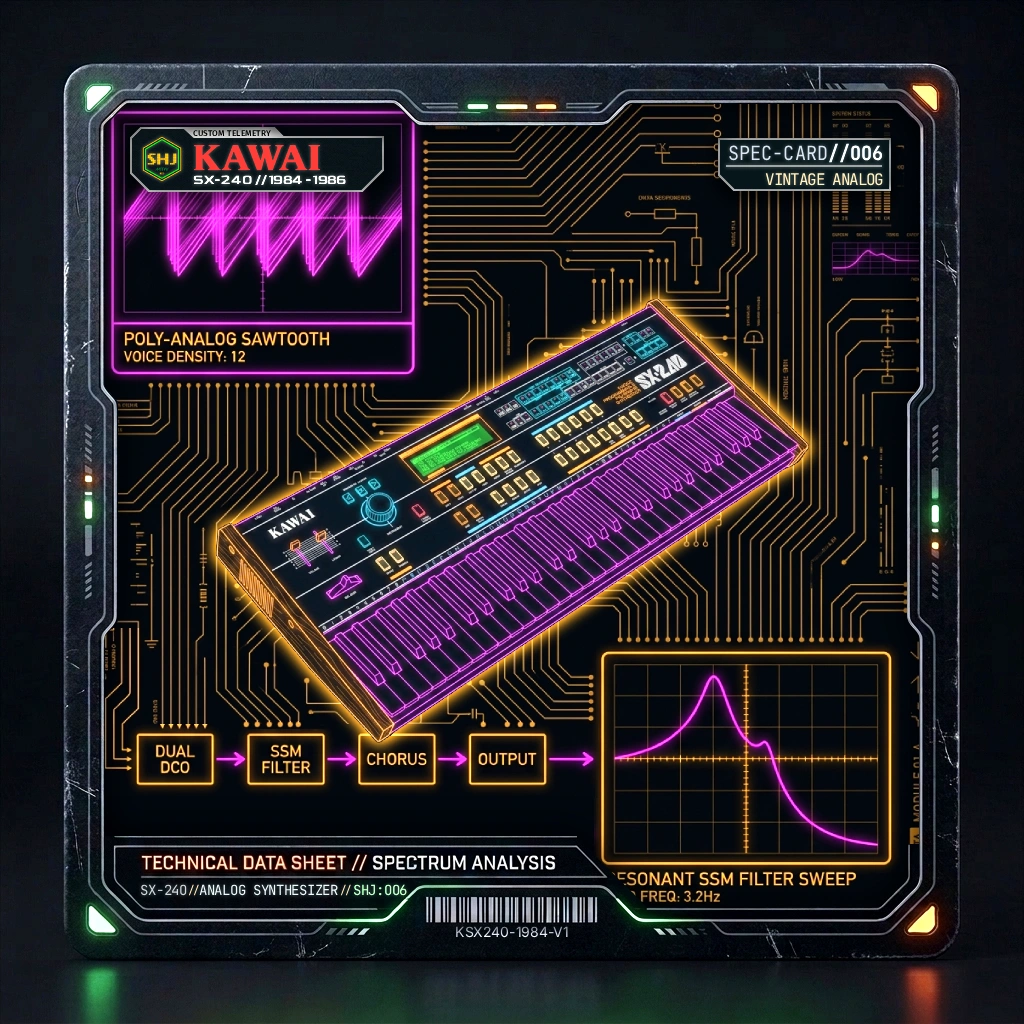
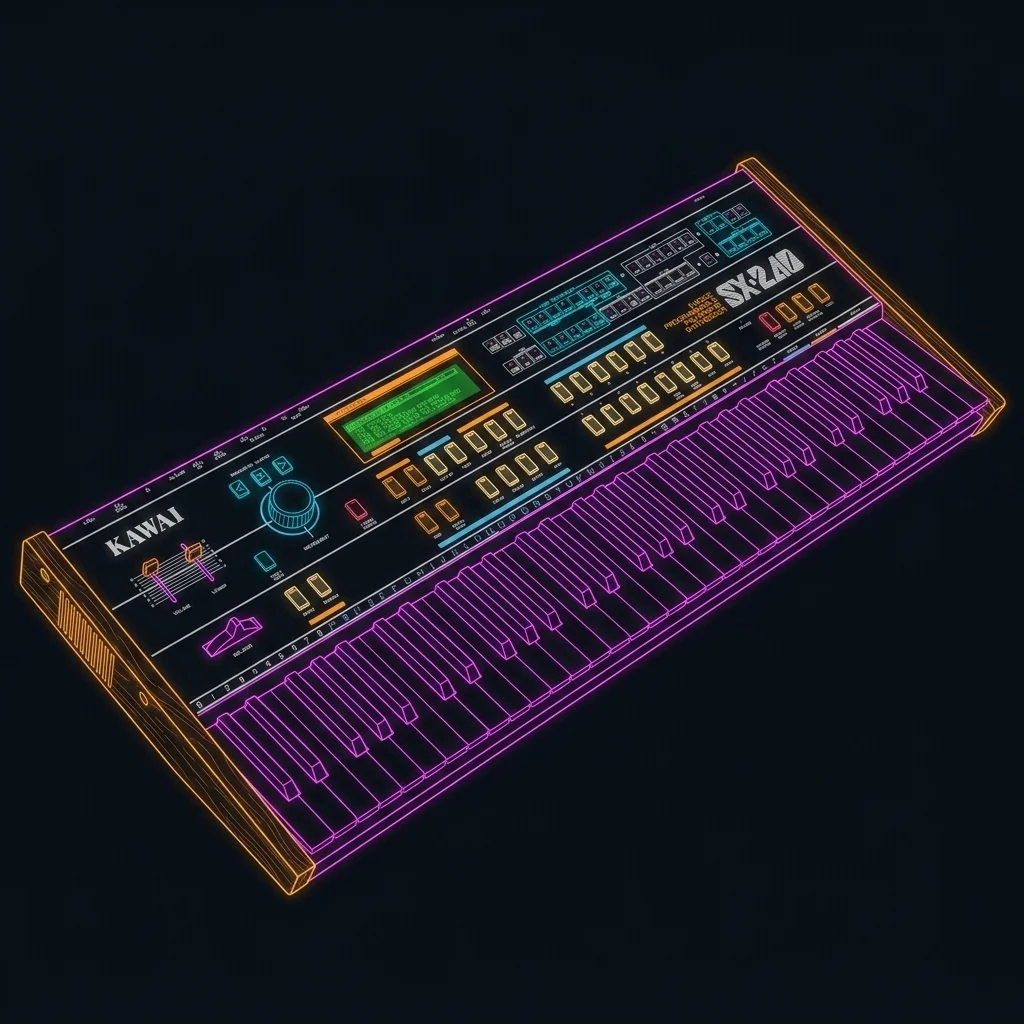
Kawai SX-240: Eight-Voice Dual-DCO Masterpiece of the Mid-Eighties
Unveiled in 1984 under the newly acquired Kawai/Teisco moniker, the Kawai SX-240 emerged at the absolute precipice of the digital synthesizer revolution. While the market’s attention was violently pulled toward the sterile, frequency-modulation-driven landscapes of the Yamaha DX7, the SX-240 quietly stood as one of the most sophisticated subtractive analog polyphonic instruments of its era. Offering eight true voices of dual-DCO synthesis at a time when its direct competitor, the Roland Juno-106, offered only six single-oscillator voices, the SX-240 represents an overlooked pinnacle of Japanese industrial synthesizer design.
The engineering core of the SX-240 is a testament to high-fidelity analog design, relying on eight legendary Solid State Micro Technology SSM2044 4-pole (24dB/octave) low-pass filter integrated circuits. These filters, renowned for their liquid-like, sweet frequency response and musical self-oscillation, are paired with a highly specialized MN3009 bucket-brigade device (BBD) triple-phase chorus circuit that produces a jaw-dropping “Ensemble” effect. Rather than relying on standard voice-allocation designs, the internal microprocessor architectures allow for complex keyboard splits, dual voice layering (forming a lush four-voice, four-DCO layer), and a massive, devastating 24-oscillator unison mono mode.
Kawai SX-240 Sonic Heritage: Pop Culture Icons & Masterclass Tracks

- BT (Brian Transeau): heavily used the Kawai SX-240 and its predecessor the SX-210, for its lush sounds and SSM filters “You can hear the synth in one way or another in almost every song I’ve done. It’s a timeless synth that never gets old”.
- Legowelt (Danny Wolfers): Wolfers is one of the most vocal champions of the Kawai SX-240. He has documented it extensively in his studio manuals, cyber-zines, and sample packs, noting its built-in Ensemble chorus and DCO architecture as central to his tape-saturated, nautical techno pads.
- Biosphere (Geir Jenssen): Geir Jenssen’s signature arctic soundscapes heavily leverage samplers (Akai S1000) and SSM2044-filtered synths (notably Korg Poly-Six / Kawai/Teisco equipment). While the SSM2044 resonance behavior described is technically exact to the SX-240’s filter circuit, frame it as a studio staple alongside his hardware sampling chains rather than an exclusive drone source.
- Jacob Korn: Accurate. Korn has explicitly documented using the SX-240 for dual/split functionality (bass + chord splits) and sampling it to analog tape for release stems and live performances.
- Sébastien Tellier: The SX-240 does not feature a dedicated Ring Modulator; its unique metallic textures stem from its onboard Ring/Glissando LFO modulation over DCOs and high-resonance SSM2044 harmonic ringing.
- The Field (Axel Willner): Willner’s primary workflow on classic albums (From Here We Go Sublime) is famously built around micro-sampling pop/rock vinyl loops in Jeskola Buzz. However, his analog stems and live rigs utilize 8-voice mono-unison DCO synths like the SX-240 for dense single-note foundation hits.
Kawai SX-240 Architecture & Reliability: The Deep Dive
- Features and Architecture: The SX-240 features a dual-oscillator-per-voice configuration that allows for incredible sonic versatility, completely eclipsing the single-oscillator limits of its contemporaries. When operated in Dual Mode, the synthesizer layers two distinct patches across four voices, creating highly complex, evolving textures where the phase relationships of the four independent DCOs beat organically against one another. This signal path runs directly through the SSM2044 filters, which exhibit a highly desirable non-linear behavior; as the resonance is pushed past 95 on the control scale, the filter enters a glass-like, pure sine-wave self-oscillation that can be tracked across the keyboard using the internal key-tracking circuitry.
- Reliability Warning: The single greatest vulnerability of the Kawai SX-240 is the original 3.6V NiCd barrel backup battery situated on the SYN-42 main CPU board. Over decades, these batteries inevitably outgas and leak highly corrosive potassium hydroxide, which creeps along the circuit traces, eating through copper runs and destroying adjacent address decoder chips (such as the 74LS139 and 74LS373) and the primary P8031AH microcontroller. Furthermore, the internal power supply transformer runs significantly hotter when plugged directly into US 120V or EU 230V mains without a step-down transformer, leading to premature thermal stress on the internal voltage regulators and dried-out electrolytic filtering capacitors.
- Present Day Relevance: In a modern production landscape dominated by mathematically perfect, phase-aligned software instruments, the SX-240 introduces crucial analog variance. Because the voice-allocation system relies on discrete hardware voices with slight component tolerance variances, each note triggered has its own unique harmonic micro-profile, envelope speed, and filter cutoff point. This natural timing and tuning jitter creates an acoustic dimensionality that feels physically alive, allowing lead lines, sub-basses, and pads to sit perfectly in a stereo mix without needing artificial saturation or heavy spatial processing.
Kawai SX-240 Technical Resources & Historical Bibliography
As we are building an archive based on technical integrity, I am providing some citations and further reading below.
🎙️ Kawai SX-240 Historical & Journalistic References
On SSM2044 Filter Performance: “The Kawai SX-240 is often said to sit somewhere in between the Polysix and the Juno 6/60 in terms of sound… Any SX-240 owner that understands the full depth and capabilities of this synth treasures it as one of their secret weapons.” – Kawai SX-240 Review via Vintage Synth Explorer
On the SSM Filter Heritage: “The Kawai SX-240 uses eight SSM 2044 filter chips (Polysix, Wave…) which help make up its powerful filter sound… creamy MN3009 triple chorus and you are in string machine heaven.” – Kawai SX-240 Technical Overview via TailOut Audio