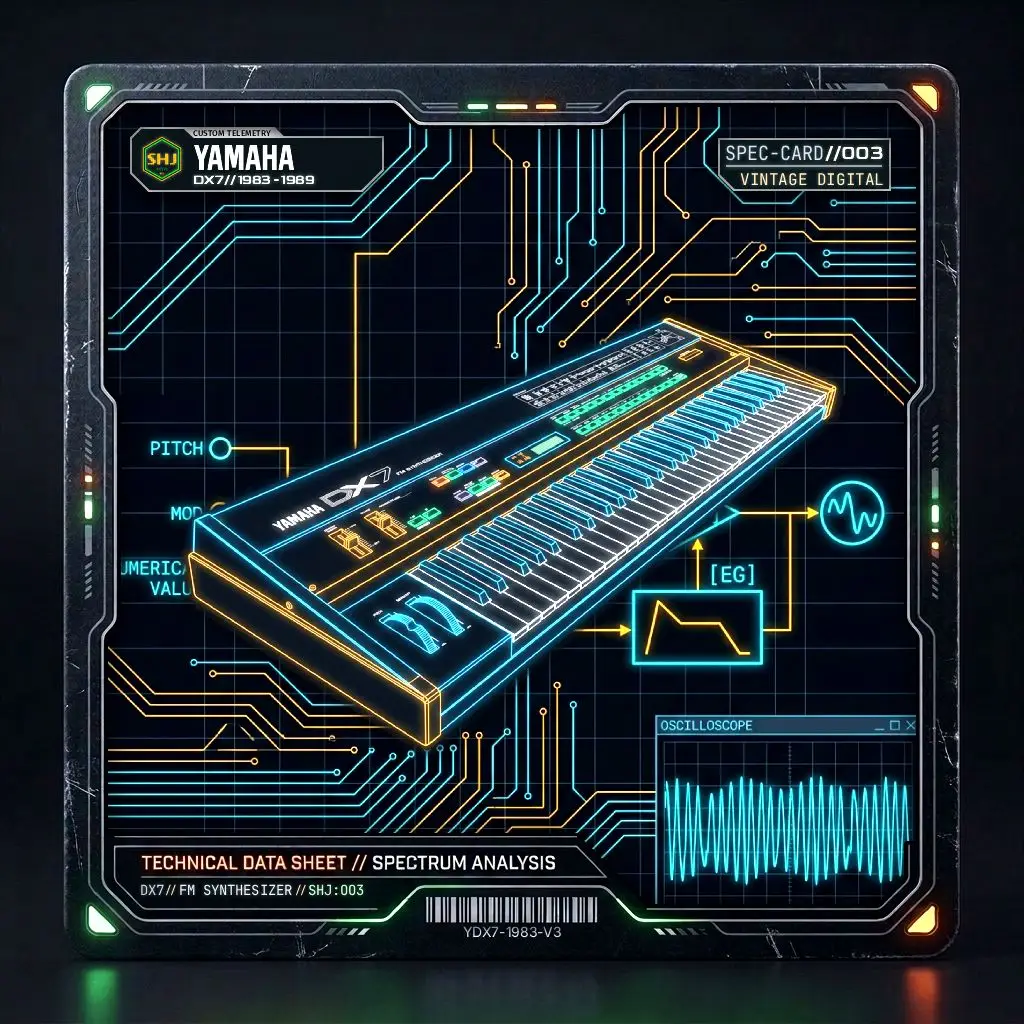
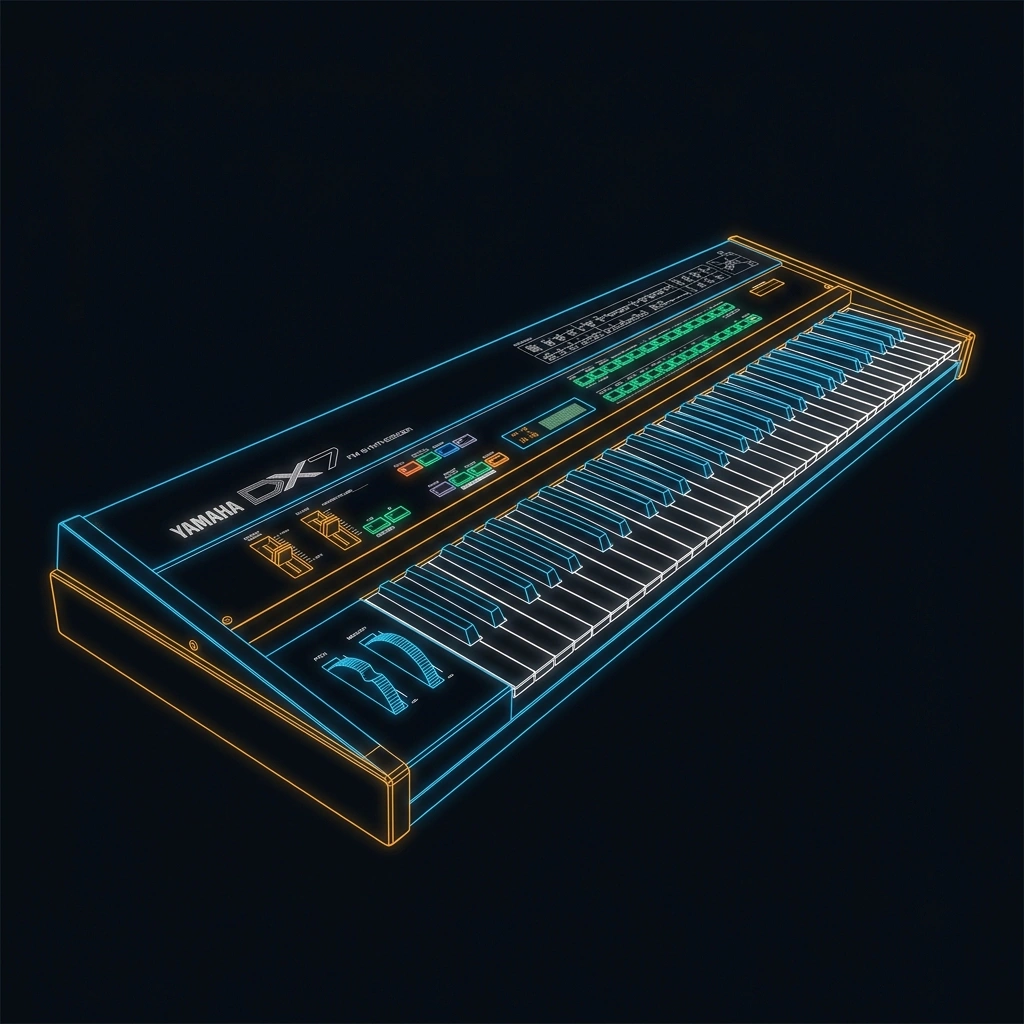
Yamaha DX7 The Glass, the Grit, and the Pure Phase-Modulation Force that Re-Engineered the 1980s Soundscape
Released in 1983, the original Yamaha DX7 (Mark I) did not merely succeed the analog era; it fundamentally disrupted it. While western synthesizers relied on subtractive synthesis utilizing VCOs and low-pass filters to carve away harmonics, Yamaha introduced a highly sophisticated digital architecture based on Phase Modulation (marketed as Frequency Modulation). By utilizing mathematical phase relationships between high-frequency sine-wave oscillators, the DX7 unlocked a whole new landscape of metallic, glassy, percussive, and acoustic-emulative sounds that analog synthesis could never produce, establishing the sonic vocabulary for an entire decade of popular music.
Beneath its brown leatherette-painted steel casing and pristine membrane panel, the DX7‘s digital engine is driven by a custom Hitachi HD63B03XP main processor, running in tandem with two proprietary Yamaha LSI chips: the YM21280 (OPS – Operator Generator) and the YM21290 (EGS – Envelope Generator). The raw digital output of this phase-modulation engine is routed directly into a classic Burr-Brown PCM53JP-V 16-bit digital-to-analog converter (DAC). Because the internal floating-point math of the operators scaling is compressed and truncated before hitting this early DAC, the DX7 exhibits a distinctive, organic digital grit, low-level distortion, and dynamic high-frequency sidebands. This unique combination makes the Mark I sound noticeably wider, dirtier, and more acoustically “alive” than later, more polished 16-bit FM machines.