
ARCHIVE_ONLINE
COMMUNITY_INITIALIZING
AKAI 1988 - 1993 DIGITAL SAMPLERS

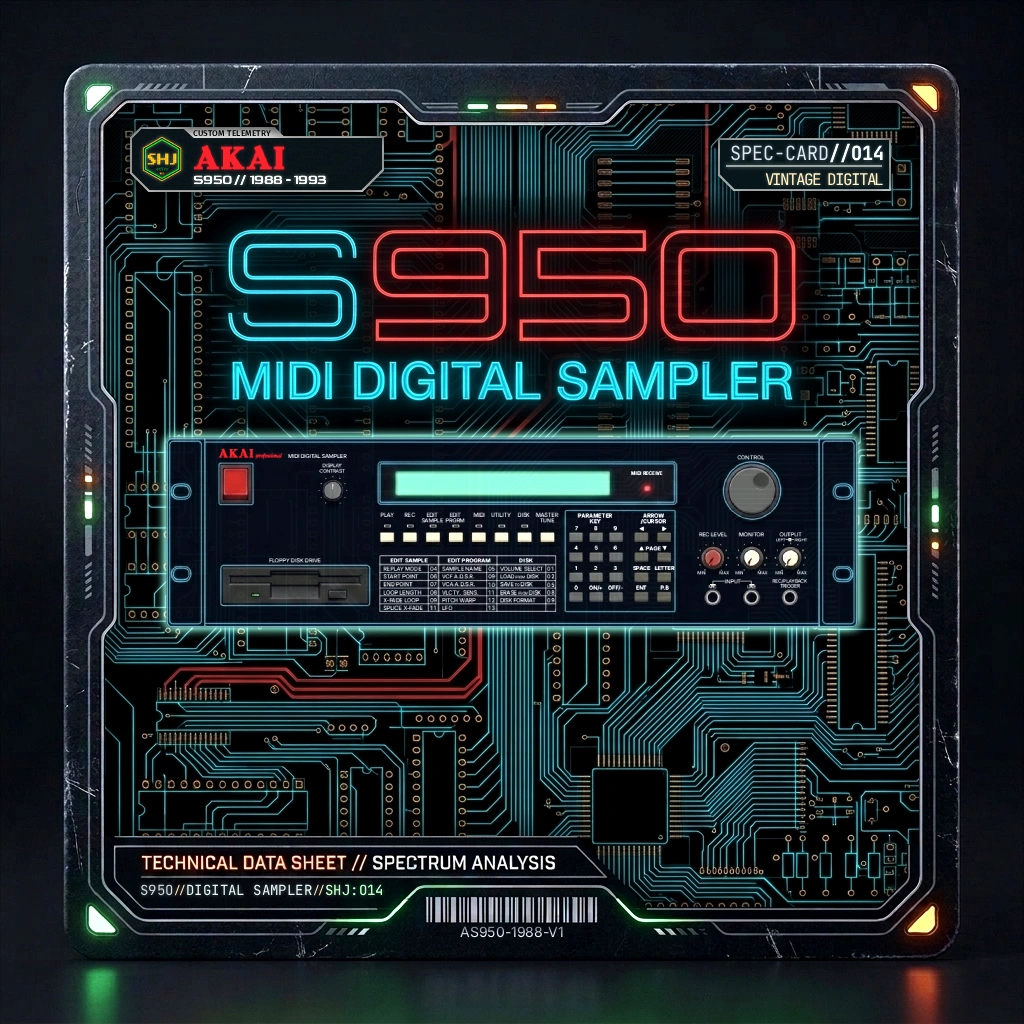
Akai S950

// VINTAGE 12-BIT DIGITAL SAMPLER //
// BE THE FIRST TO LOG IN RACK // BE THE FIRST TO PUT ON RADAR
MANUFACTURER: Akai (Japan)
PRODUCT: Akai S950
RELEASE YEAR: 1988 - 1993
SYNTHESIS ENGINE: 12-bit Linear PCM Digital Sampler
POLYPHONY / VOICES: 8 Voices
LAUNCH PRICING: 248,000 JPY
CURRENT PRICING: $1,000 USD to $1,700 USD

HARDWARE OVERVIEW & HISTORY

The 12-Bit Masterpiece of Jungle and Boom-Bap: Switched-Capacitor Filter Sweeps and the Iconic Timestretch Engine

Released by Akai in Tokyo in 1988, the Akai S950 stands as the undisputed king of 12-bit professional studio samplers: a rugged, over-engineered 3U rackmount powerhouse that permanently transformed the sonic landscape of modern music. Building upon the runaway success of its S900 predecessor, Akai took their flagship 12-bit architecture and supercharged it with an expanded variable sampling range up to 48kHz, expandable RAM capacity up to 2.25MB, an Intel 80186 central processor, and the world’s first hardware-implemented digital timestretch algorithm.

What makes the S950 an immortal studio weapon is the interplay between its conversion stage and its analog filtering. The sampler utilizes a high-precision 12-bit non-interpolated sampling engine paired with Burr-Brown PCM54HP linear digital-to-analog converters. When producers pitched down breakbeats or vinyl chops, the machine imparted a raw, punchy transient snap and mid-frequency crunch that no modern 24-bit DAW can replicate. Crucially, each of its eight individual voice outputs is routed through a discrete National Semiconductor MF6CN-50 6-pole (36dB/octave) switched-capacitor analog low-pass filter, delivering deep, resonant sweeps that roll off high frequencies with unmistakable warmth.

Across the 1990s, the S950 became the definitive engine behind two seismic musical movements. In New York, golden-era hip-hop architects DJ Premier and Pete Rock used its punchy converters to give drum breaks their trademark boom-bap knock. In London, drum and bass pioneers Goldie, Liam Howlett of The Prodigy, and Rob Playford pushed its timestretch algorithm to extreme limits, inventing the metallic, shuttering vocal artifacts and elastic amen breaks that defined jungle. As a physical pillar of music history, the S950 remains an essential hardware cornerstone of electronic and urban music.

SONIC HERITAGE: POP CULTURE ICONS & MASTERCLASS TRACKS

A curated collection of 10 iconic artists, albums, and masterclass tracks showcasing the Akai S950‘s legendary sonic signature, hardware architecture, and cultural impact across music history:

  • DJ Premier (Gang Starr): ‘Mass Appeal’ / ‘Hard to Earn’ (1994 / Chrysalis / EMI)
    The definitive sound of golden-era East Coast boom-bap. DJ Premier sampled jazz vinyl at 45 RPM into the S950 and pitched it down via the Intel 80186 engine, imparting the 12-bit crunch and punchy transient snap that defined hip-hop. (Scratch Magazine, ‘DJ Premier: The SP-1200 & S950 King’ & Sound on Sound).
  • Pete Rock & CL Smooth: ‘They Reminisce Over You (T.R.O.Y.)’ (1992 / Elektra)
    Pete Rock combined the Akai S950 with an SP-1200, leveraging the S950‘s switched-capacitor analog low-pass filters and variable 12-bit sampling rate to capture the iconic Tom Scott saxophone riff with warm low-mid weight. (Wax Poetics Magazine, ‘Pete Rock: Anatomy of a Classic’ & Complex).
  • Goldie: ‘Timeless’ / ‘Timeless’ (1995 / FFRR)
    Drum and bass history was rewritten when Goldie and engineer Rob Playford pushed the S950‘s proprietary hardware timestretch algorithm to extreme settings, creating the metallic, shuddering vocal and time-stretched breakbeat chops that launched jungle into the mainstream. (Sound on Sound Magazine, ‘Rob Playford & Goldie: The Making of Timeless’).
  • The Prodigy (Liam Howlett): ‘Firestarter’ & ‘Smack My Bitch Up’ / ‘The Fat of the Land’ (1997 / XL Recordings)
    Liam Howlett utilized the S950‘s individual outputs and clock-driven analog switched-capacitor filters to chop and sweep breakbeats, driving the audio hot into an analog console for ferocious percussive attack. (Sound on Sound Magazine, ‘Liam Howlett: Producing The Fat of the Land’).
  • Fatboy Slim (Norman Cook): ‘The Rockafeller Skank’ (1998 / Skint Records)
    The iconic, robotic ‘funk soul brother’ vocal stutter was created on the Akai S950, manipulating the rotary data encoder and looping sample start points across the rack unit. (Sound on Sound Magazine, ‘Fatboy Slim: Studio Secrets’).
  • A Guy Called Gerald: ’28 Gun Bad Boy’ (1992 / Juice Box)
    A founding cornerstone of jungle. Gerald Simpson harnessed the S950‘s 12-bit pitch-shifting and National Semiconductor MF6CN-50 filters to morph 808 sub-bass kicks and sped-up funk breaks into rapid-fire sound system artillery. (Attack Magazine, ‘The Roots of Jungle: A Guy Called Gerald’ & Resident Advisor).
  • Portishead (Geoff Barrow): ‘Dummy’ (1994 / Go! Beat)
    Geoff Barrow tracked vinyl samples, drums, and Rhodes piano into the S950 at reduced sample rates (down to 10kHz to 12kHz), exploiting the 12-bit quantization noise and analog filter roll-off for unmistakable Bristol trip-hop grit. (Sound on Sound Magazine, ‘Geoff Barrow: The Making of Portishead’s Dummy’).
  • Roni Size / Reprazent: ‘Brown Paper Bag’ / ‘New Forms’ (1997 / Talkin’ Loud / Mercury)
    The Mercury Prize-winning drum and bass masterpiece deployed the S950 for seamless double-bass slice mapping and signature high-frequency timestretch artifacts on vocal phrases. (Future Music Magazine, ‘Roni Size: The New Forms Sessions’).
  • Dr. Dre (Snoop Doggy Dogg): ‘Gin and Juice’ / ‘Doggystyle’ (1993 / Death Row / Interscope)
    Dr. Dre and Colin Wolfe used the Akai S950 for punchy drum sample playback and percussion layering, utilizing the individual outputs to process each drum voice through discrete analog outboard EQ and compression. (Keyboard Magazine, ‘The Production Architecture of G-Funk’).
  • LTJ Bukem: ‘Demon’s Theme’ / ‘Logical Progression’ (1992 / 1996 / Good Looking Records)
    The birth of intelligent drum and bass. LTJ Bukem used the S950 to time-stretch lush ambient Rhodes chords and airy vocal sweeps over crisp amen breaks, setting the standard for atmospheric jungle. (Sound on Sound Magazine, ‘LTJ Bukem & The Good Looking Sound’).

ARCHITECTURE & RELIABILITY: THE DEEP DIVE

Features and Architecture: The S950 is powered by an Intel 80186 16-bit microprocessor running at 8MHz, managing an 8-voice polyphonic architecture with dynamic voice allocation. Sampling rates are continuously variable from 7.5kHz to 48kHz, allowing sound designers to intentionally drop the sample rate to capture vintage lo-fi crunch and extend memory time. Each voice features a discrete National Semiconductor MF6CN-50 6-pole switched-capacitor analog low-pass filter with envelope and velocity modulation. The machine also introduced Akai’s pioneering hardware timestretching algorithm, allowing sample lengths to be stretched or compressed independently of pitch.

Reliability Warning: The most common failure points on vintage S950 units involve the front-panel optical rotary encoder, which accumulates dust and oxidized lubricant, causing data values to jump unpredictably. The original 40 x 2 character backlit LCD display frequently dims to near-total illegibility due to failing EL backlights. Internally, the 35W linear power supply operates hot inside the 3U enclosure, leading to dried-out electrolytic capacitors that cause audible 50/60Hz ground hum on the 8 individual outputs. Floppy drive drive belts and read heads also require regular maintenance.

Present Day Relevance: Modern DAW plugins offer pristine, mathematically perfect pitch-shifting, but they completely lack the punchy harmonic distortion, transient weight, and aggressive 12-bit character of the S950. The raw sonic impact of running drums through its analog preamps, pitching down 12-bit samples, and sweeping its switched-capacitor filters creates an immediate, cohesive mix presence that plug-ins cannot match. It remains an irreplaceable studio staple for hip-hop, jungle, house, and industrial producers.

TECHNICAL RESOURCES & HISTORICAL BIBLIOGRAPHY

🎙️ Historical & Journalistic References

On 12-Bit Sonic Punch: “The Akai S950 is not just a sampler: it is an acoustic instrument. Its 12-bit converters and analog switched-capacitor filters give drums a punch and presence that modern 24-bit samplers cannot duplicate.” (Sound on Sound Magazine, ‘Classic Samplers: The Akai S950’).

On Timestretch History: “The extreme timestretching algorithms of the S950 literally created the sound of 90s jungle and UK breakbeat hardcore, transforming vocal clips into metallic, alien textures.” (Attack Magazine, ‘The Gear That Built Drum & Bass’).

MASTER TECHNICAL SPECIFICATION SHEET

🎛️ 1. ENGINE & SIGNAL PATH

Synthesis Engine: 12-bit linear PCM digital sampler with variable sampling frequencies (7.5kHz to 48kHz), hardware switched-capacitor low-pass filters per voice, and proprietary hardware timestretching DSP algorithms
Polyphony / Voices: 8 voice polyphony with full dynamic voice allocation across multi-samples; stereo mix outputs plus 8 dedicated assignable individual voice outputs
Oscillators: N/A
Filters: 8 discrete 6-pole (36dB/octave) analog switched-capacitor low-pass filter ICs (National Semiconductor MF6CN-50) per voice channel, clock-controlled with real-time envelope tracking and velocity sensitivity
Envelopes: 2 digital multi-stage envelope generators per voice: Envelope 1 (assignable to Pitch and Switched-Capacitor Filter Cutoff with Rate and Level parameters) and Envelope 2 (dedicated VCA Amplitude ADSR envelope)
Modulation: 1 assignable multi-waveform LFO per voice (Sine, Triangle, Square, Sawtooth, Random) with adjustable speed, delay, and depth routable to pitch vibrato and filter cutoff

🧩 2. HARDWARE & INTERFACE

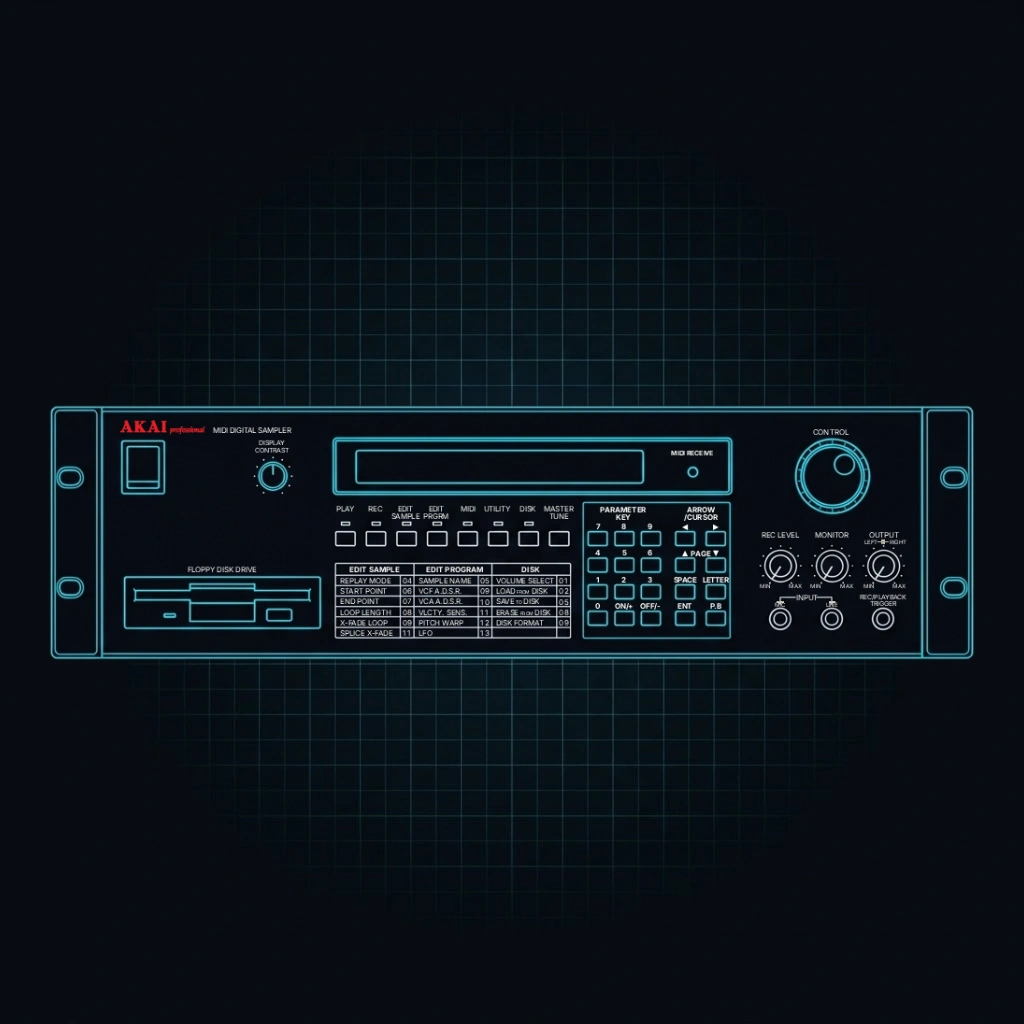
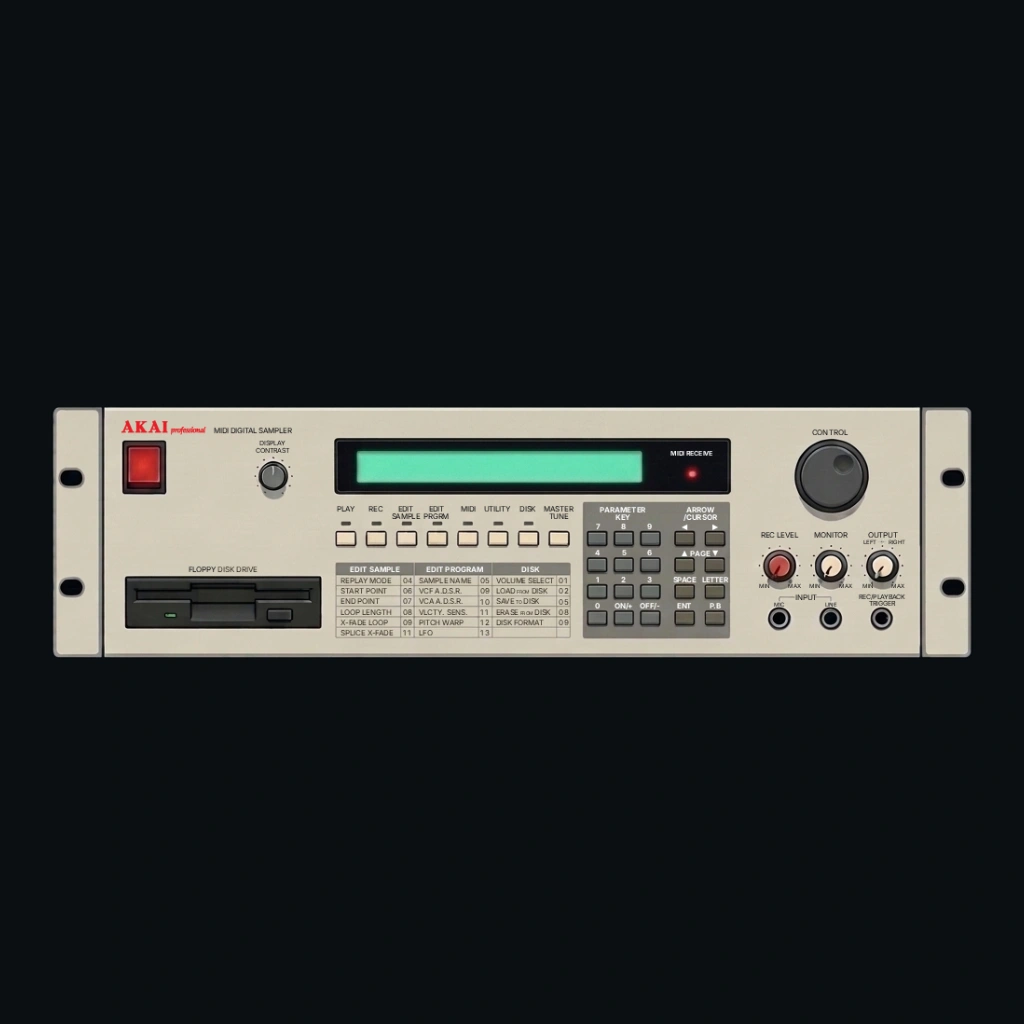
KEYBED / PANEL: 19" 3U Standard Rackmount Chassis; 40 x 2 character high-contrast backlit LCD display with contrast trimmer; 10-key numeric input matrix, optical continuous rotary data encoder; 8 individual voice LED activity indicators (No Keybed)
MICROPROCESSORS: Intel 80186 16-bit microprocessor @ 8MHz system CPU; 8 x National Semiconductor MF6CN-50 switched-capacitor filter ICs; Burr-Brown PCM54HP 16-bit linear DAC (trimmed for 12-bit audio conversion); Akai proprietary sampling LSI gate arrays
PATCH MEMORY: 750KB stock DRAM (expandable to 2.25MB maximum via two proprietary Akai EXM006 memory expansion cards); onboard 3.5" 2DD/2HD floppy disk drive (Akai S900 / S950 and MS-DOS compatible format)
PERFORMANCE CTRL: Optical rotary data jog wheel, dual concentric Rec Level and Rec Monitor input attenuators, 10-key numeric keypad, Page Up / Down navigation buttons, 8 voice activity LEDs

🔌 3. I/O & PHYSICAL SPECIFICATIONS

SYNC & I/O: 5-pin DIN MIDI In / Out / Thru; 8 x Individual Voice Audio Outputs (1/4" TS); Master Stereo L / R Audio Outputs (1/4" TS); 1/4" TS Mono Audio Input (front and rear); 1/4" TS Rec Footswitch Jack; Optional IB-105 Hard Disk SCSI Interface; Optional IB-109 Digital Audio Interface (S/PDIF Optical / Coaxial)
SIGNAL PROCESSOR: N/A
POWER VOLTAGE: Native Japanese Domestic Market (JDM) 100V AC, 50/60Hz, 35W power consumption (internal linear power supply transformer)
WEIGHT (KG): 9.8 kg (21.6 lbs)
LAUNCH PRICING: 248,000 JPY
CURRENT PRICING: $1,000 USD to $1,700 USD

JOIN THE SYNTH HUNTER JAPAN COMMUNITY

Click the link below to register your email and start receiving our weekly newsletter, feature annoucements, and more.

DIAGNOSTIC_OSCILLOSCOPE_SCAN_v1.02 // MODE: SYSTEM_SCANNING