ARCHIVE_ONLINE
COMMUNITY_INITIALIZING
ROLAND 1984 - 1988 ANALOG SYNTHESIZERS

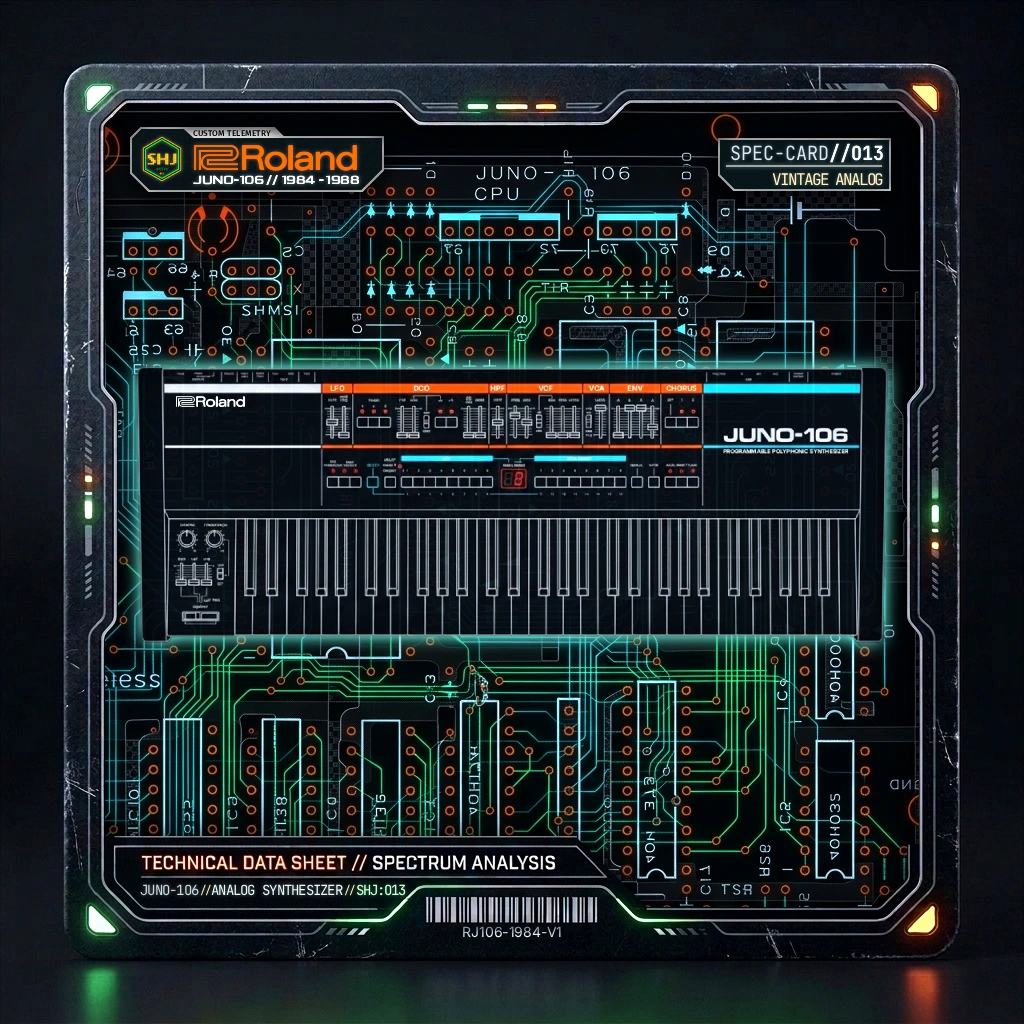
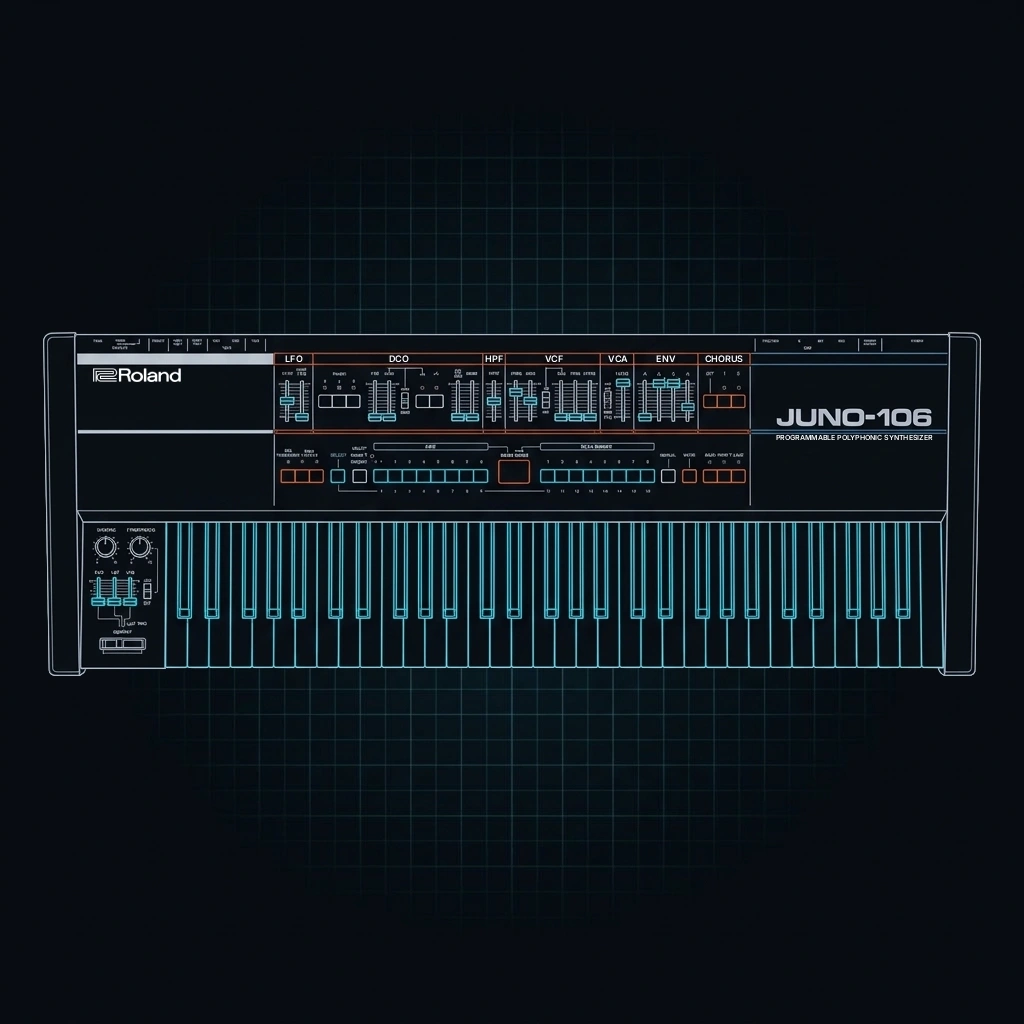
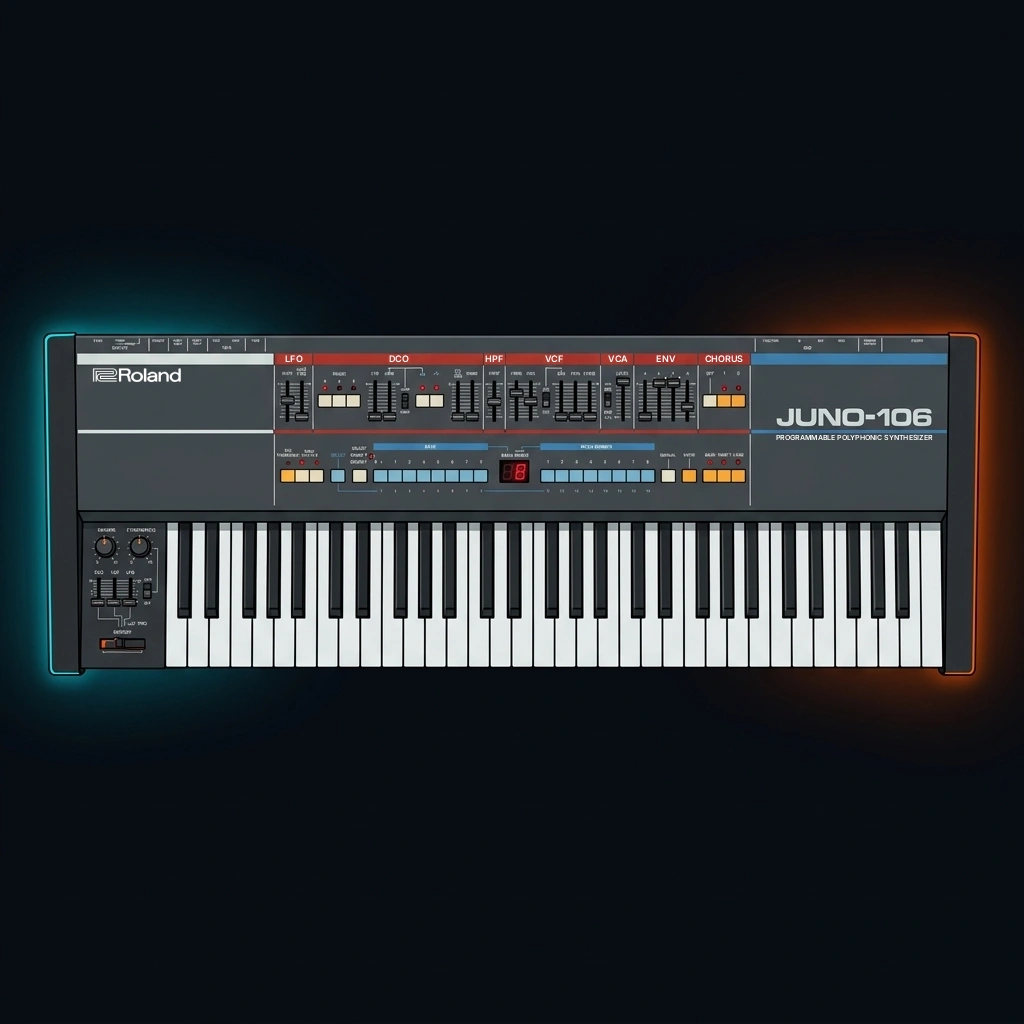
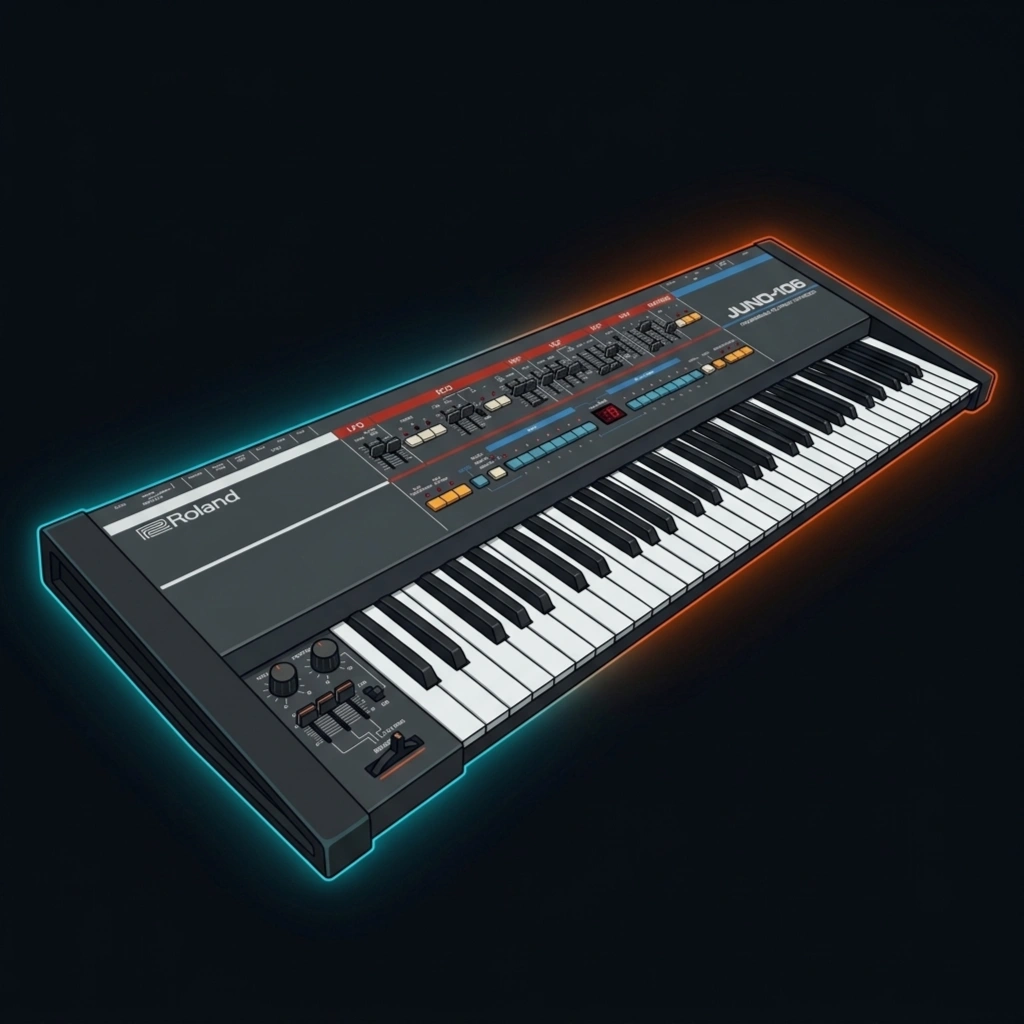
Roland Juno-106

// VINTAGE ANALOG SYNTHESIZER //
// BE THE FIRST TO LOG IN RACK // BE THE FIRST TO PUT ON RADAR
MANUFACTURER: Roland (Japan)
PRODUCT: Roland Juno-106
RELEASE YEAR: 1984 - 1988
SYNTHESIS ENGINE: Polyphonic Analog Synthesizer
POLYPHONY / VOICES: 6 Voices
LAUNCH PRICING: 139,000 JPY
CURRENT PRICING: $2,200 USD to $3,800 USD

HARDWARE OVERVIEW & HISTORY

The Quintessential Poly-Synth of the MIDI Era: Pure Analog Warmth, Tactile Slider Architecture, and the Immortal Stereo BBD Chorus

Introduced by Roland in Tokyo in 1984, the Roland Juno-106 stands as one of the most beloved, commercially successful, and musically influential analog polyphonic synthesizers ever conceived. Arriving as the third iteration of the storied Juno dynasty, the 106 perfected the formula: combining the warmth and raw power of genuine analog synthesis with rock-solid digital pitch stability and complete, bidirectional MIDI implementation. In doing so, Roland provided musicians with an affordable, ultra-reliable poly-synth that could integrate seamlessly into the emerging digital studio environments of the mid-1980s.

At the heart of the Juno-106‘s sonic dominance is its hybrid architecture: six digitally controlled analog oscillators (Roland MC55344 hybrid DCO modules) driving six discrete 24dB/octave resonant low-pass filters and analog VCAs (Roland 80017A hybrid ICs). With one tactile slider per parameter, the instrument eliminated tedious menu-diving in favor of pure, immediate physical sound sculpting. To elevate its single-oscillator-per-voice design into a massive stereo soundstage, Roland integrated their legendary dual-mode analog Bucket Brigade Device (BBD) stereo chorus circuit, instantly transforming dry basses and leads into lush, swirling polyphonic textures.

From the moment of its release, the Juno-106 became an indispensable acoustic anchor across global music production. In Chicago, house music pioneers Frankie Knuckles and Larry Heard weaponized its punchy sub-oscillator basslines and warm chord stabs to define the genre. In the UK and Europe, electronic visionaries from Daft Punk and The Chemical Brothers to Depeche Mode made the Juno-106 a studio cornerstone. As a physical pillar of music history, its warm, buttery pads, punchy plucks, and singing resonance have graced tens of thousands of hit records spanning four decades.

SONIC HERITAGE: POP CULTURE ICONS & MASTERCLASS TRACKS

A curated collection of 10 iconic artists, albums, and masterclass tracks showcasing the Roland Juno-106‘s legendary sonic signature, hardware architecture, and cultural impact across music history:

  • Frankie Knuckles (with Satoshi Tomiie): ‘Tears’ (1989 / FFRR)
    The foundational blueprint of deep house. Anchored by the Juno-106‘s lush, resonant 80017A low-pass filter sweeps, smooth analog bassline, and swirling stereo BBD chorus on the chord stabs. (Attack Magazine, ‘Classic Tracks: Frankie Knuckles & Satoshi Tomiie – Tears’ & Sound on Sound).
  • Larry Heard (Mr. Fingers): ‘Can You Feel It’ (1986 / Trax Records)
    The undisputed anthem of Chicago deep house. Larry Heard layered the Juno-106‘s warm, sub-oscillator-reinforced DCO bass with shimmering, chorus-widened polyphonic pad chords. (Resident Advisor, ‘The Making of Larry Heard’s Deep House Masterpiece’).
  • Daft Punk: ‘Rollin’ & Scratchin” / ‘Homework’ (1997 / Virgin Records)
    Thomas Bangalter and Guy-Manuel de Homem-Christo engaged the Juno-106‘s Solo Unison mode, cranking the 80017A VCF resonance into aggressive self-oscillation and driving the line inputs into mixer saturation. (Sound on Sound Magazine, ‘Daft Punk: The Homework Production Setup’).
  • The Chemical Brothers: ‘Block Rockin’ Beats’ / ‘Dig Your Own Hole’ (1997 / Freestyle Dust / Virgin)
    The iconic, screaming pitch-bent sirens and filter sweeps throughout the track were tracked directly from a Roland Juno-106 using the bender lever and real-time faders. (Keyboard Magazine, ‘The Chemical Brothers: Studio Gear Breakdown’).
  • Depeche Mode: ‘Black Celebration’ & ‘Music for the Masses’ (1986 / 1987 / Mute Records)
    Alan Wilder and producer Gareth Jones utilized the Juno-106 for subterranean analog bass sequences and dark, chorused string poly-patches tracked through Roland Dimension D and plate reverbs. (Sound on Sound Magazine, ‘Alan Wilder: Programming Depeche Mode’).
  • Tame Impala (Kevin Parker): ‘The Less I Know The Better’ / ‘Currents’ (2015 / Modular / Interscope)
    Kevin Parker’s signature psychedelic dream-pop synth tones are anchored by the Juno-106, using its DCO pulse-width modulation and Chorus II setting for warm, warbling keyboard progressions. (Reverb.com Studio Feature, ‘The Gear Behind Tame Impala’s Currents’ & Pitchfork).
  • Autechre (Sean Booth & Rob Brown): ‘Basscadet’ / ‘Incunabula’ (1993 / Warp Records)
    Early Autechre relied heavily on the Juno-106 for rubbery, resonant basslines and melodic counterpoint, modulated via real-time SysEx control. (Future Music Magazine, ‘Autechre: Early Sheffield Works’).
  • Fatboy Slim (Norman Cook): ‘Praise You’ / ‘You’ve Come a Long Way, Baby’ (1998 / Skint Records)
    Norman Cook tracked the Juno-106 for rising brass-like pad stabs and sustained chord textures that tied together the sampled piano and vocal loops. (Sound on Sound Magazine, ‘Norman Cook: Producing You’ve Come a Long Way, Baby’).
  • Chvrches: ‘The Mother We Share’ / ‘The Bones of What You Believe’ (2013 / Virgin / Goodbye Records)
    Martin Doherty and Iain Cook constructed their driving synth-pop aesthetic around vintage analog gear, featuring the Juno-106 as the primary engine for lead synth riffs and polyphonic arpeggios. (Sound on Sound Magazine, ‘Chvrches: In The Studio’).
  • Moby: ‘Go’ (1991 / Outer Rhythm / Instinct)
    Combining the Twin Peaks Laura Palmer motif with the Juno-106‘s soaring, resonant low-pass filter sweeps and wide BBD ensemble chorus, creating one of the earliest global rave crossover anthems. (Electronic Musician Magazine, ‘Moby: Building the Early Classics’).

ARCHITECTURE & RELIABILITY: THE DEEP DIVE

Features and Architecture: The Juno-106 features 6 voices of polyphony driven by digitally controlled oscillators (DCOs). While the pitch is clocked by microprocessors for rock-solid tuning stability, the wave generators produce true analog sawtooth and pulse waveforms with manual and LFO-driven pulse-width modulation. A dedicated square-wave sub-oscillator reinforces the low frequencies, while pink noise adds percussive grit. Each voice passes through Roland‘s legendary 80017A hybrid module, housing an IR3109-based 24dB/octave resonant low-pass filter and BA662-based VCA. The signal then enters a 4-position high-pass filter with bass boost and the iconic analog stereo BBD chorus circuit (MN3009 delay lines).

Reliability Warning: The single most notorious failure point on the Juno-106 is the black protective coating on the six Roland 80017A voice modules. Over decades, this resin coating becomes semi-conductive, bridging microscopic traces and causing voice crackling, DC offset drifting, voice dropouts, and perpetual resonance whistling. Additionally, the soldered-in 3V CR2032 memory battery will eventually deplete, resulting in complete patch memory loss. The front-panel linear sliders are also prone to dust contamination, causing parameter jumping, while the internal linear power supply capacitors degrade from heat.

Present Day Relevance: While countless software emulations exist, they struggle at times to truly captures the organic physical presence, raw bottom-end punch, and three-dimensional stereo spread of a fully restored Roland Juno-106. The immediate physical hands-on joy of moving its tactile sliders and shaping a patch in real-time remains unmatched. It remains one of the gold standard for warm analog bass, luscious house chord progressions, and shimmering synth-pop pads.

TECHNICAL RESOURCES & HISTORICAL BIBLIOGRAPHY

🎙️ Historical & Journalistic References

On Analog Accessibility: “The Juno-106 strikes the perfect balance between raw analog warmth and bulletproof usability. With one slider per function and full MIDI, it remains the ultimate hands-on poly-synth.” (Sound on Sound Magazine, ‘Roland Juno Series Retrospective’).

On Club Culture Impact: “Without the Juno-106, house and techno music would simply not sound the same. Its basslines and lush chorus defined the underground sound from Chicago to Berlin.” (Attack Magazine, ‘Synthesizers That Shaped Dance Music’).

MASTER TECHNICAL SPECIFICATION SHEET

🎛️ 1. ENGINE & SIGNAL PATH

Synthesis Engine: 6-voice polyphonic analog synthesizer driven by digitally controlled analog oscillators (DCOs), discrete analog filters, and analog VCAs with onboard analog stereo bucket brigade (BBD) chorus
Polyphony / Voices: 6 voices with selectable Poly 1 (standard polyphonic assignment), Poly 2 (mono-priority round-robin), and Solo Unison mode (all 6 voices stacked monophonically)
Oscillators: 6 Digitally Controlled Oscillators (Roland MC55344 hybrid DCO wave generator modules) outputting Sawtooth, Variable Pulse / Square with Manual and LFO Pulse Width Modulation (PWM), dedicated square-wave Sub-Oscillator (-1 octave), and pink Noise generator
Filters: 6 discrete 24dB/octave (4-pole) resonant low-pass filters (Roland 80017A hybrid ICs containing IR3109 VCF and BA662 VCA stages) with self-oscillation capability, keyboard tracking (0 to 100%), and 4-position stepped high-pass filter (HPF 0, 1, 2, 3 with bass boost)
Envelopes: 1 hardware analog ADSR envelope generator per voice (software micro-calculated via Intel 8051 CPU feeding 80017A modules) assignable to VCF cutoff and VCA level (switchable between ENV and Gate)
Modulation: 1 multi-waveform analog LFO (Triangle, Sine) with programmable rate and delay time, routable to DCO pitch vibrato, DCO pulse width, and VCF cutoff

🧩 2. HARDWARE & INTERFACE

KEYBED / PANEL: 61-note full-size C-scale keybed (unweighted, no velocity or aftertouch); 2-digit 7-segment red LED patch display; 16 patch bank selector buttons; 16 tactile linear faders for 1:1 real-time physical programming
MICROPROCESSORS: Intel 8051 8-bit main control CPU (NEC uPD8051C / Roland custom mask); Intel 8049 secondary sub-CPU for keybed scanning; 6 x Roland 80017A custom hybrid VCF/VCA modules; 3 x Roland MC55344 DCO custom hybrid ICs; dual Panasonic MN3009 256-stage BBD delay lines with MN3101 clock drivers for analog stereo chorus
PATCH MEMORY: 128 user-programmable patch memory locations (arranged in two groups of 8 banks x 8 patches), battery-backed static CMOS RAM with rear cassette tape interface for data storage
PERFORMANCE CTRL: Roland combination Pitch Bend and LFO Modulation bender lever; Portamento / Glide with variable rate; Key Transpose button; 3-mode analog stereo Chorus switch (Off, Chorus I, Chorus II, Chorus I+II); Master Volume and Tuning knobs

🔌 3. I/O & PHYSICAL SPECIFICATIONS

SYNC & I/O: Standard 5-pin DIN MIDI In / Out / Thru with real-time SysEx fader telemetry (switchable MIDI function 1/2/3); 1/4" TS Unbalanced Audio Outputs (L/Mono, R); 1/4" Stereo Headphone Jack; 1/4" TS Patch Shift Pedal Jack; 1/4" TS Hold / Sustain Pedal Jack; Tape Memory Interface In / Out (1/4" TS)
SIGNAL PROCESSOR: N/A
POWER VOLTAGE: Native Japanese Domestic Market (JDM) 100V AC, 50/60Hz, 25W power consumption (internal linear power supply transformer)
WEIGHT (KG): 10.0 kg (22.0 lbs)
LAUNCH PRICING: 139,000 JPY
CURRENT PRICING: $2,200 USD to $3,800 USD

JOIN THE SYNTH HUNTER JAPAN COMMUNITY

Click the link below to register your email and start receiving our weekly newsletter, feature annoucements, and more.

DIAGNOSTIC_OSCILLOSCOPE_SCAN_v1.02 // MODE: SYSTEM_SCANNING