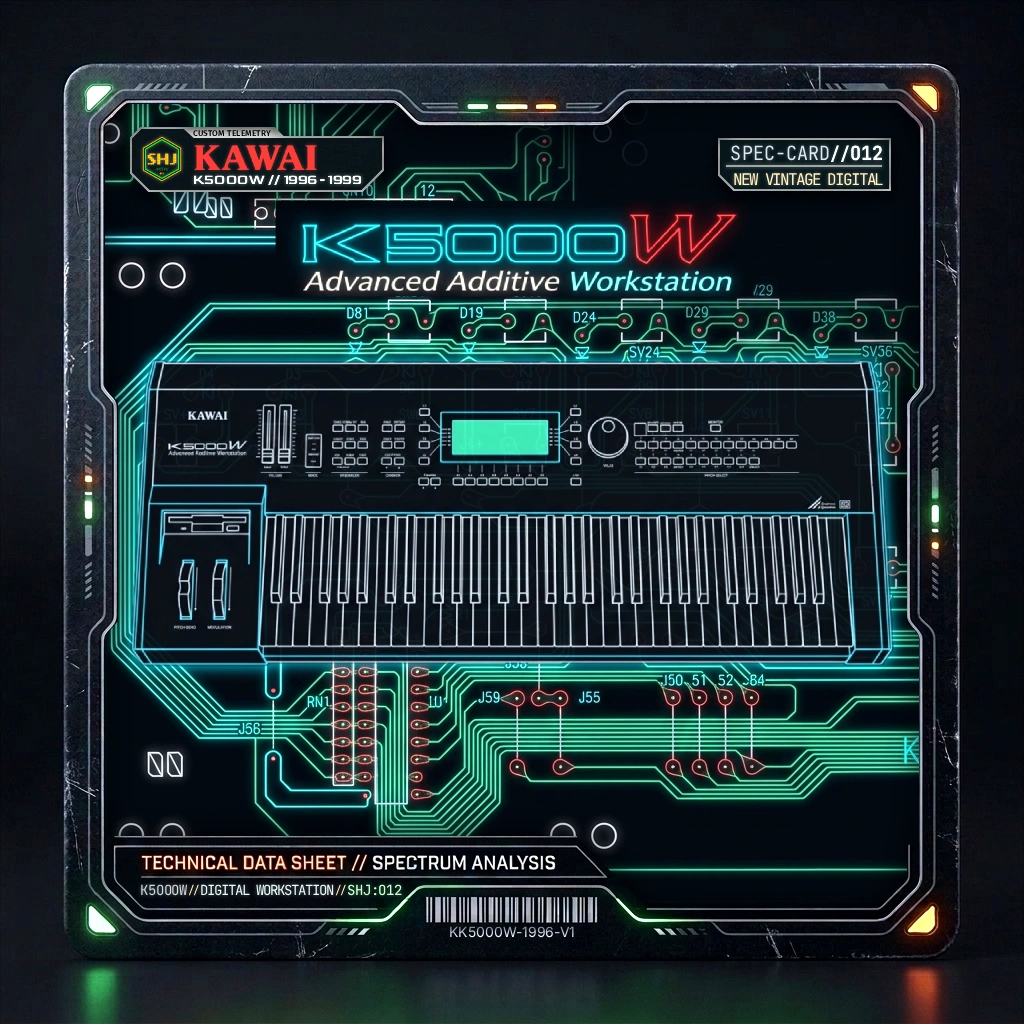
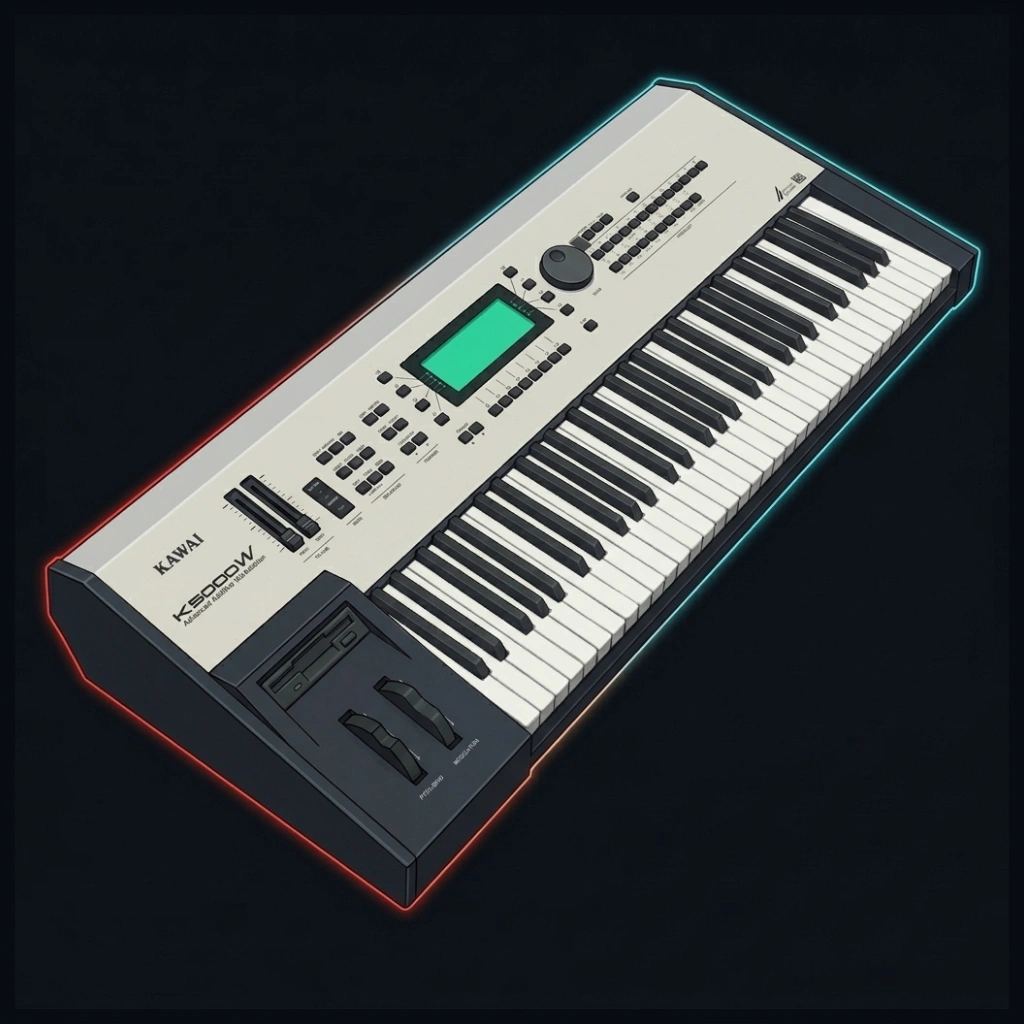

The Advanced Additive Monolith Workstation: 128-Band Formant Filtering & Biomechanical Synthesizer Masterpiece
Unveiled by Kawai in Hamamatsu in 1996, the Kawai K5000 stands as the absolute zenith of hardware additive synthesis: a bold, unapologetic digital titan engineered at a moment when the global synthesizer industry was completely fixated on generic, disposable sample-playback workstations. Rather than taking the easy road of static PCM romplers, Kawai’s acoustic research laboratories committed massive DSP processing power to real-time spectral generation, creating a machine that generates sound from its purest mathematical components: harmonic sine waves calculated and animated in real-time.
Beneath its sleek, dark graphite steel chassis, the K5000 is powered by an advanced 16-bit NEC V53 central microprocessor working in tandem with custom Kawai ADD-LSI real-time additive math ASICs and dual audiophile-grade Burr-Brown PCM1702 20-bit digital-to-analog converters. Each of the instrument’s multi-source voices can stack up to 128 individual harmonic sine waves via high-speed Inverse Discrete Fourier Transform algorithms, routed through an astonishing 128-band dynamic formant filter. This dedicated formant architecture allows producers to morph spectral resonant peaks across time, generating vocal chorales, metallic bells, and biomechanical textures that possess uncanny acoustic realism and infinite harmonic depth.
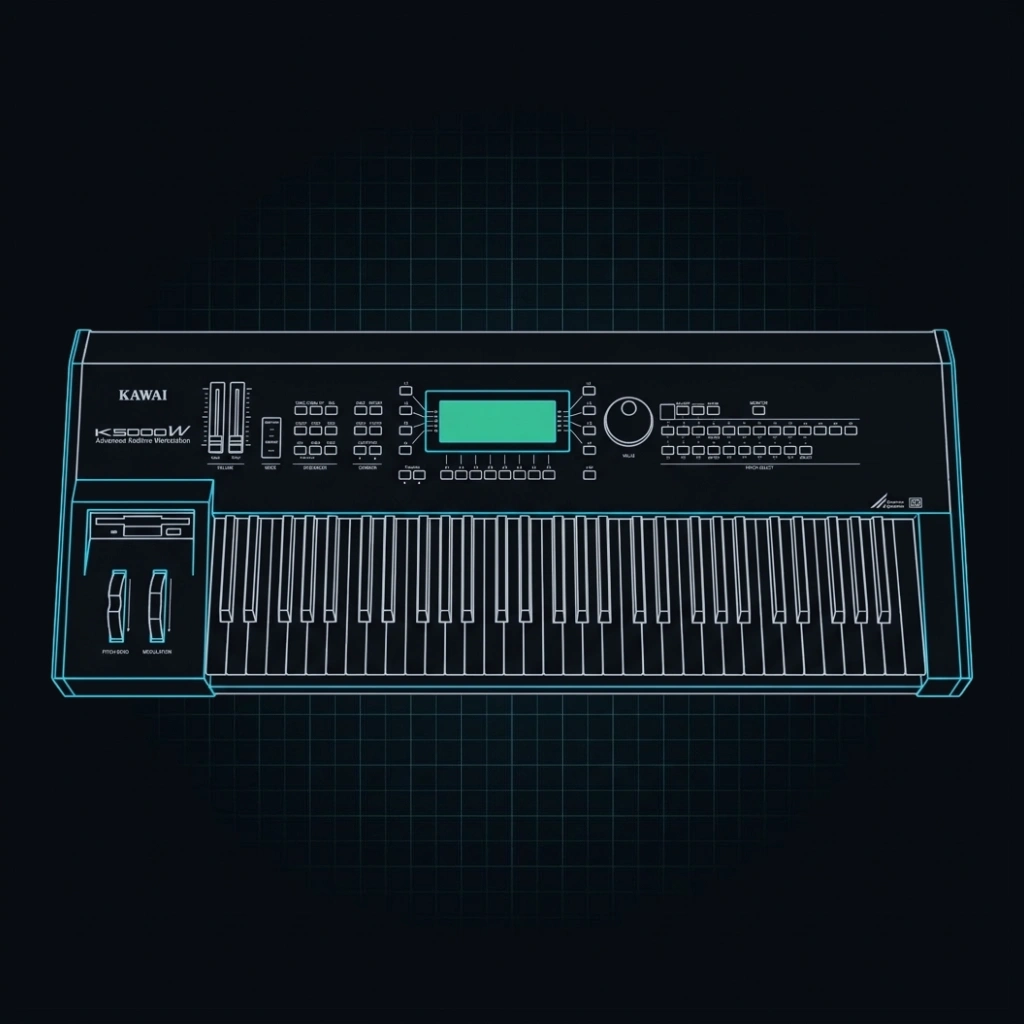
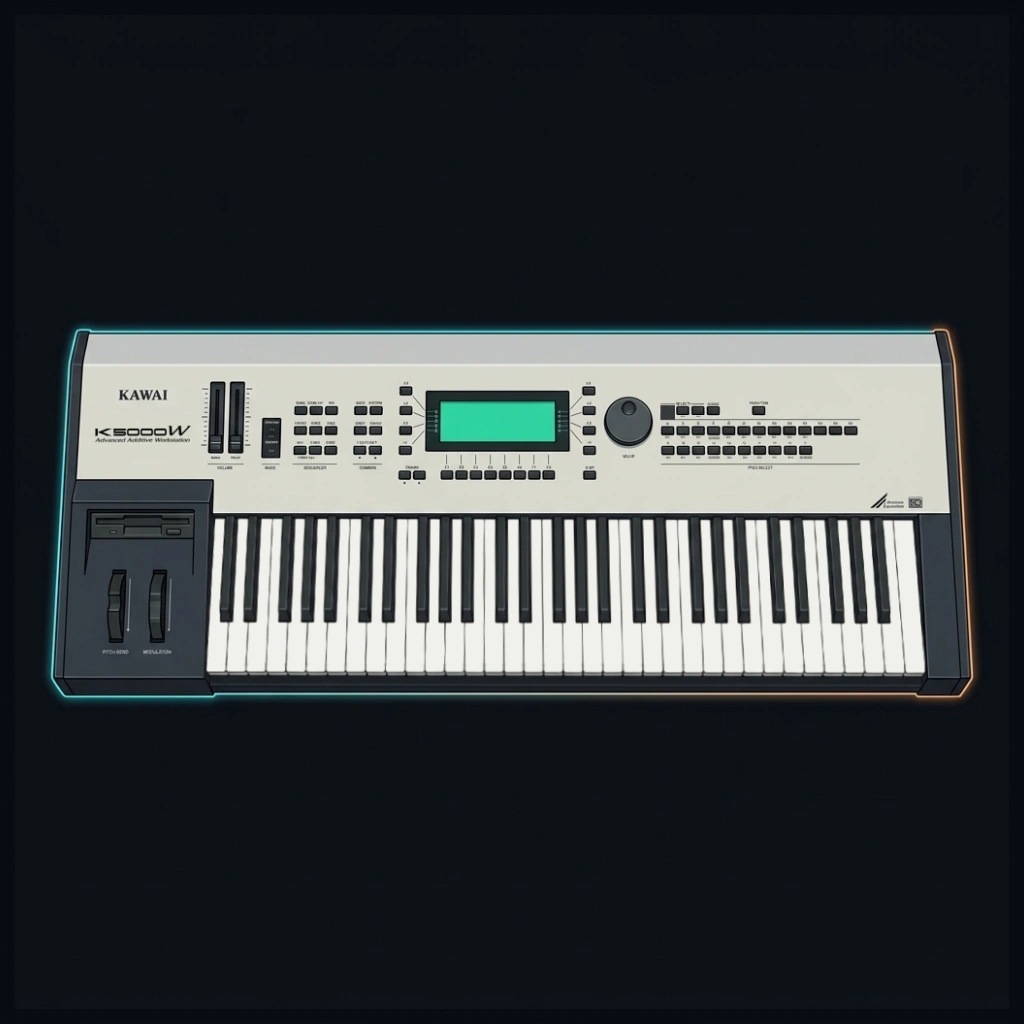
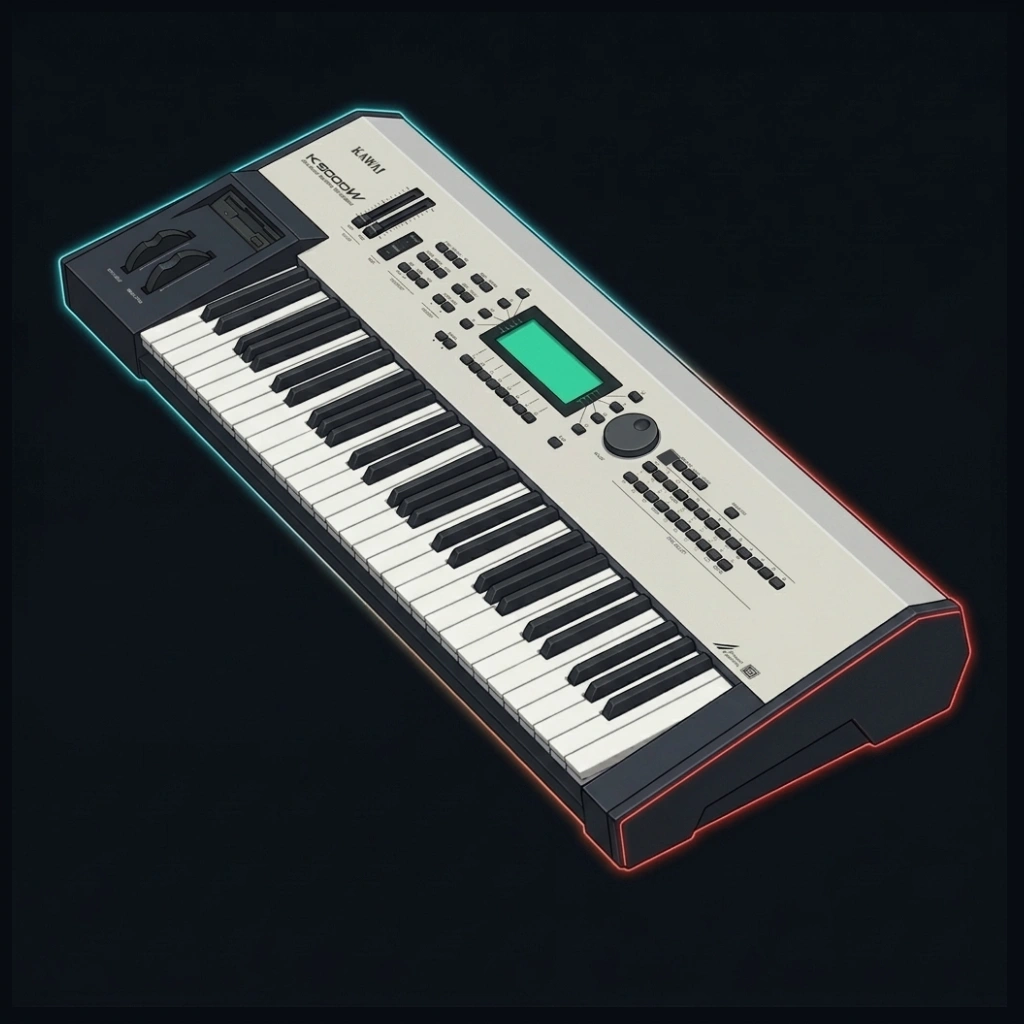
To address different production workflows, Kawai released the K5000 family in three distinct hardware variants, each tailored to specific studio and stage demands. The flagship K5000S (‘Synthesizer’) was engineered specifically for live sound sculptors, equipping a 61-note semi-weighted keybed with channel aftertouch and a dedicated front-panel matrix of 16 continuous real-time control knobs (arranged in four banks of four) for instantaneous, tactile manipulation of additive harmonics, formant filters, and envelopes. By contrast, the K5000W (‘Workstation’) targeted complete music production: while omitting the 16-knob matrix in favor of sequencer transport buttons, it integrated an onboard 40-track MIDI sequencer and an expanded General MIDI (GM) compatible PCM soundbank alongside the core additive engine. Finally, the K5000R (‘Rackmount’) consolidated the complete Advanced Additive Synthesis engine and 128-band formant filter of the K5000S into a rugged 2U 19-inch rack unit, featuring the full 240 x 64 dot backlit LCD and four assignable macro knobs for dense studio rack environments without sacrificing deep sonic editing.
Despite its technical brilliance, the K5000 arrived just as the market was shifting toward software instruments, leading to a limited production lifecycle across the K5000S, K5000W, and K5000R. Today, visionary electronic artists recognize the K5000 as a physical pillar of music history. From Klaus Schulze and Kraftwerk to Vince Clarke and Steve Roach, the instrument’s razor-sharp 20-bit DAC stage and alien, evolving soundscapes deliver an organic presence that modern software plugins simply cannot replicate.