
The Formant Masterpiece: 8-Operator FM, Formant Shaping Synthesis, and the Undisputed Summit of Complex Digital Acoustics
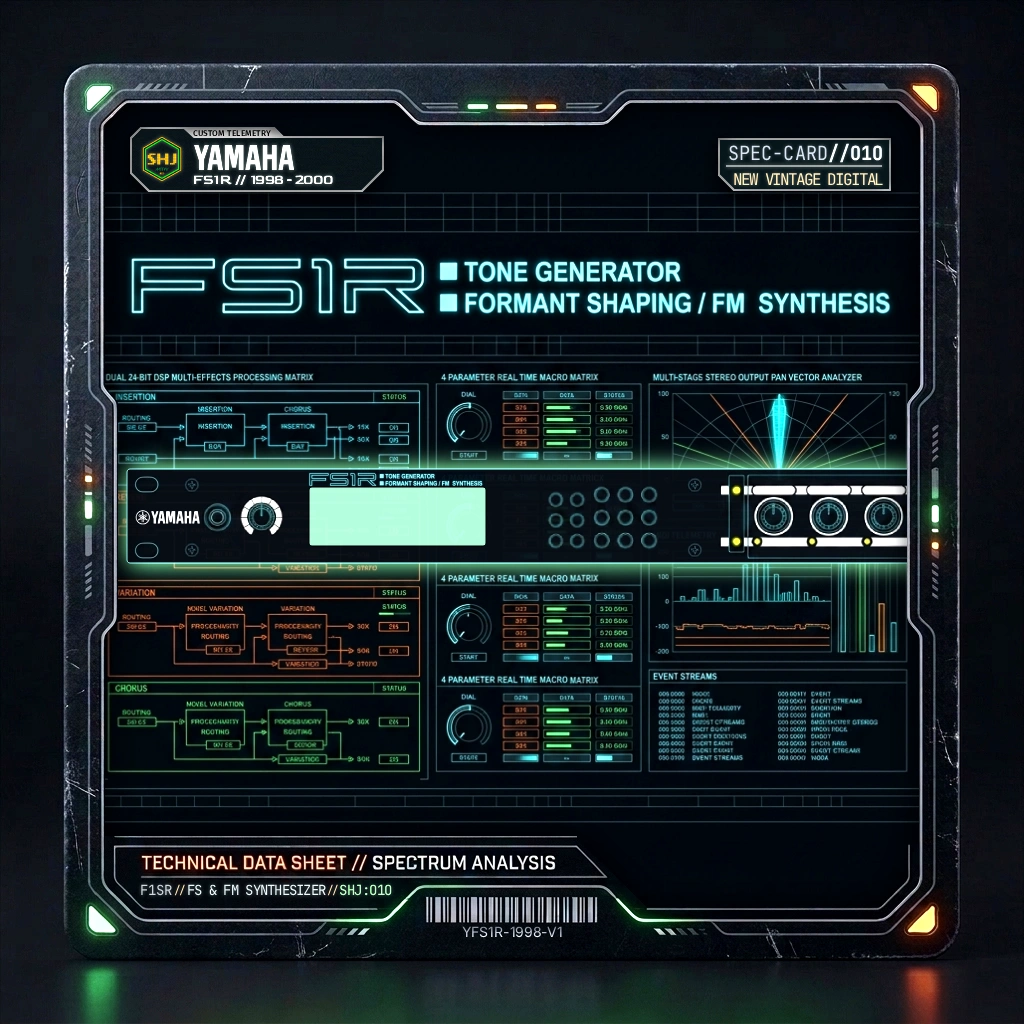
Released by Yamaha in 1998, the Yamaha FS1R stands as the absolute zenith of complex digital frequency modulation engineering: an uncompromising, over-engineered 1U rackmount titan that remains the most sophisticated FM synthesizer ever manufactured. Arriving at a time when the global electronic instrument market was demanding cheap, disposable sample-playback romplers, Yamaha chose instead to push the boundaries of pure mathematical synthesis. By fusing an expanded 8-operator FM architecture with revolutionary Formant Shaping (FS) technology, Yamaha created an instrument capable of generating uncanny human vocalizations, spectral resonances, and evolving acoustic textures that no other hardware or software synthesizer has ever duplicated.
Beneath its heavy, industrial-grade steel chassis, the FS1R is powered by a high-performance Hitachi HD64F7044 SH-2 32-bit RISC central microprocessor running at 28 MHz, working in close coordination with dual proprietary Yamaha YMP706 Formant DSP ASICs and dual Yamaha YSS236 multi-effects processors. Rather than being limited to standard 6-operator sine waves like its DX7 ancestor, each of the FS1R‘s voices deploys 16 discrete operators: eight voiced operators providing broad sinusoidal and all-pass formant waves, paired with eight unvoiced noise operators designed to emulate consonants, friction, and percussive breath. Routed through dual premium Sanyo LC78834M 18-bit stereo digital-to-analog converters, the FS1R produces an extraordinarily three-dimensional soundstage characterized by razor-sharp high-frequency air and thunderous low-end weight.
Despite its rapid commercial discontinuation after a single production run, the FS1R has achieved an almost mythical status among visionary producers and elite sound designers. From Squarepusher, Autechre, and Richard Devine to BT and Meat Beat Manifesto, electronic pioneers quickly recognized the FS1R as a physical pillar of music history. In an era where modern digital audio workstations offer predictable, mathematically sterile wavetable plugins, the physical summing of the FS1R‘s dual custom ASICs and the raw acoustic behavior of its Formant Sequences (Fseq) deliver an organic, alien presence that is hard to replicate.
Yamaha FS1R Sonic Heritage: Pop Culture Icons & Masterclass Tracks

A curated collection of 10 iconic artists, albums, and masterclass tracks showcasing the Yamaha FS1R‘s 8-operator FM complexity, Formant Shaping synthesis, and uncanny vocal textures across music history:
- Squarepusher (Tom Jenkinson): ‘Music Is Rotted One Note’ (1998 / Warp Records)
Tom Jenkinson acquired the FS1R upon release, deploying its 8-operator microtonal FM textures and eerie vocal formant sweeps to contrast against his raw, live acoustic jazz drumming and electric basslines. (Sound on Sound Magazine, ‘Squarepusher: In The Studio’). - Autechre (Sean Booth & Rob Brown): ‘Confield’ (2001 / Warp Records)
Sean Booth and Rob Brown exploited the FS1R‘s complex formant sequences and non-standard operator ratios, feeding algorithmic Max/MSP data streams into the FS1R to generate abstract, shifting digital acoustic environments. (Sound on Sound Magazine, ‘Autechre: The Sound of Confield’ & Pitchfork Retrospective). - Richard Devine: ‘Deviant EP’ (2001 / Schematic Records)
Celebrated sound designer Richard Devine relied on the FS1R as a primary synthesis engine for microscopic, metallic FM percussion and robotic vowel glides, using the front-panel encoders for real-time formant modulation. (Keyboard Magazine, ‘Richard Devine: Advanced Synthesis Masterclass’ & Attack Magazine). - The Grid (Richard Norris & Dave Ball): Studio Productions & Ambient Works (1999–2000)
Electronic veterans Dave Ball and Richard Norris utilized the FS1R‘s unvoiced noise operators and formant sequences to generate uncanny robotic vocal chorales, tracking through analog tape delays for warmth. (Future Music Magazine, ‘The Grid: Synth Vault Archive’). - Biosphere (Geir Jenssen): ‘Shenzhou’ (2002 / Touch)
Ambient pioneer Geir Jenssen utilized the FS1R‘s 8-operator multi-mode resonant filters and slow formant modulation to create icy, evolving arctic drones and subtle spectral harmonic shifts. (Resident Advisor, ‘Biosphere: In The Studio’ & Touch Music Production Logs). - BT (Brian Transeau): ‘Movement in Still Life’ (1999 / Headspace / Pioneer)
Electronic music producer and audio software pioneer BT extensively used the FS1R for vocal glitching, complex formant pad layering, and metallic cybernetic textures across his late-90s productions. (Sound on Sound Magazine, ‘BT: Producing Movement in Still Life’). - Meat Beat Manifesto (Jack Dangers): ‘Actual Sounds & Voices’ (1998 / Nothing / Interscope)
Jack Dangers deployed the FS1R immediately after its Japanese release, utilizing its formant sequence playback and unvoiced friction operators to create menacing, industrial vocal chops and alien dialogue FX. (Keyboard Magazine, ‘Jack Dangers: Inside Meat Beat Manifesto’s Gear Vault’). - Fluke: ‘Puppy’ (2003 / One Little Indian)
UK progressive house and breakbeat pioneers Fluke harnessed the FS1R‘s Formant Shaping synthesis to create expressive, synthetic lead vocalizations and shifting FM bass textures that cut through heavy breakbeat rhythms. (Sound on Sound Magazine, ‘Fluke: Creative Sound Design’). - Amon Tobin: ‘Supermodified’ (2000 / Ninja Tune)
Brazilian-born sound sculptor Amon Tobin utilized the Yamaha FS1R to synthesize bizarre, organic insect-like chirps, metallic scrapes, and spectral vocal textures layered over manipulated vinyl breaks. (Future Music Magazine, ‘Amon Tobin: The Art of Synthesis’). - Sin (Olivier Lechevestrier): ‘No Place to Hide’ / Industrial Techno Releases (1999 / Polydor)
French industrial electronic artist Sin pushed the FS1R‘s multi-mode resonant low-pass filter and 8-operator FM algorithms to hard-clipping saturation, demonstrating that the FS1R could produce devastating industrial aggression alongside delicate formants. (Electronic Musician Magazine, ‘Sin: Sound Design & Hardware Processing’).
Yamaha FS1R Architecture & Reliability: The Deep Dive
Features and Architecture: The core technological breakthrough of the FS1R is Formant Shaping. The synthesizer utilizes eight voiced and eight unvoiced operator pairs to approximate the spectral resonances (formants) of the human vocal tract. By routing these operators through pre-programmed Formant Sequences (FSeqs), the FS1R can speak, sing, or generate complex vowel rhythm loops. Crucially, the 8-operator FM engine is completely backward-compatible with original 6-operator DX7 patches, allowing you to load classic DX soundbanks via MIDI SysEx and completely transform them using the FS1R‘s resonant multi-mode filters and studio-grade dual DSP effects engines.
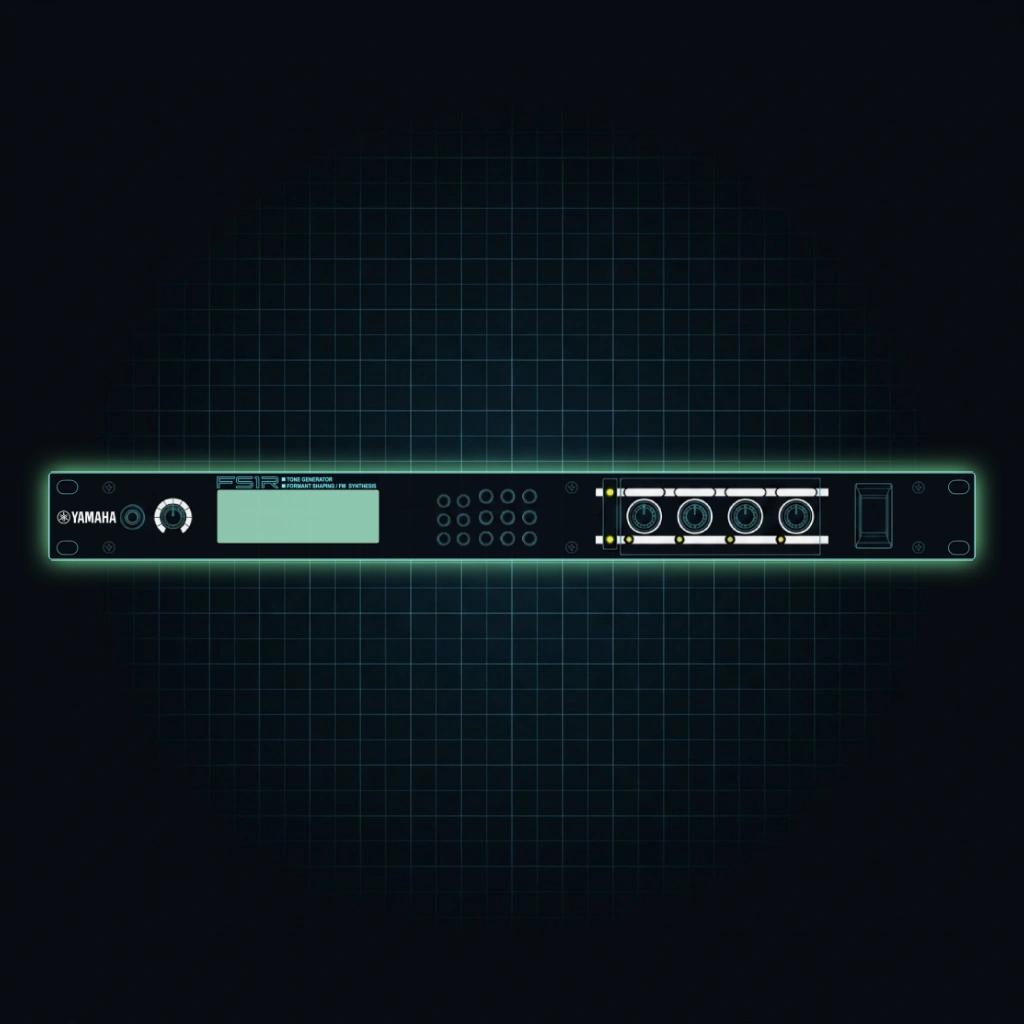
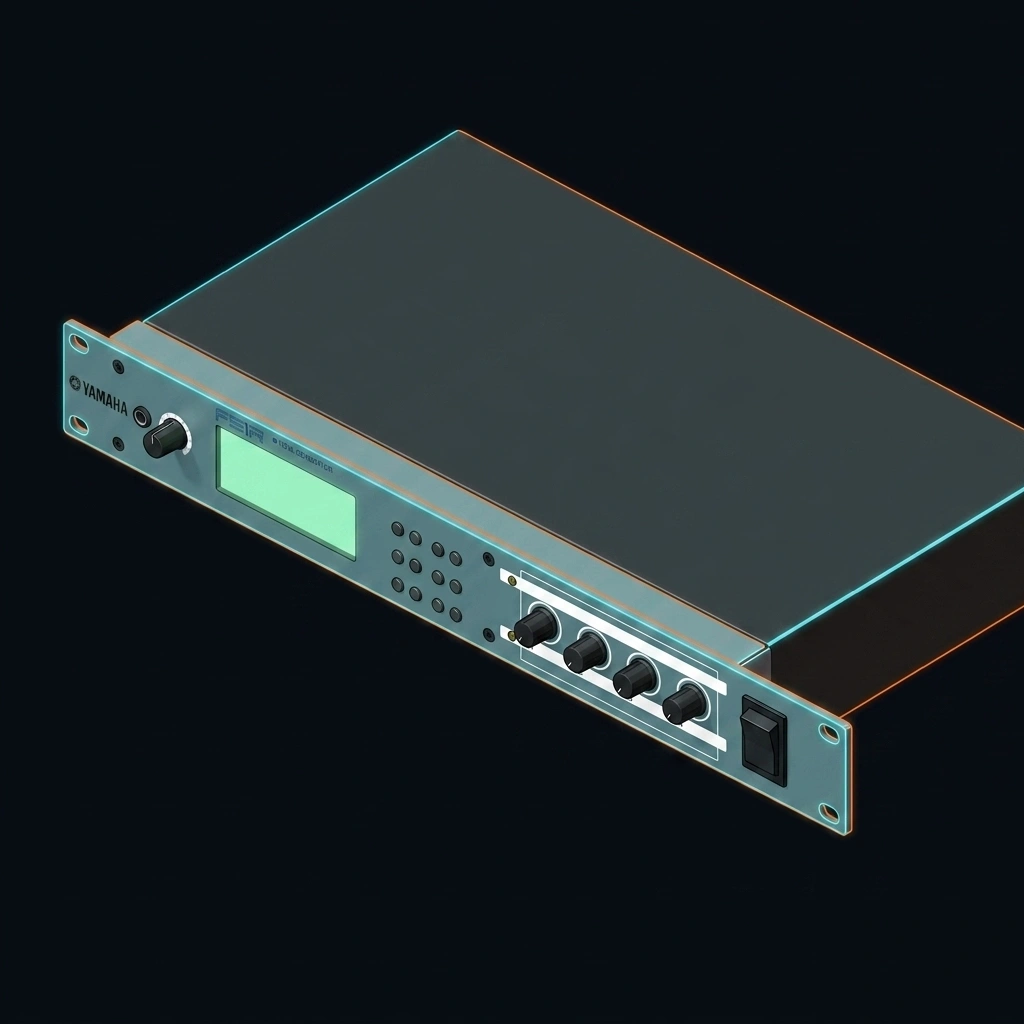
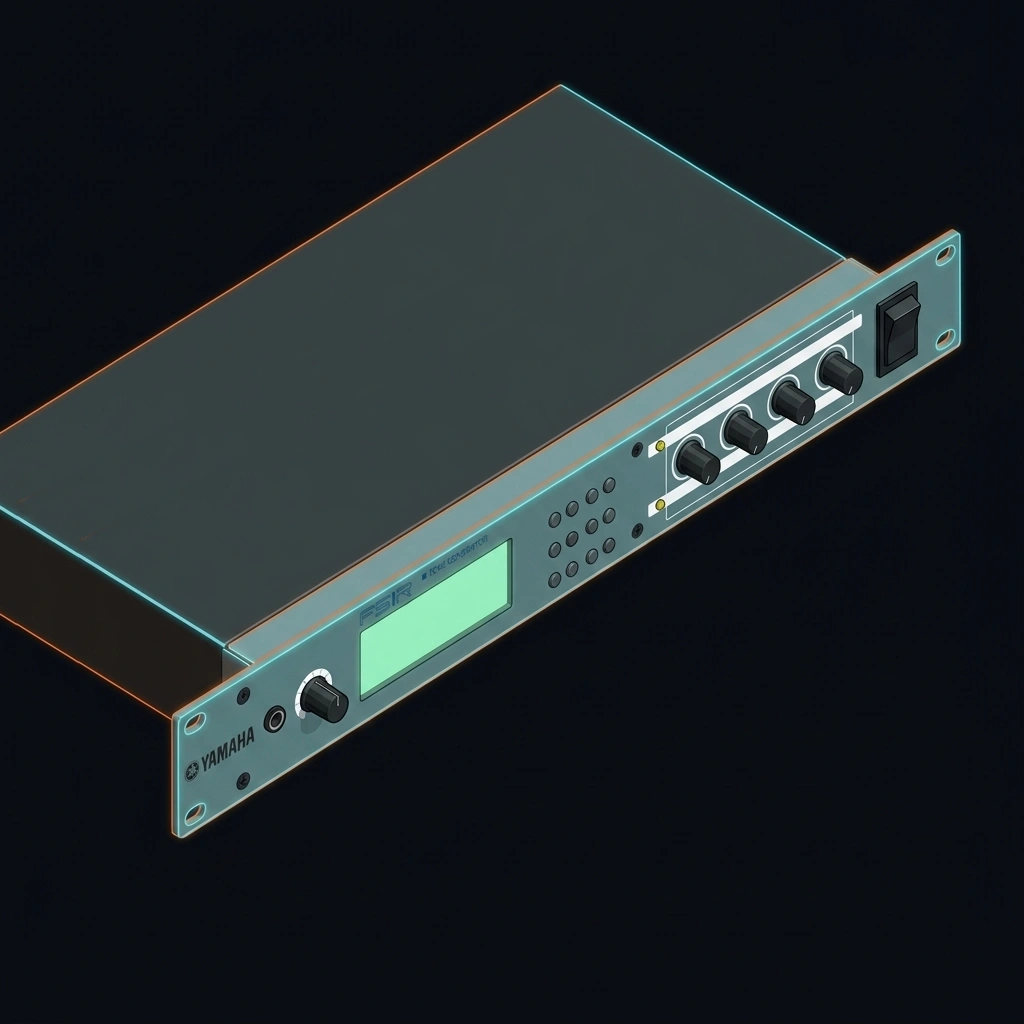
Reliability Warning: The FS1R‘s internal power supply board is compact and runs warm inside the 1U rack enclosure. Over three decades, this sustained thermal load degrades the electrolytic filter capacitors, introducing micro-fluctuations on the DC voltage rails that can cause digital hash, clock jitter, and high-frequency noise in the Sanyo DAC output stage. Mechanically, the four front-panel rotary encoders can suffer from internal contact wear, causing parameter values to jump erratically during live editing. The turquoise graphic LCD display is also subject to fading contrast if operating in high-temperature environments.
Present Day Relevance: In a modern production landscape dominated by clean, phase-perfect software wavetable plugins, the FS1R is a physical, organic antidote. Sourcing an authentic FS1R is not just about owning an ultra-rare collector’s item: it is about introducing a completely unique acoustic color. The non-linear summing of the dual YMP706 ASICs and the subtle harmonic presence of the Sanyo LC78834M DACs inject a distinct high-mid frequency clarity and low-end punch that digital plugins cannot replicate, making the FS1R a definitive secret weapon for atmospheric IDM, cinematic ambient, and cutting-edge sound design.
Yamaha FS1R Technical Resources & Historical Bibliography
As we are building an archive based on technical integrity, I am providing some citations and further reading below.
🎙️ Historical & Journalistic References
On the Summit of FM Synthesis: “Discontinued after barely a year, the FS1R combined 8-operator FM with groundbreaking formant synthesis, creating an over-engineered masterclass in digital sound design that modern software cannot replicate.” (Sound on Sound Magazine, ‘Yamaha FS1R Review’).
On Formant Acoustic Realism: “The FS1R stands as a synthesis peak that modern plugins struggle to emulate, producing vocal sweeps, metallic textures, and glassy tones with incredible harmonic depth and organic movement.” (Vintage Synth Explorer, ‘Yamaha FS1R Architectural Profile’).