

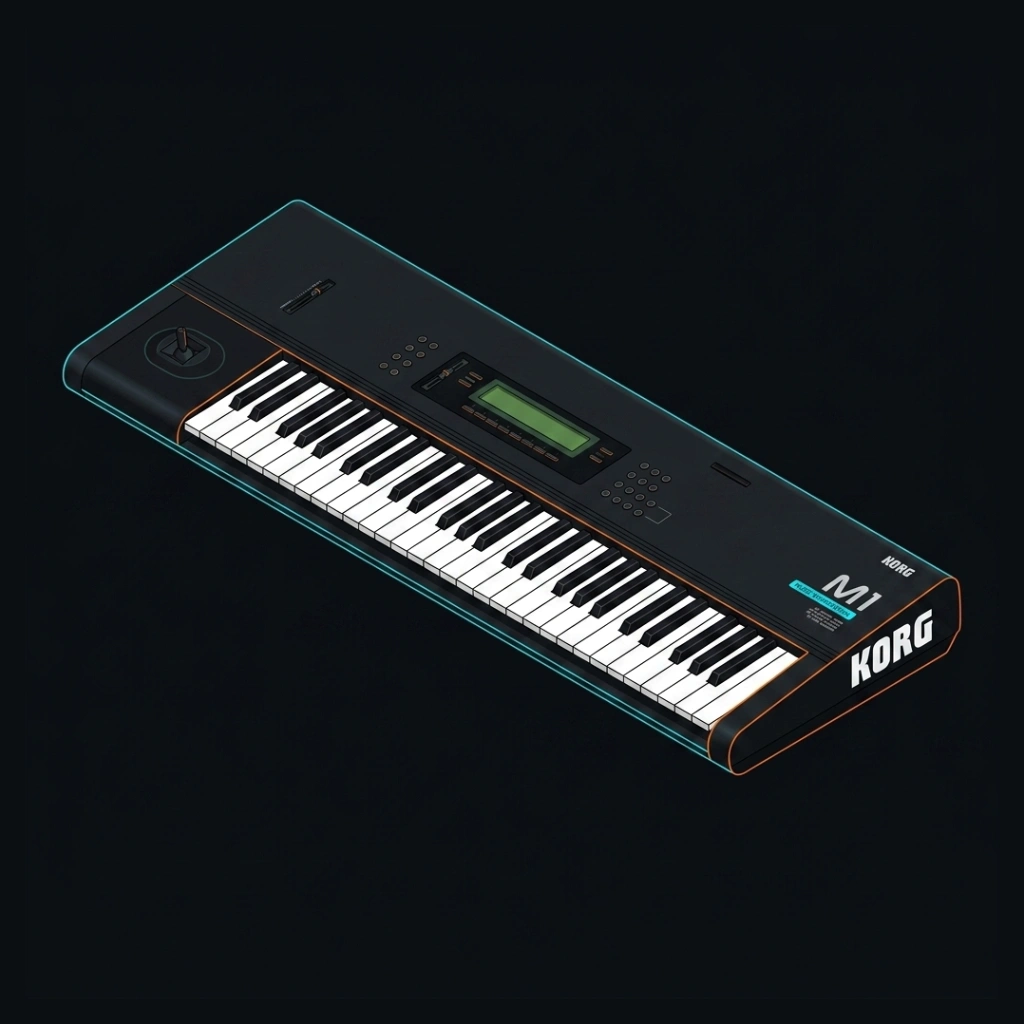


The Workstation Revolution: 16-Bit AI Synthesis, Burr-Brown DAC Punch, and the Defining Sounds of Late-80s Dance and Pop History
Released in Tokyo in May 1988, the Korg M1 is not simply a classic synthesizer: it is one of the most commercially successful synthesizer in electronic music history, defining the shift toward the modern ‘music workstation’ format. By uniting a 16-bit digital synthesizer engine, a dual digital multi-effects processor, and an 8-track onboard MIDI sequencer under an elegant, matte-black chassis, the M1 revolutionized studio production. Selling over 250,000 units worldwide, it empowered musicians and producers to compose, arrange, and mix complete commercial tracks on a single machine, laying the sonic foundations for the late-80s and 1990s dance, house, and pop movements.
At the heart of the M1‘s legendary acoustic footprint lies Korg‘s proprietary Advanced Integrated (AI) Synthesis system. Rather than generating simple mathematical waveforms, the M1 utilizes 4 Megabytes of high-density, 16-bit PCM multi-samples stored across internal ROM chips. Managed by an Intel-derived NEC V50 microprocessor running at 10 MHz, these samples are processed through digital low-pass filters (VDF) and amplifiers (VDA). The defining element of its punchy, forward sound is the digital-to-analog conversion stage, powered by the musical 16-bit Burr-Brown PCM54HP DAC. This circuit configuration delivers a muscular, mid-range-focused presence with a crisp transient attack that effortlessly punches through dense mixes without heavy outboard EQ.
Throughout the 1990s, the M1 became an absolute acoustic fixture across global music culture. Its factory presets, most notably ‘Piano 16”, ‘Organ 2’, and ‘Universe’, became legendary sonic hallmarks across Chicago house, UK garage, Italo-dance, ambient, and pop productions. From Robin S and Madonna to The Orb, Enigma, and Queen, the M1 was embraced not merely as a studio workstation, but as a physical pillar of music history. In an era where modern digital audio workstations offer clinical precision, the M1 stands out for its warm summing, analog-like punch, and nostalgic mojo.