
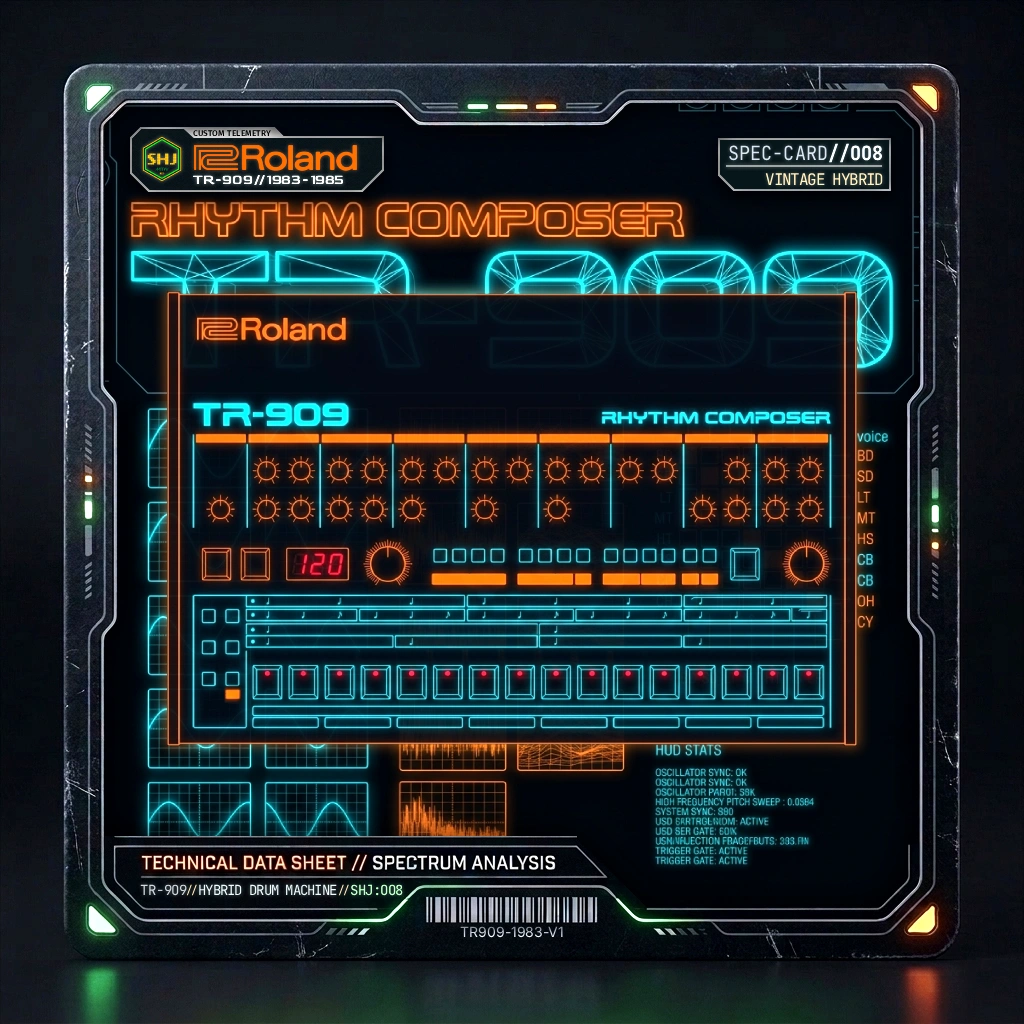
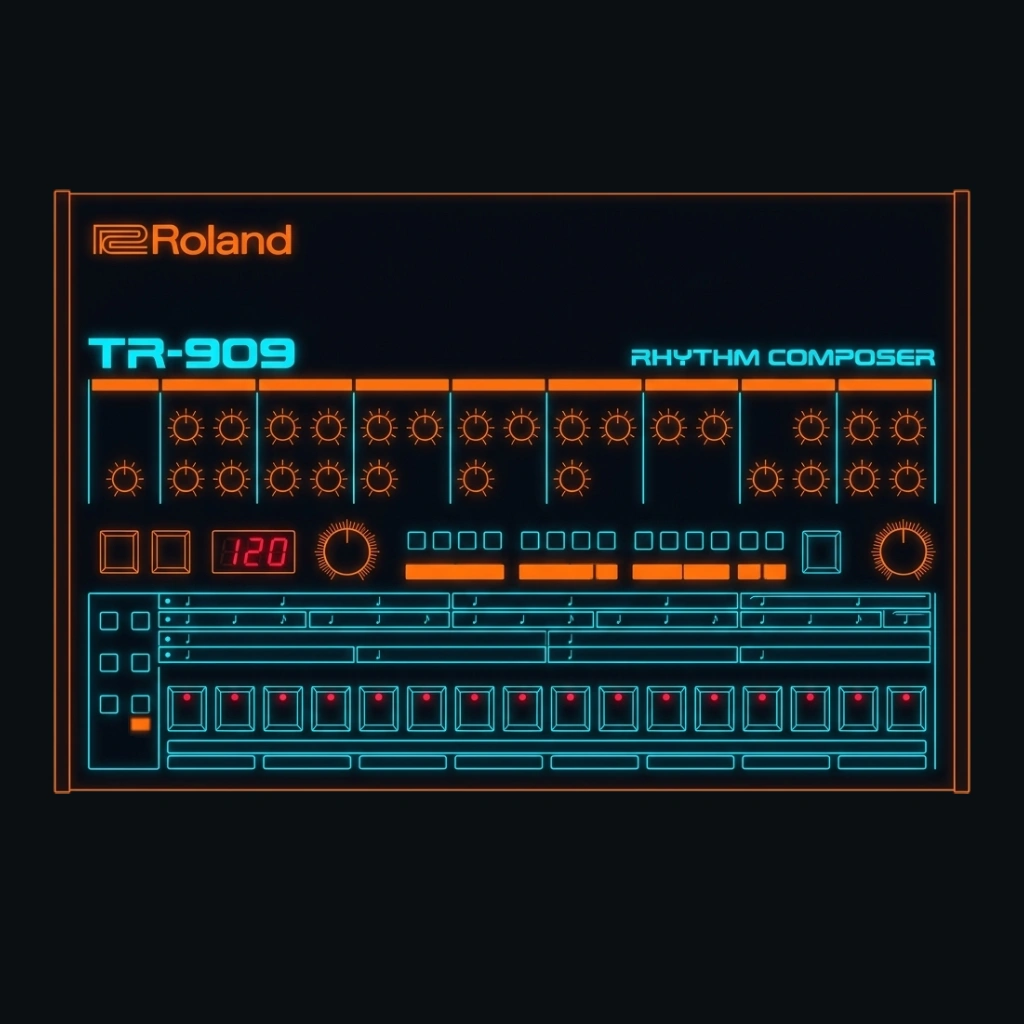
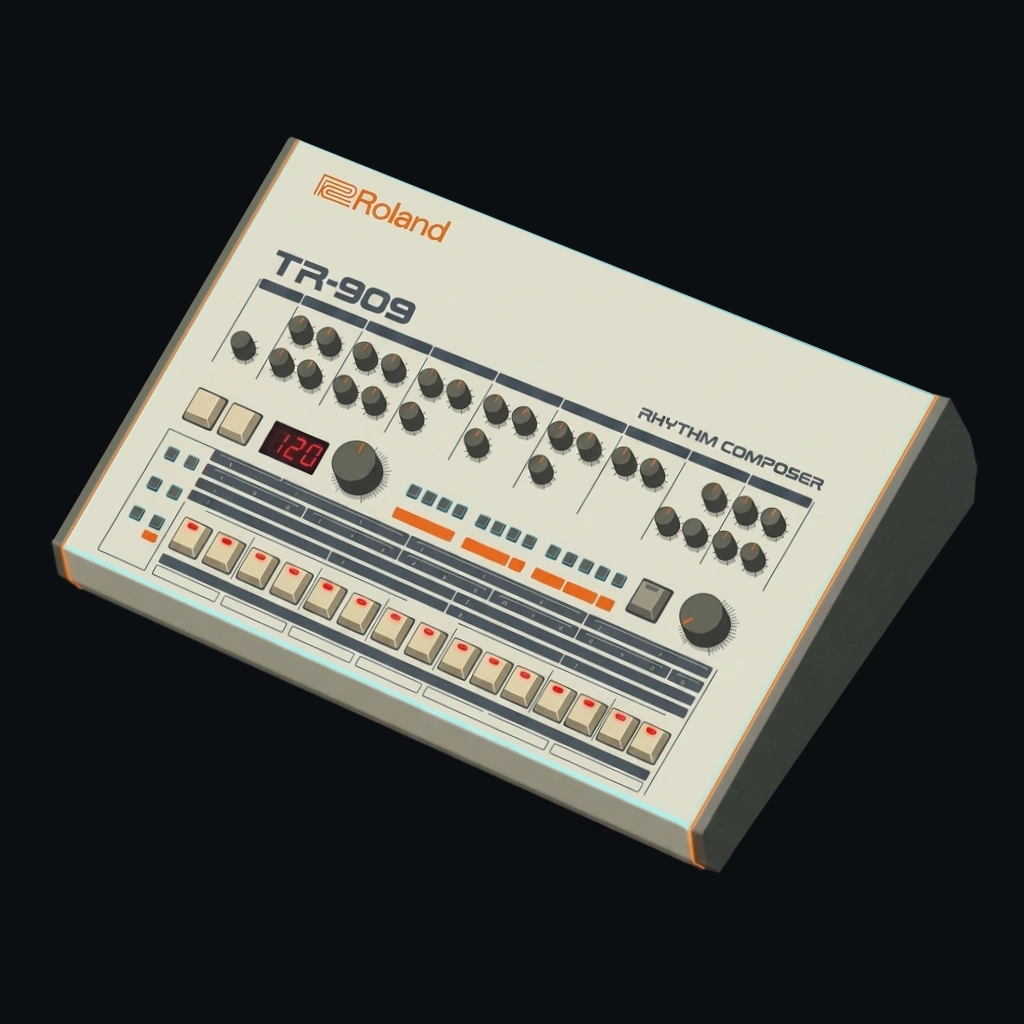
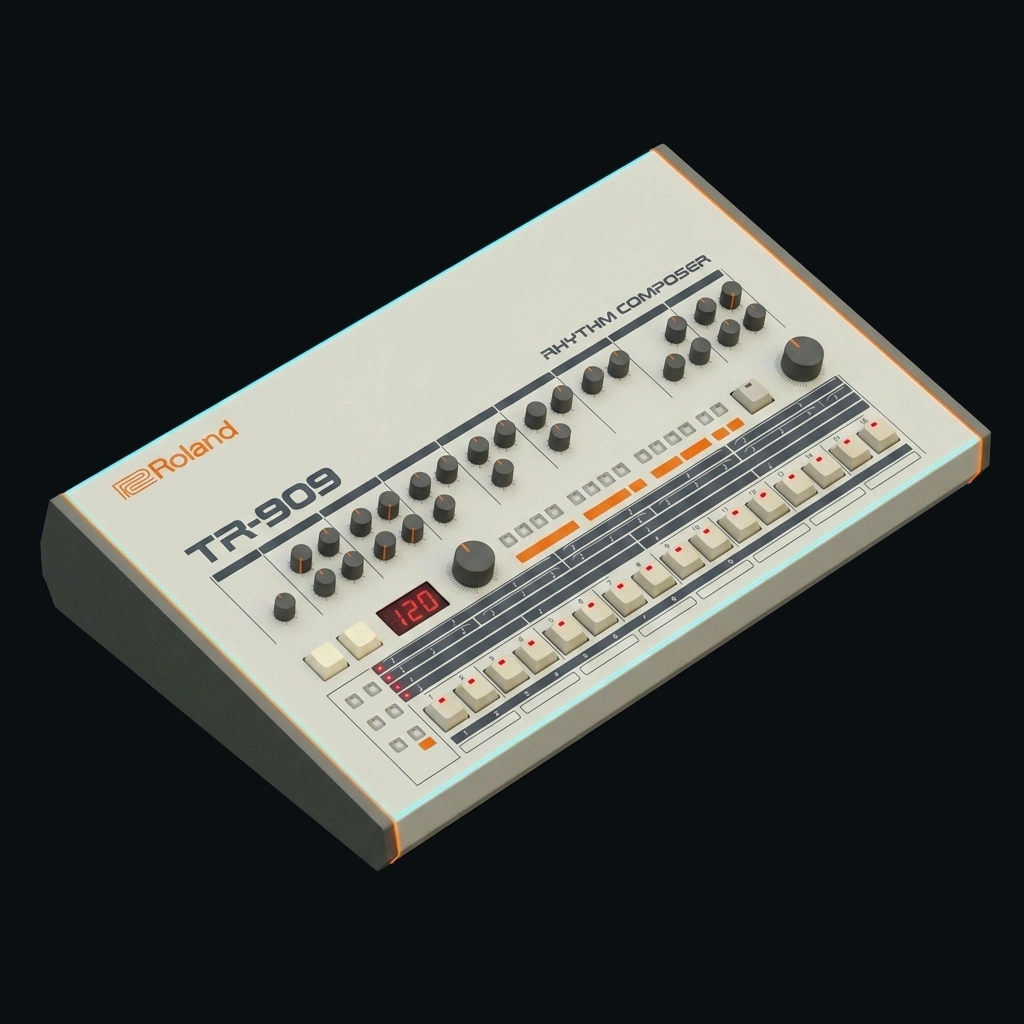
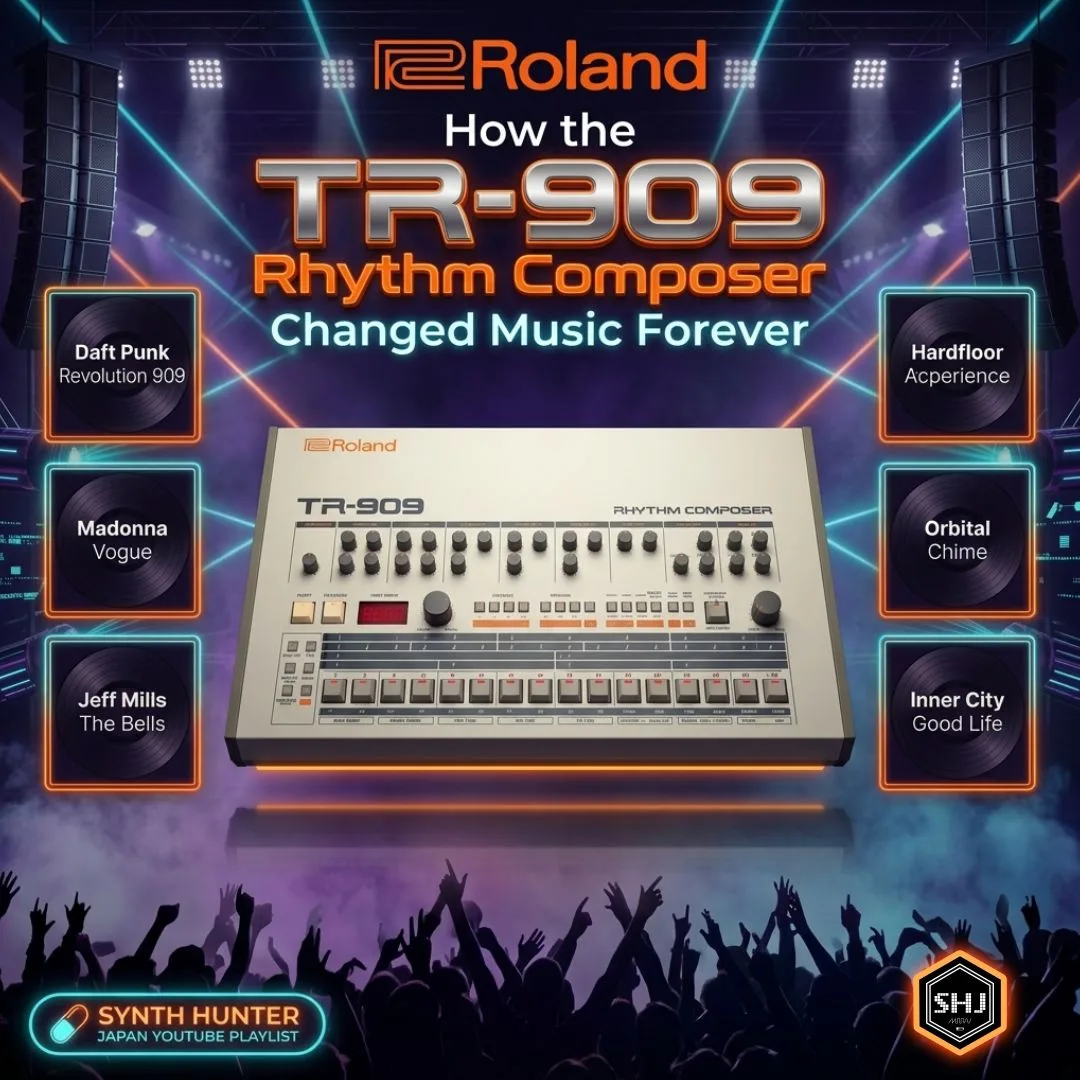
The Colossus of House and Techno: Hybrid Analog Synthesis, 6-Bit PCM Cymbals, and Tadao Kikumoto’s Legendary Shuffle Groove Engine
The Roland Rhythm Composer TR-909 stands as the single most dominant, hard-hitting rhythmic instrument in modern music history: the absolute physical powerhouse that constructed the foundations of Detroit techno, Chicago house, UK rave, and global club culture. Arriving in late 1983, it was a visionary, boundary-pushing hybrid. It represented Roland’s first drum machine to combine a fully discrete analog synthesis engine (for the kick, snare, toms, rimshot, and handclap) with punchy, crunchy 6-bit PCM digital samples (for the hi-hats, ride, and crash cymbals) played back through real analog envelopes and VCAs. Driven by a dedicated Intel 8031 microprocessor, the TR-909 was also Roland’s very first drum machine to feature standardized MIDI implementation, a massive 96-pattern memory, and a physical shuffle-and-flam layout that forever changed how machines groove.
At the circuit level, the sonic authority of the TR-909 is an absolute masterclass in intentional acoustic weight. The undisputed crown jewel of the machine is its analog bass drum: engineered around a discrete pitch-swept bridged-T oscillator combined with a transient attack click and a soft noise component, its kick delivers a tight, chest-thumping punch that naturally compresses and commands any sound system. The 6-bit PCM hi-hats and cymbals run through physical analog reconstruction filters and VCA envelopes, creating a gritty, metallic sizzle that defines the driving momentum of dance music. As a physical pillar of music history, its unmistakable sonic signature remains one of the most coveted in the world.
Throughout the 1980s and 1990s, the TR-909 evolved from an overlooked studio tool into an iconic global standard. From Frankie Knuckles and Kevin Saunderson to Daft Punk, Jeff Mills, and Orbital, visionary artists embraced its raw analog punch, tactile voice controls, and organic swing timing. In a contemporary production landscape filled with static digital samples, the physical phase interactions between the 909‘s individual voice circuits, dynamic accents, and human-feel shuffle engine deliver a living, breathing groove that software recreations struggle to reproduce.
Roland TR-909 Sonic Heritage: Pop Culture Icons & Masterclass Tracks
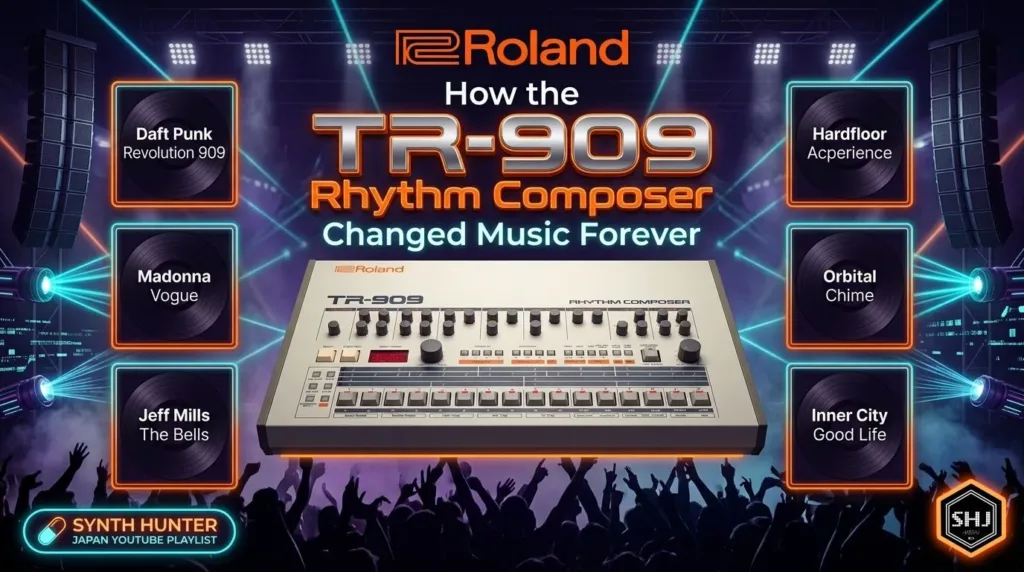
Released in 1983, the Roland TR-909 Rhythm Composer became the undisputed heartbeat of the dance floor. Combining punchy analog drums with crisp 6-bit digital cymbals, this legendary machine provided the driving kick drums, snapping snares, and that signature “shuffle” groove that defined the evolution of house, techno, and acid music across the globe.
Synth Hunter Japan explores the iconic tracks where the TR-909’s unmistakable power and swing redefined music history. From the high-energy “filter-house” of Daft Punk and the deep Chicago soul of Frankie Knuckles to the relentless techno masterclasses of Jeff Mills and the acid anthems of Hardfloor, discover how this hybrid powerhouse gave pioneers the tools to build the underground. Whether you’re a gear enthusiast or a fan of electronic heritage, experience the rhythm machine that fueled a global revolution.
A curated collection of 10 iconic artists, albums, and masterclass tracks showcasing the Roland TR-909‘s hybrid analog punch, 6-bit cymbals, and legendary shuffle groove across music history:
- Daft Punk: ‘Revolution 909’ / Homework (1997 / Virgin)
Thomas Bangalter and Guy-Manuel de Homem-Christo placed the TR-909 at the heart of French house music. On ‘Revolution 909’, they routed the 909‘s separate Bass Drum and Open Hi-Hat outputs hot into analog compressors, defining the genre’s signature sidechain pumping drive. (Sound on Sound Magazine, ‘Daft Punk & French House Production Archives’). - Jeff Mills: ‘The Bells’ / Purpose Maker (1996)
The ultimate live TR-909 masterclass. Mills treated the 909 as a dynamic, expressive solo instrument during his legendary DJ and live sets, manually sweeping kick pitch, snare snappy, tom tuning, and accent faders in real time to build hypnotic techno rhythms. (Resident Advisor, ‘Jeff Mills: The Exhibitionist Live 909 Breakdown’). - Inner City (Kevin Saunderson): ‘Big Fun’ & ‘Good Life’ / Paradise (1988 / 10 Records)
Kevin Saunderson defined early Detroit techno and crossover house with the TR-909‘s massive analog kick, snappy snare, and 6-bit open hi-hat cutting through heavy Yamaha FM synthesizer basslines. (Sound on Sound Magazine, ‘Classic Tracks: Inner City – Big Fun’). - Frankie Knuckles & Satoshi Tomiie: ‘Tears’ (1989 / FFRR)
A seminal deep Chicago house classic, powered by the TR-909‘s subtle shuffle swing, gentle rimshot, and open hi-hat accents sitting underneath lush piano chords and emotional vocal phrasing. (Billboard Dance Archives & Red Bull Music Academy Lecture: Satoshi Tomiie). - Madonna (Prod. Shep Pettibone): ‘Vogue’ / I’m Breathless (1990 / Sire)
Producer Shep Pettibone utilized the TR-909‘s snappy handclap, tight rimshot, and crisp 6-bit ride cymbal to drive this global pop anthem, demonstrating the drum machine’s pristine commercial studio power. (Sound on Sound Magazine, ‘Classic Tracks: Madonna – Vogue’). - Orbital: ‘Chime’ (1989 / Oh’Zone / FFRR)
Recorded straight to cassette in Paul and Phil Hartnoll’s home studio using a Roland TR-909, TB-303, and Akai sampler, creating one of the defining UK rave anthems of all time. (Sound on Sound Magazine, ‘Classic Tracks: Orbital – Chime’). - Aphex Twin (Richard D. James): ‘Heliosphan’ / Selected Ambient Works 85-92 (1992 / Apollo)
Richard D. James utilized the TR-909‘s individual voice outputs to route analog toms through lush delays as melodic basslines, while running its crunchy 6-bit cymbals through early digital reverbs. (Warp Records Technical Production Archives & Pitchfork Retrospective). - Hardfloor: ‘Acperience 1’ / TB Resuscitation (1992 / Harthouse)
Ramon Zenker and Oliver Bondzio paired screaming dual TB-303 lines with a pounding TR-909 kick, snappy snare rolls, and flam accents to create the definitive European acid techno blueprint. (Attack Magazine, ‘Classic Acid House & Techno Rigs’). - 808 State: ‘Pacific State’ / Ninety (1989 / ZTT)
Graham Massey and Gerald Simpson layered the TR-909‘s tight shuffle groove, snappy snare, and tom patterns with soprano sax and ambient pads for the quintessential Manchester chillout anthem. (Future Music Magazine, ‘The Making of Pacific State’). - Robin S. (Prod. StoneBridge): ‘Show Me Love’ (1993 / Champion / Big Beat)
Swedish producer StoneBridge utilized the TR-909‘s punchy kick, accented closed hi-hats, and sharp handclaps to drive the iconic Korg M1 organ bassline into global chart dominance. (Sound on Sound Magazine, ‘Classic Tracks: Robin S – Show Me Love’).
Roland TR-909 Architecture & Reliability: The Deep Dive
Features and Architecture: The design of the TR-909 is a triumph of hybrid engineering. The Bass Drum relies on a discrete, active pitch-swept triangle wave oscillator combined with a transient click pulse and a soft white-noise component, producing a tight, chest-thumping knock. The Hi-Hats and Cymbals utilize 6-bit compressed PCM samples stored across two 32KB ROMs and routed through physical analog VCA filters and envelope circuits, giving them a gritty, metallic sizzle. The sequencer’s shuffle and flam algorithm, coded by Tadao Kikumoto, introduces subtle micro-timing variations on a 96 PPQN clock to create a natural, organic swing: a physical groove that rigid digital systems cannot duplicate.
Reliability Warning: The greatest technical hazard to a vintage TR-909 is the internal linear power supply. Because the power transformer is mounted internally directly adjacent to the main voice cards, it generates substantial thermal load. Over decades, this excessive heat dries out the electrolytic filter capacitors, causing 50/60Hz AC ground hum and voltage instability across the analog voice circuits. Furthermore, the original ALPS micro-tact switches (the 16 step-entry buttons) suffer from heavy internal contact oxidation, resulting in skipped steps or double-triggering during pattern programming.
Present Day Relevance: In modern hybrid production setups, the TR-909 remains the gold standard for acoustic presence in club tracks. The subtle micro-timing variations in its internal master clock and the physical phase interactions of its 11 dedicated voice outputs create a deep, cohesive rhythm foundation. Producers regularly stem out the kick and open hi-hat to drive external bus compressors, capturing a classic analog punch that software emulations struggle to match.
Roland TR-909 Technical Resources & Historical Bibliography
As we are building an archive based on technical integrity, I am providing some citations and further reading below.
🎙️ Historical & Journalistic References
On Techno Legacy & Rhythm Architecture: “The TR-909 is the drum machine that defined techno. By combining massive analog weight with crunchy 6-bit digital hi-hat samples, it built an aggressive, pumping groove that is the literal heartbeat of modern club music.” – Sound on Sound Magazine, “The Beat That Defined Clubs”.
On Hybrid Analog/Digital Engineering: “The genius of the 909 lies in its hybrid design. Running compressed digital samples through physical, analog VCAs and envelope filters creates a raw, organic sizzle that modern digital DAWs struggle to capture.” – MusicRadar, “Vintage Drum Machine Technical Focus”.